

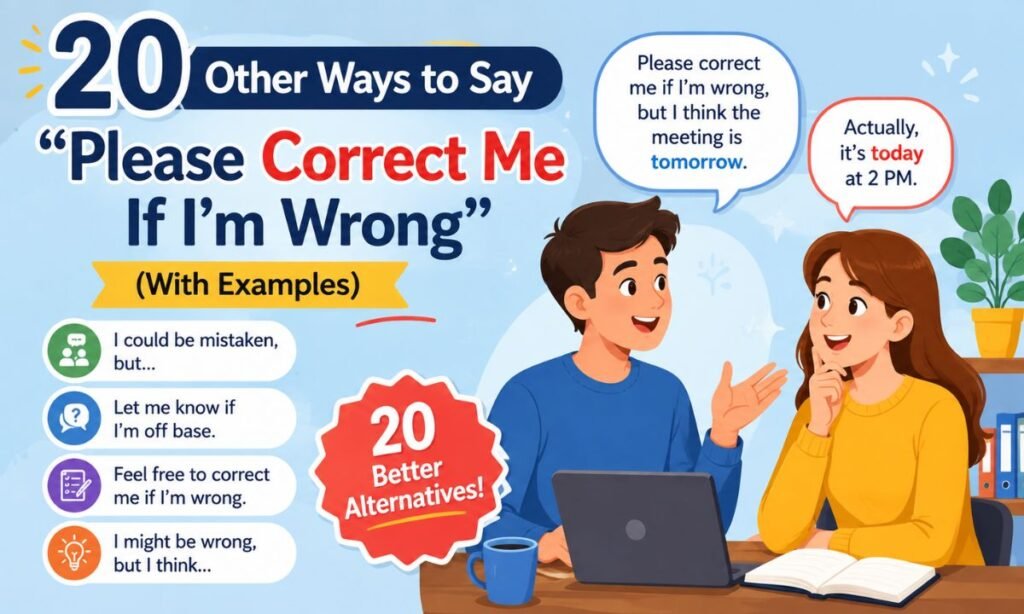
You’ve probably typed “please correct me if I’m wrong” more times than you can count. It’s a safe line. It shows you’re open to feedback without sounding pushy. But when you lean on it in every email, every meeting, and every group chat, it starts to feel flat.
This guide gives you 20 fresh alternatives you can swap in based on the room you’re in, whether that’s a formal report, a quick Slack message, or a chat with a friend who won’t judge your grammar. Each one comes with a real example so you know exactly when to use it.
What Does “Please Correct Me If I’m Wrong” Mean?
At its core, this phrase is an invitation. You’re sharing what you believe to be true, but you’re leaving the door open for someone to step in and fix it if you got a detail wrong.
It’s a small piece of verbal humility. You’re not claiming to know everything. You’re saying “here’s my understanding, and I’d rather hear the truth than stay confidently wrong.”
People reach for it before stating an opinion, recapping a meeting, or double checking a fact they half remember. Think of it as a built in safety net for your own credibility. If you’re wrong, you already gave people permission to say so, and that softens the moment.
Is It Professional or Polite to Say “Please Correct Me If I’m Wrong”?
Yes, it holds up fine in professional settings. It reads as respectful and shows you value the other person’s knowledge over your own ego.
Managers use it before pushing back on a plan. New hires use it before questioning a process they don’t fully understand yet. It signals confidence paired with humility, which is a combination most workplaces actually reward.
That said, tone matters more than the words themselves. Say it with a shrug in your voice and it sounds genuine. Say it right before you steamroll someone’s point anyway, and it starts to feel like a formality rather than an actual invitation to be corrected.
Advantages and Disadvantages of Saying “Please Correct Me If I’m Wrong”
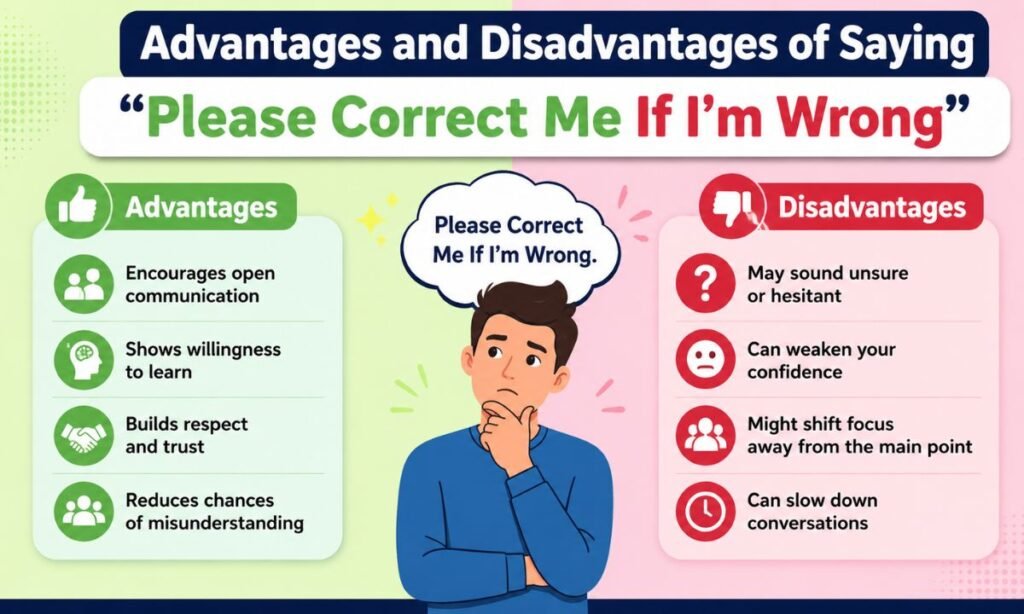
Like any go to phrase, this one has an upside and a downside depending on how often you lean on it.
Advantages
● Shows humility without making you look unsure of yourself
● Opens the door for honest feedback instead of silent disagreement
● Keeps conversations collaborative rather than one sided
● Softens a correction before it even happens, so nobody feels caught off guard
● Works in almost any setting, from a boardroom to a family group chat
Disadvantages
● Repeated too often, it can make you sound like you doubt your own judgment
● Some listeners tune it out because it’s become such a stock phrase
● In fast moving conversations, it can slow things down unnecessarily
● Overusing it in writing can make an email or report feel padded
ALSO READ THIS:20 Other Ways to Say “Welcome Home” (With Examples)
Why You Need Alternatives to “Please Correct Me If I’m Wrong”
Here’s the honest reason to branch out: repetition gets noticed. If you say the exact same line in every email thread, people start skimming past it instead of actually engaging with the correction you’re inviting.
Switching up your phrasing also lets you match the tone of the room. A casual “let me know if I’m off” fits a coffee chat with a coworker way better than it fits a client proposal. And a more formal version, like “please advise if my understanding is incorrect,” carries more weight in a report going to leadership.
There’s also a confidence angle here. Some alternatives sound less tentative, which matters if you’re trying to come across as capable while still staying open to feedback. You want people to trust your read on things, not assume you’re guessing.
Tips for Choosing the Right Phrase
Before you pick a replacement, run through a quick mental checklist:
1. Know your audience. A phrase for your manager isn’t always the right one for a group text with friends.
2. Match the medium. Emails can carry a slightly more polished phrase than a quick chat message.
3. Read the stakes. For a small detail, keep it light. For something that could affect a decision, use a phrase that sounds a bit more deliberate.
4. Watch your frequency. If you’re saying it three times in one conversation, rotate through a few different versions instead of repeating the same one.
5. Say it like you mean it. The right words still fall flat if your tone suggests you don’t actually want to be corrected.
Full List of Alternatives
Below are 20 ways to say the same thing without repeating yourself. Some lean formal, some are built for casual chats, and all of them keep that same spirit of staying open to feedback.
| # | Phrase | Best For |
| 1 | Let Me Know If I’m Mistaken | General use, casual and professional |
| 2 | Feel Free to Correct Me If I’m Wrong | Group discussions |
| 3 | I Might Be Mistaken, But… | Softening an opinion |
| 4 | Please Let Me Know If I Misunderstood | Formal emails |
| 5 | I Could Be Wrong, But… | Casual conversation |
| 6 | Do Correct Me If I’m Mistaken | British or formal tone |
| 7 | If I’m Off Base, Please Tell Me | Casual team chats |
| 8 | Let Me Know If That’s Not Accurate | Fact heavy discussions |
| 9 | I May Be Mistaken Here | Meetings |
| 10 | If I’m Misunderstanding, Please Clarify | Complex topics |
| 11 | Tell Me If I’m Getting This Wrong | Informal check ins |
| 12 | Please Point It Out If I’m Mistaken | Peer review |
| 13 | Let Me Know If That’s Incorrect | Reports and summaries |
| 14 | Correct Me If I’m Off Here | Brainstorming sessions |
| 15 | If I’m Mistaken, I’d Appreciate the Correction | Formal writing |
| 16 | Please Set Me Straight If I’m Wrong | Casual and direct |
| 17 | Let Me Know If My Understanding Is Wrong | Clarifying instructions |
| 18 | If That’s Not Right, Please Let Me Know | Emails and messages |
| 19 | I’d Appreciate Being Corrected If I’m Mistaken | Academic or formal settings |
| 20 | Feel Free to Clarify If I Got It Wrong | Friendly, low pressure tone |
1. Let Me Know If I’m Mistaken
This is one of the most versatile swaps on the list. It works in a work email just as well as it works texting a friend about weekend plans.
It carries the same meaning as the original phrase but sounds a touch lighter. There’s no “please” propping it up, which makes it feel more like a casual aside than a formal request.
Example: “The client meeting is moved to Thursday, let me know if I’m mistaken.”
2. Feel Free to Correct Me If I’m Wrong
Adding “feel free” takes the pressure off the other person. It tells them correcting you isn’t a big deal, it’s welcome.
This one works especially well in group settings where multiple people might have the answer. It invites anyone in the room to jump in, not just one specific person.
Example: “Feel free to correct me if I’m wrong, but I think the budget review happens every quarter.”
3. I Might Be Mistaken, But…
This phrase leads with the uncertainty right up front, before you even share your point. It’s a nice way to soften an opinion you’re not fully confident about yet.
Use it when you’re about to say something a little risky or unpopular. Leading with the hedge makes the statement land softer.
Example: “I might be mistaken, but I don’t think that vendor delivers on weekends.”
4. Please Let Me Know If I Misunderstood
This version fits formal writing better than most on this list. It shows up often in emails, reports, and any written communication where tone needs to stay polished.
It also shifts the focus slightly. Instead of implying you might be flat out wrong, it suggests a misunderstanding, which feels a little less blunt.
Example: “Please let me know if I misunderstood the new refund policy outlined in your last email.”
5. I Could Be Wrong, But…
Short, casual, and easy to drop into everyday conversation. This is the phrase you use with a coworker over coffee or in a quick Slack message.
It doesn’t carry much formality, which makes it feel natural rather than scripted.
Example: “I could be wrong, but didn’t we already send that invoice last week?”
6. Do Correct Me If I’m Mistaken
Adding “do” gives this phrase a slightly more polished, almost British lean. It reads as polite and a bit more deliberate than casual versions.
This works well in professional emails, especially when you want to sound thoughtful rather than rushed.
Example: “Do correct me if I’m mistaken, but the contract renewal is due at the end of the month.”
7. If I’m Off Base, Please Tell Me
“Off base” is a casual, conversational way to say wrong without actually using the word. It fits team chats and informal discussions where you want to sound relaxed.
It also invites honesty in a friendly way, since “off base” feels less harsh than a direct correction.
Example: “If I’m off base, please tell me, but I thought the deadline was next Friday.”
8. Let Me Know If That’s Not Accurate
This phrasing works especially well when you’re sharing facts or figures. It focuses less on your personal understanding and more on the accuracy of the information itself.
That small shift makes it feel less personal, which can be useful when you’re presenting data or numbers you pulled from somewhere else.
Example: “The report shows a 12% increase in sign ups, let me know if that’s not accurate.”
9. I May Be Mistaken Here
A slightly more formal cousin of “I could be wrong.” This one fits nicely in meetings, especially when you’re speaking up in front of a group.
It signals confidence in your point while still leaving room for someone with more information to step in.
Example: “I may be mistaken here, but I believe the last version of the plan already covers this.”
10. If I’m Misunderstanding, Please Clarify
This one works best for complex or technical topics, where the issue isn’t necessarily that you’re wrong, but that something wasn’t fully explained.
It puts a bit of the responsibility back on clarity of communication rather than just your own knowledge gap.
Example: “If I’m misunderstanding, please clarify how the new pricing tiers apply to existing customers.”
11. Tell Me If I’m Getting This Wrong
Direct and conversational, this phrase fits informal check ins well. It sounds like something you’d say out loud in a quick hallway conversation.
There’s no extra formality here, which makes it feel genuine rather than rehearsed.
Example: “Tell me if I’m getting this wrong, but I thought Sarah was handling the client call today.”
12. Please Point It Out If I’m Mistaken
This version works well in peer review situations, like reviewing a coworker’s document or feedback on shared work. It frames the correction as something practical rather than personal.
It also sounds a little more formal, which fits well when you’re reviewing something in writing.
Example: “Please point it out if I’m mistaken, but this section seems to repeat what’s covered earlier in the report.”
13. Let Me Know If That’s Incorrect
Clean and simple, this phrase fits well in reports and summaries. It’s short enough to tuck into the end of a sentence without disrupting the flow.
It works especially well when you’re recapping information for someone else’s benefit, like a status update or meeting notes.
Example: “Per our last call, the launch date is set for March, let me know if that’s incorrect.”
14. Correct Me If I’m Off Here
Casual and quick, this fits well during brainstorming sessions where ideas are moving fast and nobody wants to slow things down with overly formal language.
It sounds like something you’d say mid conversation without breaking stride.
Example: “Correct me if I’m off here, but I think we already ruled out that approach last week.”
15. If I’m Mistaken, I’d Appreciate the Correction
This is one of the more formal options on the list. It fits academic writing, official reports, or communication with someone higher up who expects a polished tone.
It reads as respectful without sounding overly casual or too relaxed for the setting.
Example: “If I’m mistaken, I’d appreciate the correction, as I want to make sure the final draft reflects accurate figures.”
16. Please Set Me Straight If I’m Wrong
A bit more direct and even a touch playful. “Set me straight” carries a friendly, no nonsense tone that works well with people you’re already comfortable with.
It fits casual professional settings, like a team you’ve worked with for a while.
Example: “Please set me straight if I’m wrong, but didn’t we already approve this design last week?”
17. Let Me Know If My Understanding Is Wrong
This phrase works well when you’re clarifying instructions or confirming details before moving forward on a task. It puts the focus on your interpretation rather than the facts themselves.
It’s a good pick when you want to double check you’re on the same page as someone before you commit time to a project.
Example: “Let me know if my understanding is wrong, but I thought we were skipping the second round of edits.”
18. If That’s Not Right, Please Let Me Know
Simple, polite, and easy to use across emails and messages. It doesn’t lean too formal or too casual, which makes it a safe default when you’re unsure of the tone you need.
It’s an easy phrase to keep in your back pocket for almost any written exchange.
Example: “I’ve listed the meeting for 3 PM on Thursday, if that’s not right, please let me know.”
19. I’d Appreciate Being Corrected If I’m Mistaken
This one leans formal, making it a strong fit for academic writing, professional reports, or communication with someone you don’t know well yet.
It shows a genuine willingness to be corrected rather than just a polite formality tacked onto the end of a sentence.
Example: “I’d appreciate being corrected if I’m mistaken, since accuracy matters for this presentation.”
20. Feel Free to Clarify If I Got It Wrong
A friendly, low pressure way to close out this list. It works well in casual professional settings and takes any weight off the correction, framing it as simple clarification instead of a mistake.
Example: “Feel free to clarify if I got it wrong, but I thought the survey results were shared yesterday.”
How to Personalize These Phrases for Your Own Style
Don’t just pick one phrase and use it forever, that defeats the purpose of having options. Try rotating between two or three that fit your natural voice.
If you’re naturally casual, lean toward phrases like “I could be wrong, but…” or “tell me if I’m getting this wrong.” If your job leans formal, keep two or three polished versions on hand, like “please let me know if I misunderstood” or “I’d appreciate being corrected if I’m mistaken.”
A good trick is matching the phrase to the platform. Save the formal versions for email and reports. Save the casual ones for chat apps and quick conversations. That small habit alone makes your communication feel more natural instead of copy and pasted.
Frequently Asked Questions
Is “please correct me if I’m wrong” grammatically correct?
Yes, it’s a complete and correct sentence in standard English.
Can I use these phrases in a job interview?
Yes, the more formal options work well when you’re clarifying something during an interview.
Is it rude to say “correct me if I’m wrong”?
No, it’s generally seen as polite and shows you’re open to feedback.
What’s a more confident way to say this phrase?
Try “let me know if that’s not accurate,” which sounds assertive while still inviting correction.
Should I use this phrase in formal emails?
Yes, just lean toward the more polished versions like “please let me know if I misunderstood.”
Final Thoughts
Swapping out “please correct me if I’m wrong” for one of these 20 alternatives keeps your communication feeling fresh instead of repetitive. The right phrase depends on your audience, the setting, and how much weight the correction actually carries.
Keep a few favorites in your back pocket, rotate between formal and casual depending on the room, and you’ll come across as both confident and open to feedback, which is exactly the balance this phrase is meant to strike.