

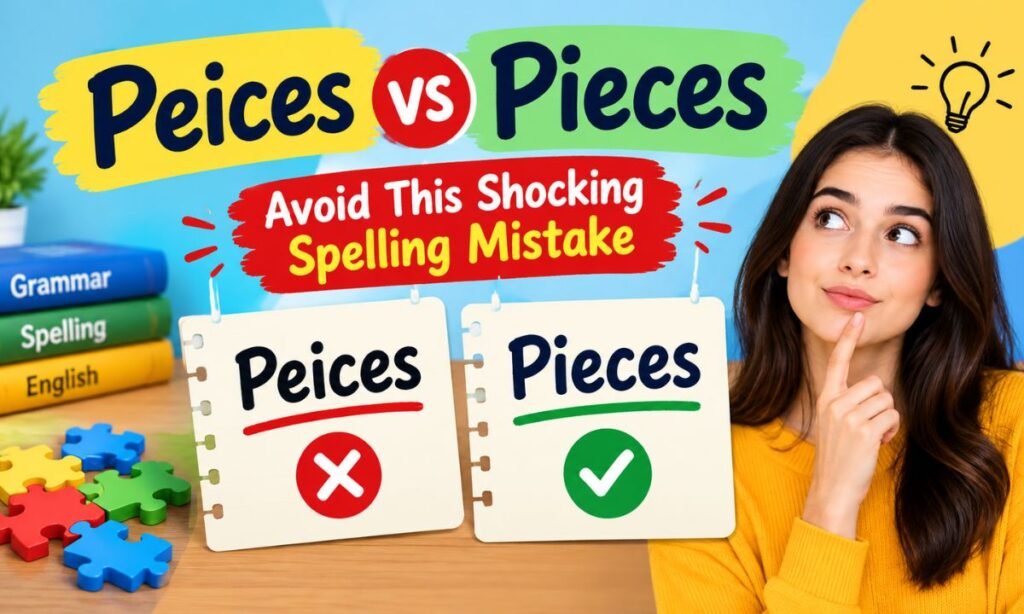
If you’ve ever paused mid-sentence wondering whether to type “peices” or “pieces,” you’re not alone. This tiny mix-up is one of the most common spelling slips in English, and it shows up everywhere — emails, school essays, social media captions, and even professional reports. The good news? Once you understand the simple rule behind it, you’ll never second-guess yourself again.
In this guide, we’ll break down exactly why “pieces” is correct, why “peices” is always wrong, and how a single memory trick can lock the right spelling into your brain for good.
Quick Answer
Pieces is the correct spelling. Peices is a misspelling that happens when the letters “i” and “e” get swapped.
- ✅ Correct: pieces
- ❌ Incorrect: peices
Whenever you’re unsure, remember: the word follows the “i before e” pattern, so it’s always p-i-e-c-e-s, not p-e-i-c-e-s. This rule applies in both American and British English, so there’s no regional exception to worry about.
What Does Pieces Mean?
The word “pieces” is the plural form of “piece.” A piece refers to a part, section, or individual unit of something larger. It can describe a physical object, an amount, or even a creative work like a song or painting.
In everyday conversation, people use pieces to talk about broken items, food portions, puzzle parts, art, and much more. It’s one of those everyday words we use so often that we rarely stop to think about its spelling — until we accidentally get it wrong.
Examples of Pieces
Here are a few simple sentences that show how the word works in real life:
- The puzzle has 500 pieces.
- She cut the pizza into eight pieces.
- He collects rare vintage pieces of furniture.
- The vase fell and broke into several pieces.
- The museum displayed ancient pottery pieces.
Notice how each sentence uses pieces to describe separate parts of a whole. That’s the core meaning you should always keep in mind.
Why “Peices” Is Incorrect
“Peices” isn’t recognized as a standard English word in any dictionary. It’s simply a misspelling caused by reversing two letters. Most people who write “peices” aren’t doing it on purpose — it usually happens because of typing speed, muscle memory, or confusion with the classic spelling rule that governs words like this one.
Spell-checkers, grammar tools, and dictionaries will all flag “peices” as an error. If you ever see it in a draft, the fix is simple: change it to “pieces” immediately.
The “I Before E” Rule
Many people learned this rhyme in school:
“I before E, except after C.”
This rule helps explain why pieces is spelled the way it is. Since the word “piece” doesn’t have a “c” right before the vowel pair, it follows the standard pattern — “i” comes before “e.” That gives us p-i-e-c-e, and the plural simply adds an “s” at the end: pieces.
The confusion usually happens because people try to apply the rule backward, assuming that since there’s a “c” somewhere in the word, the “e” should come first. But the rule only applies when “c” comes immediately before the vowel combination — not anywhere else in the word.
ALSO READ “Of Course or Ofcourse: The Complete Guide to Correct Usage“
Similar Examples
The “i before e” pattern shows up in plenty of other common words. Here’s a quick look:
| Correct Spelling | Common Misspelling | Rule Applied |
|---|---|---|
| Believe | Beleive | I before E |
| Friend | Freind | I before E |
| Piece / Pieces | Peice / Peices | I before E |
| Receive | Recieve | E before I (after C) |
| Field | Feild | I before E |
| Ceiling | Cieling | E before I (after C) |
As you can see, understanding this one small rule helps you fix several spelling headaches at once, not just the pieces vs peices confusion.
Peices vs Pieces: Main Difference
Let’s make this as clear as possible with a side-by-side comparison.
| Feature | Pieces (Correct) | Peices (Incorrect) |
|---|---|---|
| Dictionary status | Recognized standard word | Not a real word |
| Spelling pattern | I before E | E before I (wrong order) |
| Usage in sentences | Common and acceptable | Always a spelling error |
| Regional differences | Same in US and UK English | Not applicable |
| Spell-check result | Passes | Flagged as an error |
There’s really only one takeaway here: pieces is the only version you should ever use in writing, whether it’s casual, academic, or professional.
Common Uses of Pieces
The word pieces is incredibly versatile. It pops up across many everyday topics, from meals to music to broken household items. Let’s look at a few common categories where pieces is used naturally.
Food
Food is one of the most common places you’ll see the word pieces used in daily conversation.
- Cut the chicken into small pieces before cooking.
- The bakery sells cake in individual pieces.
- She added pieces of fruit to the salad.
Art
In art and design, pieces often refers to individual works or components of a larger collection.
- The gallery featured several modern art pieces.
- He created a sculpture from broken glass pieces.
- The collection includes rare ceramic pieces from the 1800s.
Writing
Writers and journalists also use pieces to describe individual articles or written works.
- She published three opinion pieces this month.
- The magazine ran a feature piece on climate change.
- His latest pieces have received great feedback online.
Broken Objects
This is probably the most familiar everyday use — describing something that has shattered or fallen apart.
- The mirror shattered into tiny pieces.
- The plate slipped and broke into several pieces.
- Be careful; there are glass pieces on the floor.
Common Mistakes People Make
Even confident writers occasionally slip up with this word. Here are the three most common reasons peices shows up by accident.
Mistake 1: Reversing “IE” and “EI”
The most frequent error is simply swapping the order of the two vowels. Since “peices” and “pieces” look so similar, the brain sometimes types the wrong sequence without noticing.
Mistake 2: Ignoring the Spelling Rule
Some writers never fully learned or remembered the “i before e” pattern, so they guess the spelling based on how the word sounds rather than how it’s actually written.
Mistake 3: Fast Typing Errors
When typing quickly — especially on a phone — it’s easy to hit letters out of order. This is one of the most common causes of the peices mistake in emails, texts, and social media posts.
Real-Life Examples of Pieces
To really understand how flexible this word is, let’s look at how pieces shows up across different areas of life and culture.
Music
Musicians often refer to individual songs or compositions as pieces.
- The pianist performed three classical pieces.
- She composed a beautiful piano piece for the recital.
- The orchestra rehearsed several new pieces this week.
Literature
In literature, pieces can refer to essays, short stories, or standalone written works.
- The anthology includes short pieces from emerging writers.
- His latest piece explores themes of identity and memory.
- The editor selected the best pieces for publication.
Fashion
Fashion designers and stylists frequently use pieces to describe individual clothing items.
- This outfit includes statement pieces from the new collection.
- She added a few vintage pieces to her wardrobe.
- The designer unveiled ten new pieces at the show.
Games
Board games and puzzles rely heavily on the word pieces to describe individual components.
- The chess set has thirty-two pieces.
- Make sure all the puzzle pieces are accounted for.
- He lost a few game pieces under the couch.
Singular vs Plural Form
It’s worth remembering that “piece” is the singular form, while “pieces” is the plural. You use piece when referring to one item and pieces when referring to more than one.
| Singular | Plural |
|---|---|
| A piece of cake | Several pieces of cake |
| One piece of paper | Many pieces of paper |
| A single piece of art | Multiple pieces of art |
Example
- Singular: I need a piece of tape.
- Plural: I need several pieces of tape.
This distinction matters because using the wrong form — even with correct spelling — can still make a sentence sound off. Always match the form to the quantity you’re describing.
American vs British English Differences
Here’s some reassuring news: there’s no difference in spelling between American and British English for this word. Unlike pairs such as “color” and “colour,” pieces is spelled exactly the same way on both sides of the Atlantic.
- American English: pieces
- British English: pieces
Since there’s no regional variation, you never have to adjust your spelling based on your audience’s location. This makes pieces one of the more straightforward words in English, as long as you avoid the “peices” trap.
Synonyms for Pieces
Sometimes you might want to vary your vocabulary instead of repeating the word pieces too often in a single paragraph. Here are some useful alternatives.
Common Synonyms
- Parts
- Portions
- Fragments
- Sections
- Segments
- Chunks
- Bits
- Components
Example
Instead of writing “the vase broke into pieces,” you could say “the vase broke into fragments” or “the vase shattered into bits.” Both options keep your writing fresh while preserving the original meaning.
Why Correct Spelling Matters
Spelling might feel like a small detail, but it has a real impact on how your writing is perceived. Here’s why getting pieces right actually matters:
- Credibility: Misspellings like peices can make even well-researched content look careless.
- Professionalism: In resumes, emails, and reports, spelling errors can create a poor first impression.
- SEO performance: Search engines reward well-written, accurate content, and readers are more likely to trust and share error-free writing.
- Clear communication: Correct spelling helps readers focus on your message instead of getting distracted by mistakes.
Whether you’re writing a school assignment, a blog post, or a business email, using pieces correctly reflects attention to detail.
Easy Trick to Remember the Correct Spelling
If rules and rhymes don’t stick in your memory, try this simple visual trick instead.
Piece Has “IE”
Think of the phrase: “Piece of pie.” Both words contain “ie” in that exact order. Since pie comes right before piece in that phrase, it’s an easy way to lock in the correct letter order every time you write it.
Another helpful approach is breaking the word down phonetically: p-IE-ce. Say it slowly, emphasizing the “ie,” and the spelling will start to feel natural.
Related Word Forms
The word piece can take on different forms depending on how it’s used in a sentence. Here are a few common variations:
| Word Form | Meaning | Example |
|---|---|---|
| Piece | Singular noun | A piece of cake |
| Pieces | Plural noun | Several pieces of cake |
| Pieced | Past tense verb | She pieced together the story |
| Piecing | Present participle | He is piecing the puzzle together |
| Piecemeal | Adverb/adjective | The project was completed piecemeal |
Example Sentence
“After the argument, she slowly pieced together what had really happened, gathering pieces of information from everyone involved.”
This sentence shows how versatile the root word “piece” really is — it can function as a noun and a verb within the same sentence.
FAQs
Is “peices” ever correct? No. Peices is never correct in any form of English.
What is the plural of piece? The plural of piece is pieces.
Does British English spell it differently? No. Both American and British English use the same spelling: pieces.
Why do people misspell pieces as peices? It usually happens due to fast typing or confusion with the “i before e” rule.
Will spell-check catch “peices”? Yes, most spell-checkers and grammar tools will flag peices as an error.
Is “peace” the same as “piece”? No. Peace means calm or absence of conflict, while piece means a part of something.
What’s an easy way to remember the spelling? Think “piece of pie” — both words share the same “ie” letter order.
Can “pieces” be used as a verb? Not directly, but related forms like “pieced” and “piecing” function as verbs.
Conclusion
The difference between peices and pieces comes down to one simple rule: pieces follows the “i before e” pattern, while peices reverses it and creates an error that doesn’t exist in standard English. Whether you’re writing about food, art, music, or broken objects, pieces is the spelling you should always use.
Next time you’re unsure, just remember the phrase “piece of pie” — a small trick that can save you from a shockingly common mistake. With this guide, you now have everything you need to spell pieces correctly, confidently, and consistently every single time.
1 thought on “Peices vs Pieces: Avoid This Shocking Spelling Mistake”