


Have you ever typed a sentence and stopped halfway, unsure if you needed it’s called or just it called? You’re not alone. This mix-up trips up even people who write every day, and it happens because the two phrases look so close on paper but carry totally different jobs in a sentence.
The truth is simple once you see it clearly. It’s called is a contraction, short for “it is called,” and you use it when you’re naming or labeling something. It called, on the other hand, is just past tense, showing that something made a sound or reached out, like a bird that called or a friend who called you yesterday.
In this guide, we’ll break down exactly when to use each one, with real examples you can picture in your head. No grammar-textbook talk here, just plain explanations that stick. By the time you finish reading, you’ll never second-guess it’s called vs it called again. 😊
What Does “It’s Called” Mean?
It’s called is short for “it is called.” That little apostrophe stands in for the missing letters in “is.” Whenever you use this phrase, you’re naming or identifying something for the reader, plain and simple.
Grammatically, this is a passive voice construction. The subject isn’t doing anything at all here. It’s simply receiving a name, the same way a jar gets a label stuck on it at the factory before it ships out.
This structure shows up constantly because naming things is one of the most basic things we do with language. Kids learn it early. “What’s that? It’s called a doggy.” Adults use the exact same pattern for far more complex ideas, from science to slang to office jargon.
Here’s what that looks like in real sentences:
- “What’s this tool? It’s called a wrench.”
- “It’s called photosynthesis when plants turn light into energy.”
- “That show on Netflix? It’s called Stranger Things.”
- “This dish is popular in Punjab. It goes by a specific name, sarson da saag.”
- “In marketing, this trick has a name too. It goes by the name anchoring.”
Notice the pattern across every single example. Each sentence answers one simple question: what is this thing called? That’s really the entire job of this phrase, and it’s why you’ll see it everywhere, from cookbooks to science class to casual texts between friends.
I use this construction constantly when writing product descriptions for clients. Someone asks what a tool does, and the fastest, clearest answer almost always starts with the same naming pattern. It works because it’s short, direct, and instantly understood by any reader, regardless of their background.
Related Structures
Grammar rarely shows up in just one flavor. This naming phrase has a few close cousins worth learning at the same time, since they trip people up in remarkably similar ways.
What’s it called? This is the casual, spoken version of the question. You’ll hear it in everyday conversation, texts, and podcasts. “What’s it called when your face turns red from embarrassment?” People reach for this version instinctively when talking out loud.
What is it called? This is the fuller, more formal question. It fits better in essays, interviews, and professional emails, where contractions can feel a touch too relaxed for the setting. “What is it called when a company merges with a competitor?”
It is called This is the uncontracted version of our main phrase. Academic papers, legal documents, and technical manuals often prefer this form. Dropping the apostrophe entirely and spelling both words out signals a more formal register right away.
It was called This shifts everything into the past tense. Use it whenever a name used to apply but no longer does today. “Before 1953, Istanbul was called Constantinople.” History books lean on this pattern heavily, almost sentence after sentence.
It’s known as A close synonym worth mentioning here too. This alternative phrase carries almost the exact same meaning, though it leans slightly more formal or technical. “In finance, this strategy is known as dollar cost averaging.”
It goes by A more casual synonym, often used for nicknames or alternate names. “Around here, everyone just calls it by a shorter name. It goes by Mo.”
Here’s a quick trick worth remembering for every version above. If you can stretch the contraction back into “it is” and the sentence still makes sense, your grammar is doing its job correctly. If stretching it out creates nonsense, something’s gone sideways in the sentence somewhere.
What Does “It Called” Mean?
The version without the apostrophe means something completely different from our main phrase. Here, “it” is the actual subject performing the action of calling. This is active voice, and it sits firmly in the past tense.
Picture a phone ringing on your desk. “The phone rang once, then it called again a minute later.” In that sentence, the phone itself is doing something. It’s not being named, labeled, or defined in any way at all.
This usage is genuinely rare in everyday conversation. We don’t often describe random objects making phone calls or shouting out names. You’ll mostly run into this pattern in fiction, tech writing, or system logs describing exactly what a machine did during a process.
A few real examples of this rarer active structure:
- “The alarm system glitched, and it called the wrong contact twice.”
- “The script failed once, so it called the retry function automatically.”
- “In the story, the wind howled through the trees, then it called her name.”
- “The old radio crackled to life, and it called out a station from decades ago.”
Here’s the honest truth about this pattern. If you’re not describing an object or system that literally performed an action, you almost certainly don’t need it at all. Reach for the naming phrase instead, nine times out of ten, since that covers the vast majority of everyday sentences you’ll ever write.
Writers sometimes reach for this rarer structure on purpose, purely for style. Giving a machine, a storm, or a ghost the ability to “call” adds a bit of drama or personality to a scene. That’s a deliberate stylistic choice, though, not the default grammar you’d use in a straightforward explanation.
ALSO READ “Deepest Sympathy: Meaning, and Complete Grammar Guide“
Real Examples Across Different Contexts
Seeing a rule explained is one thing. Watching it work across different settings makes it stick. Let’s walk through a few contexts where this phrase shows up constantly.
In casual conversation: Friends chatting rarely think twice about grammar, yet they use the naming phrase correctly almost every time. “Have you tried that new coffee place? It’s called Brew Loft, right near the market.”
In business writing: Professionals lean on this structure to introduce products, tools, or strategies without sounding stiff. “Our new pricing model launches next quarter. It’s called the flexible tier.”
In academic writing: Students and researchers often prefer the fuller, uncontracted version for a more formal tone. “This phenomenon is called cognitive dissonance, and it affects decision making.”
On social media: Captions and comments lean heavily on the shortest, most natural version. “Obsessed with this new song. It’s called Golden Hour.”
In storytelling: Fiction writers occasionally reach for the active past tense version, especially when giving objects or forces a voice of their own. “The storm rolled in fast, and it called every ship back to shore.”
In quick texts and messages: Speed matters here, so people default to the shortest natural phrasing without thinking twice. “Running late, meet me at the spot, the Corner Cafe, can’t miss it.”
Across every single one of these settings, one pattern holds steady. Naming something almost always calls for the passive construction, while describing an action calls for the active one.
Quick Comparison Table
Sometimes a table clears things up faster than a paragraph ever could. Bookmark this one for whenever you freeze mid sentence and can’t decide which version to type.
| Feature | It’s Called | It Called |
|---|---|---|
| Full form | It is called | It (subject) called |
| Grammar voice | Passive | Active |
| Tense | Present | Simple past |
| Main job | Naming or identifying | Describing a past action |
| Where it shows up | Conversation, articles, academic writing | Storytelling, tech logs, rare cases |
| Frequency in daily English | Very common | Rare |
| Sample sentence | It’s called a spatula | It called the office twice |
The Key Difference Between “It’s Called” vs “It Called”
The real difference boils down to two things: voice and tense. The naming phrase sits in present tense and uses a passive construction. Something is receiving a name right now, in this exact moment, from the person speaking or writing.
The active version, on the other hand, sits in past tense and uses active construction. The subject already performed an action before you started talking about it. Nobody is being named or defined anywhere in that sentence.
Here’s a simple test you can run in your head anytime you’re unsure. Can you ask “what is this thing called” about your sentence? Then the naming phrase is your answer. Are you instead describing something that rang, buzzed, glitched, or reached out earlier? Then the active past tense version might be the right fit.
Mixing these two up doesn’t just sound slightly off to a careful reader. It can genuinely confuse people, especially in written English, where tone and context are harder to pick up on than they are in a live conversation. A misplaced apostrophe changes the entire grammatical function of your sentence.
Think about it this way too. One version describes a state of being, something simply existing under a certain name. The other describes an action, something a subject actively did at some point. Once that distinction clicks, you’ll rarely mix them up again.
It also helps to notice what comes right after each phrase. The naming version almost always leads into a noun, since you’re labeling something specific. The active version usually leads into an object receiving the call, like a person, a number, or a place. Watching that next word can confirm your choice in a heartbeat.
“It’s Called” vs “It Called” Comparison
Let’s put both phrases side by side so the contrast really sinks in. This table pulls together the situations you’ll run into most often in daily writing.
| Situation | Correct Phrase | Example |
|---|---|---|
| Naming an everyday object | It’s called | This gadget? It’s called a whisk. |
| Defining an abstract concept | It’s called | It’s called gravity, and it keeps us grounded. |
| Naming a place | It’s called | Locals say it’s called the old quarter. |
| An object performing an action | It called | The system crashed, then it called support. |
| Asking someone for a name | What’s it called | What’s it called when leaves change color in fall? |
| A common writing error | ❌ It called | ~~It called a smartphone~~ (incomplete and incorrect) |
See how clearly the pattern lines up across every row? The naming phrase wins almost every time you’re identifying, labeling, or defining something. The active version only belongs in sentences where a real subject genuinely took an action.
When to Use “It’s Called” vs “It Called”
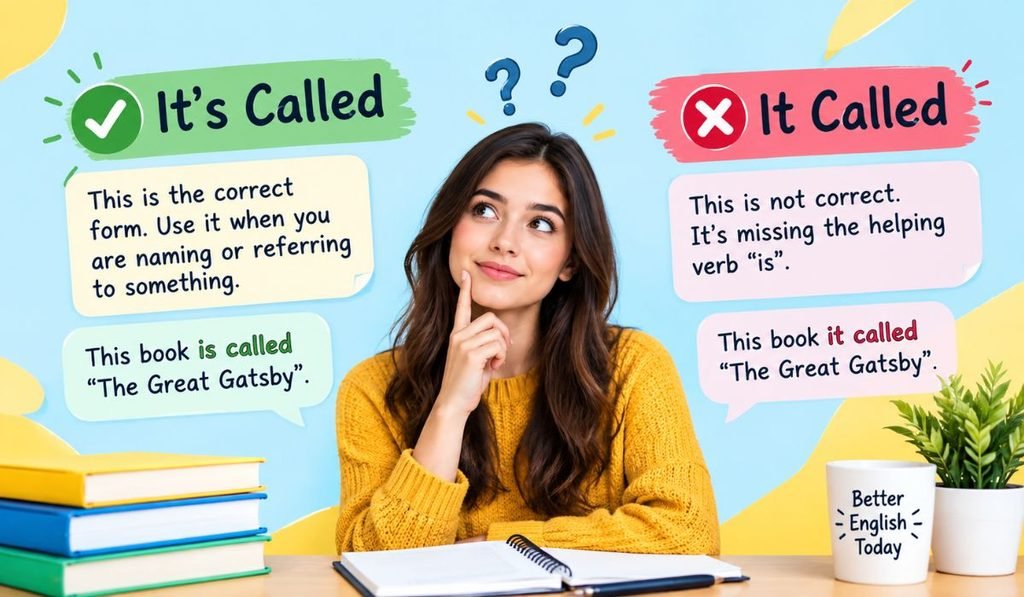
Still not sure which phrase fits your sentence? Run through these quick checklists before you hit publish, send that email, or turn in that assignment. Context is really the deciding factor every single time, more than any hard rule you memorize.
Reach for it’s called when you:
- Are naming or defining something for the reader
- Want to answer the question “what is this?”
- Are writing formal content, like a report or an article
- Are writing casual content, like a text or a social caption
- Need a complete, grammatically correct sentence
- Are introducing a new term or concept for the first time
Reach for it called when you:
- Are describing an object or system performing an action
- Are writing a story with a non human subject, like a ghost or a machine
- Are talking about something that already happened
- Have a clear subject that genuinely did the calling
- Are writing dialogue heavy fiction or a technical log
Most everyday writing leans heavily on the naming phrase, and that’s completely normal. Save the active version for the rare moments when an object or system truly does something on its own, without a person behind it.
If you’re ever stuck between the two mid sentence, default to the naming version first. It’s correct far more often, and readers rarely question it. You can always revise later if the context genuinely calls for the rarer active structure instead.
Common Mistakes to Avoid
Even careful, experienced writers slip up here sometimes. These are the mistakes I see most often, both in client drafts and in my own early drafts years ago.
- Dropping the apostrophe entirely. Writing “its called” is always incorrect. “Its” shows possession, not a shortened verb phrase.
- Using the active version to name something. A sentence like “it called a spatula” is incomplete. You need that missing “is” to make it work correctly.
- Confusing “it’s” with “its.” These two words sound identical out loud but mean completely different things once written down.
- Overusing “it called” in casual writing. This phrase belongs in specific, rare situations, not general naming or defining.
- Skipping the helping verb altogether. Sentences without “is” or “was” nearby often leave readers confused about what you actually meant.
- Mixing tenses mid paragraph. Switching between present and past versions without a clear reason can make your writing feel shaky and unpolished.
- Forgetting subject clarity. If “it” doesn’t clearly refer to something specific, your reader will lose track of who or what performed the action.
- Autocorrect swaps. Phones and keyboards sometimes swap the apostrophe automatically, so always double check before you hit send.
A quick fix works for nearly all of these mistakes. Read your sentence out loud before you post it. If it sounds incomplete or awkward, it probably needs that missing “is” somewhere in the middle.
Keep an eye on longer sentences too. The farther the apostrophe sits from the start of the sentence, the easier it is to lose track of whether you already established your subject correctly. Breaking long sentences into shorter ones often clears up the confusion on its own, without any extra editing needed.
It’s Called vs Its Called vs It Called at a Glance
Three similar looking phrases, three very different jobs. Seeing all three lined up together usually clears up any lingering doubt for good.
| Phrase | Correct? | What It Does |
|---|---|---|
| It’s called | ✅ Yes | Names or identifies something, present tense |
| Its called | ❌ Never | Not a real phrase, mixes possession with a verb incorrectly |
| It called | ✅ Rarely | Describes an object or system performing an action, past tense |
Only two of these three forms are ever correct, and each one belongs in a completely different type of sentence. The middle form, without any apostrophe at all, simply doesn’t exist as valid grammar. Keep this table handy the next time autocorrect tries to talk you into the wrong choice.
Why This Confusion Happens So Often
It helps to understand why this mix up is so common in the first place, rather than just memorizing a rule. English compresses a lot of meaning into very small sounds, and that’s exactly where the trouble starts.
When spoken out loud, the contraction and the possessive word sound nearly identical. Your ear can’t tell them apart, so your brain sometimes types the wrong one without noticing. This isn’t about intelligence at all. It’s simply how spoken and written English can drift apart.
ESL learners face an extra layer of difficulty here too. Many languages don’t use contractions the same way English does, so the whole concept of squeezing “it is” into “it’s” can feel unfamiliar at first. With enough practice, though, it becomes second nature fairly quickly.
Even fast typers and native speakers slip up under deadline pressure. Autocorrect tools sometimes make things worse by guessing wrong. Slowing down for just a second before hitting send solves most of these slips before they ever reach a reader. Reading your own writing back a few minutes later, instead of immediately after typing it, also catches far more of these small errors.
This mix up isn’t limited to any one region either. Writers translating directly from Urdu, Spanish, or Mandarin often run into this exact snag, since contractions simply don’t map cleanly across languages. Once you see the pattern as a swap for “is” rather than a random rule to memorize, the whole thing gets far easier to apply consistently.
Quick Practice: Test Your Skills
Reading about grammar only gets you so far. Try filling in the blanks below before checking the answers underneath.
- What’s this called? ___ a stapler.
- The phone rang, then ___ again.
- This condition ___ jet lag.
- Before Mumbai was renamed, ___ Bombay.
- The system glitched, and ___ the wrong number.
Answers: 1) It’s called, 2) it called, 3) it’s called, 4) it was called, 5) it called.
How many did you get right? If you caught all five, you’ve basically mastered this distinction. If a couple tripped you up, just glance back at the comparison table above and try again in a day or two.
How to Test Yourself in 3 Seconds
Here’s a fast, practical trick you can use anytime you’re stuck, whether you’re writing an email, a caption, or a school essay under deadline pressure.
Say your sentence out loud and swap the contraction for “it is.” If the sentence still makes sense, you’re good to go. If it suddenly turns into nonsense, you’ve either made a typo or you actually need the active past tense version instead.
Try it right now with a sentence you’re currently writing. Nine times out of ten, this simple swap settles the question in seconds, and it works whether you’re texting a friend or finishing up a client report on a tight deadline.
Another handy trick involves reading backward from context. Ask yourself whether your sentence is naming something or describing an event that already happened. That single question usually points you straight to the right choice, even on your busiest days.
Frequently Asked Questions
Is this naming phrase grammatically correct? Yes. It’s the contraction of “it is called,” and it’s correct for naming or identifying something.
Is “its called” ever correct? No. “Its called” is always wrong, since “its” shows possession rather than a verb phrase.
Can I use “it called” in professional writing? Rarely. It only fits when an object or system genuinely performed the action of calling.
What’s the difference between “it’s called” and “what’s it called”? One answers a question, while the other asks one.
Is “it called” a complete sentence on its own? Only with a clear subject and object, like “it called the office twice.”
Which form is more common in everyday English? The naming phrase is far more common, since we name things much more often than we describe them calling.
Does British English follow the same rule? Yes. American and British English both require the apostrophe when naming something.
Can “it’s called” be used directly in a question? Not directly. Flip it around to “what’s it called” or “is it called” instead.
Why do people confuse these two so often? Spoken English blurs the sound difference, so writers accidentally carry that confusion onto the page.
Does this rule change in texting or social media? No. The grammar stays the same, even though tone gets far more relaxed online.
Is there a way to remember this for good? Picture the apostrophe as a tiny placeholder for “is.” No placeholder means no naming happening.
Do editors and teachers actually flag this mistake? Yes, often. It’s one of the most common corrections in student essays and early drafts alike.
Final Takeaways
So here’s the bottom line. Use it’s called whenever you’re naming, defining, or identifying something, whether you’re writing casually or formally. Save the active version for the rare cases where a real subject actually performs the action of calling.
That one small apostrophe changes voice, tense, and meaning all at once. Keep the comparison table nearby, run the quick three second test, and you’ll stop second guessing this phrase for good. Got another tricky grammar pair you want broken down next? Drop it in the comments and let’s work through it together.