

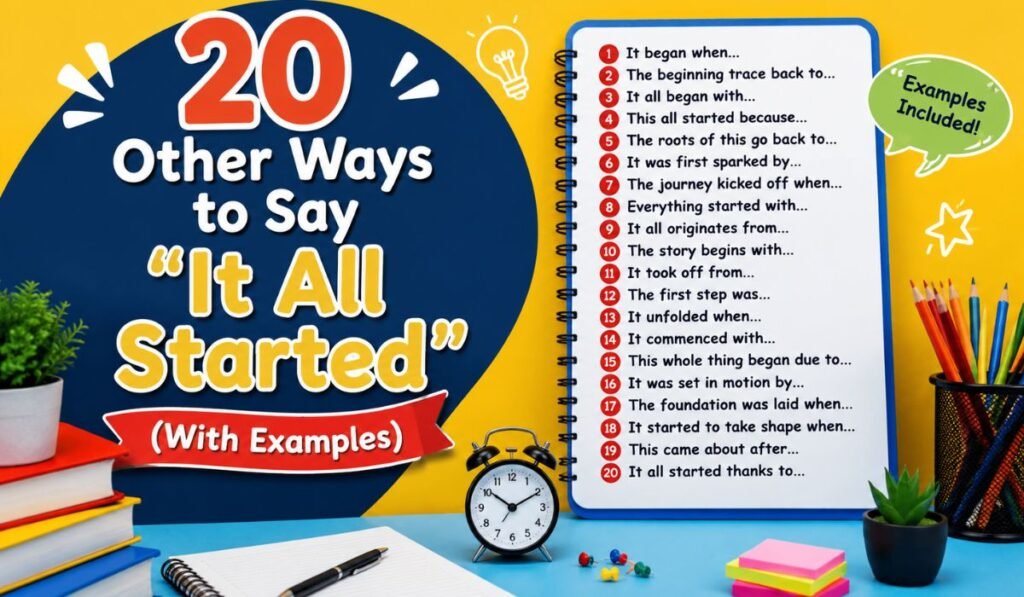
Every story needs a doorway in, and for most of us, that doorway is the phrase “it all started.” It’s simple, it works, and it gets the job done. But if you use it in every email, blog post, caption, or speech, it starts to sound flat.
This guide breaks down 20 fresh alternatives to “it all started,” complete with meanings, examples, and guidance on when each one fits best — whether you’re writing a personal story, a business pitch, or a casual social media caption.
What Does “It All Started” Mean?
“It all started” is an opening phrase used to mark the beginning of an event, idea, relationship, or journey. It tells your reader or listener: here’s where the story begins.
It’s commonly used in:
- Personal anecdotes and memoirs
- Business origin stories (“about us” pages)
- Speeches and presentations
- Social media captions
- Interviews and casual conversation
The phrase works because it’s instantly understood. The trade-off is that it’s also extremely common, which means it can make your writing sound generic if it shows up too often.
Is It Professional or Polite to Say “It All Started”?
Yes, “it all started” is polite and generally acceptable in both formal and informal settings. It isn’t rude, incorrect, or out of place in a business context.
That said, it leans casual. In highly formal writing — legal documents, academic papers, or executive reports — a more precise phrase like “the initiative originated” or “the process began” tends to sound more authoritative. In everyday communication, blog posts, or storytelling, “it all started” is perfectly fine.
Why You Need Alternatives for “It All Started”
Relying on one phrase repeatedly can weaken your writing, even if the phrase itself isn’t wrong. Here’s why switching things up matters:
- Avoids repetition: Using the same opener across paragraphs or documents feels lazy to a reader.
- Matches tone: Not every story needs the same energy. A business report and a heartfelt Instagram caption call for different language.
- Improves engagement: Varied phrasing keeps readers interested and signals thoughtful writing.
- Strengthens professionalism: Formal alternatives can make business communication sound more polished.
- Adds emotional depth: Some alternatives carry more feeling, which helps in storytelling and personal writing.
ALSO READ THIS:20 Other Ways to Say “Please Confirm Receipt of This Email” (With Examples)
Tips for Choosing the Right Phrase
Not every alternative fits every situation. Keep these tips in mind:
- Match the tone of your content. Formal writing calls for phrases like “the process originated,” while casual writing works well with “it all kicked off.”
- Think about your audience. A business audience expects clarity and structure; a personal audience responds better to warmth and emotion.
- Consider the context of the story. A dramatic beginning suits phrases like “the spark came when,” while a steady, gradual origin fits better with “the foundation was laid.”
- Avoid overusing any single phrase. Even a great alternative loses impact if repeated too often.
- Read it out loud. If it sounds natural when spoken, it will likely read naturally too.
Advantages and Disadvantages of Using Alternatives
Advantages:
- Makes your writing sound more natural and less repetitive
- Helps you adjust tone for formal, casual, or emotional contexts
- Improves storytelling flow and reader engagement
- Adds variety across long documents, decks, or content series
- Signals stronger command of language
Disadvantages:
- Some phrases can feel forced if used in the wrong context
- Overly poetic alternatives may not suit formal or technical writing
- Choosing the wrong tone can confuse or distract the reader
- Requires a bit more thought than defaulting to one familiar phrase
Full List of Alternatives
Here’s a quick-reference table before we go into detail on each phrase.
| # | Alternative Phrase | Best Tone |
| 1 | The journey began | Personal, reflective |
| 2 | It all kicked off | Casual, energetic |
| 3 | That’s where it all began | Narrative, storytelling |
| 4 | The story started | Neutral, versatile |
| 5 | It all took off | Business, momentum-driven |
| 6 | It originated from | Formal, precise |
| 7 | It all started back when | Nostalgic, casual |
| 8 | The beginning traces back to | Formal, historical |
| 9 | It all came into being | Formal, creative |
| 10 | Everything started when | Neutral, conversational |
| 11 | It all unfolded from | Narrative, dramatic |
| 12 | The spark came when | Emotional, dramatic |
| 13 | It all emerged from | Formal, analytical |
| 14 | It all began to take shape | Gradual, developmental |
| 15 | It was born when | Emotional, creative |
| 16 | The foundation was laid | Formal, business |
| 17 | It all traces back to | Formal, historical |
| 18 | It sparked when | Casual, energetic |
| 19 | It all set in motion | Formal, business |
| 20 | It came to life when | Emotional, creative |
1. The journey began
Meaning: Refers to the start of a long, meaningful process or personal path.
Example: The journey began the day I packed my bags and left home for college.
Best Use: Personal stories, memoirs, motivational speeches, and travel content. It works well anywhere you want to highlight growth or progress over time.
2. It all kicked off
Meaning: An energetic, informal way to describe the start of an event or activity.
Example: It all kicked off with a random conversation at a coffee shop.
Best Use: Casual storytelling, social media captions, and conversational writing. It’s not suited for formal business documents.
3. That’s where it all began
Meaning: Points directly to a specific moment or place as the origin of a story.
Example: That’s where it all began — a small garage with two laptops and a big idea.
Best Use: Origin stories, “about us” pages, and speeches that want to highlight a defining moment.
4. The story started
Meaning: A neutral, simple way to introduce a narrative’s beginning.
Example: The story started with a letter that arrived out of the blue.
Best Use: Works almost anywhere — blogs, books, interviews, and presentations. It’s one of the safest and most versatile alternatives on this list.
5. It all took off
Meaning: Suggests a sudden rise or acceleration after a starting point.
Example: It all took off once we launched our first product online.
Best Use: Business growth stories, startup narratives, and any content describing momentum and success.
6. It originated from
Meaning: A formal way to describe the source or root cause of something.
Example: The company’s mission originated from a personal experience with poor customer service.
Best Use: Formal writing, reports, academic content, and professional presentations.
7. It all started back when
Meaning: A nostalgic phrase that looks back at an earlier point in time.
Example: It all started back when we were still in high school.
Best Use: Personal anecdotes, reunions, nostalgic blog posts, and casual conversations.
8. The beginning traces back to
Meaning: Indicates that the roots of something go back to a specific time or event.
Example: The beginning traces back to a research project from the early 1990s.
Best Use: Historical writing, company history pages, and academic or research-based content.
9. It all came into being
Meaning: A more literary way to describe how something was created or formed.
Example: The tradition all came into being after a chance meeting between two neighbors.
Best Use: Creative writing, formal essays, and content that benefits from a slightly poetic tone.
10. Everything started when
Meaning: A conversational way to point to a triggering moment or event.
Example: Everything started when we decided to take a leap of faith and move cities.
Best Use: Interviews, podcasts, casual blog posts, and everyday conversation.
11. It all unfolded from
Meaning: Suggests a story developed gradually, step by step, from an initial event.
Example: It all unfolded from a single email that changed the direction of the project.
Best Use: Narrative writing, dramatic storytelling, and articles describing a chain of events.
12. The spark came when
Meaning: Highlights a specific moment of inspiration or motivation.
Example: The spark came when I watched a documentary about ocean conservation.
Best Use: Motivational content, personal stories, and speeches about inspiration or turning points.
13. It all emerged from
Meaning: A formal, analytical way to describe how something developed out of a situation or need.
Example: The new policy all emerged from months of internal research and feedback.
Best Use: Business writing, research reports, and analytical or academic content.
14. It all began to take shape
Meaning: Describes a gradual process where an idea slowly becomes something concrete.
Example: The plan all began to take shape after our first team meeting.
Best Use: Project updates, progress reports, and content describing development over time.
15. It was born when
Meaning: An emotional, creative way to describe the moment something came into existence.
Example: The idea was born when two friends decided to solve their own problem.
Best Use: Startup stories, creative writing, and brand narratives that want an emotional touch.
16. The foundation was laid
Meaning: Refers to the early groundwork that made later success possible.
Example: The foundation was laid years before the company ever made a profit.
Best Use: Business writing, formal presentations, and content focused on long-term planning.
17. It all traces back to
Meaning: Points to a specific origin point, similar to “traces back to” but slightly more conversational.
Example: It all traces back to a decision we made on a random Tuesday afternoon.
Best Use: Personal stories, casual interviews, and reflective writing.
18. It sparked when
Meaning: A short, punchy way to describe a sudden beginning or trigger.
Example: It sparked when a friend challenged me to try something new.
Best Use: Social media captions, short-form content, and casual storytelling.
19. It all set in motion
Meaning: Suggests that one event triggered a series of following events or actions.
Example: That single phone call all set in motion everything that followed.
Best Use: Formal writing, business narratives, and content describing cause and effect.
20. It came to life when
Meaning: Describes the moment an idea or project became real and active.
Example: The community garden came to life when neighbors pooled their resources together.
Best Use: Creative writing, brand stories, and content describing the launch of a project or idea.
Frequently Asked Questions
Is “it all started” grammatically correct?
Yes, it’s a correct and commonly used phrase in both spoken and written English.
What’s the most formal alternative to “it all started”?
“It originated from” and “the foundation was laid” are among the most formal options.
Can I use these phrases in professional emails?
Yes, phrases like “it all emerged from” or “it originated from” work well in professional communication.
Which alternative works best for casual conversation?
“It all kicked off” and “everything started when” sound natural in everyday speech.
Do these phrases work for business “about us” pages?
Yes, phrases like “the foundation was laid” or “it all took off” are common in company origin stories.
Conclusion
“It all started” is a reliable phrase, but it isn’t your only option. Whether you’re writing a heartfelt personal story, a professional report, or a quick social media caption, the 20 alternatives above give you room to match your tone and keep your writing fresh. Pick the phrase that fits your context, avoid repeating the same one too often, and your storytelling will feel more natural, engaging, and memorable.