

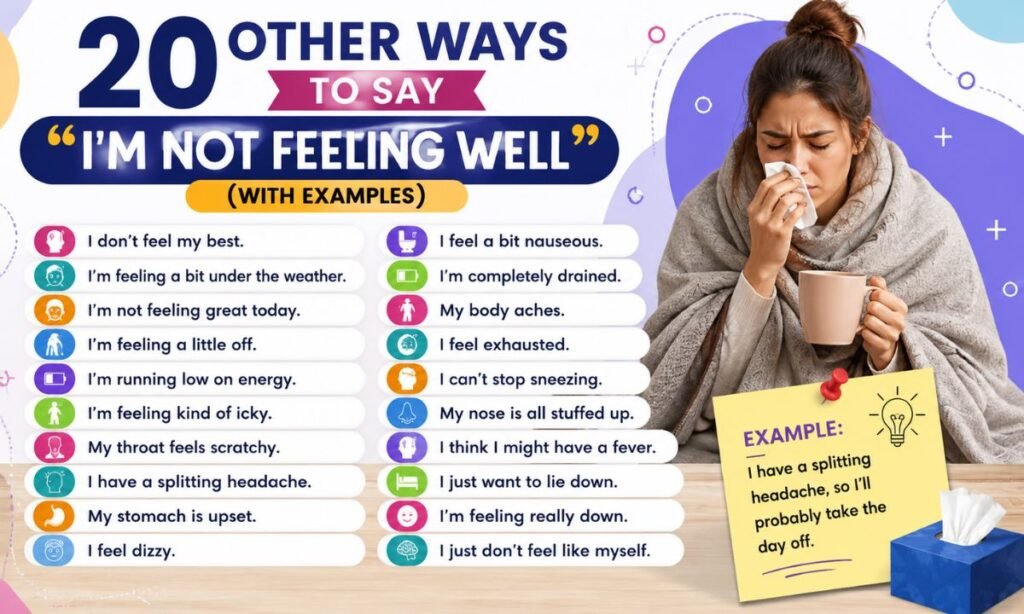
Telling your boss, your partner, or a friend that you feel sick shouldn’t always sound the same. “I’m not feeling well” gets the point across, but it’s vague, overused, and doesn’t tell anyone how you actually feel. Whether you need something polite for a work email or something casual for a text to a friend, this guide gives you 20 natural alternatives, real examples, and tips on picking the right one for the moment.
What Does “I’m Not Feeling Well” Mean?
“I’m not feeling well” is a general phrase used to say that you’re sick, tired, or physically off in some way. It doesn’t point to a specific symptom — no headache, no fever, no stomach ache — it just signals that something is wrong with your health right now.
People use it because it’s safe and doesn’t require an explanation. But that vagueness is also its biggest weakness: it can sound like an excuse, especially in professional settings where clarity matters.
Is It Professional/Polite to Say “I’m Not Feeling Well”?
Yes, it’s professional and polite. It’s a neutral, respectful way to explain an absence or a drop in performance without oversharing personal medical details.
That said, it works best in short, direct messages — like an email to a manager or a quick note to a coworker. In casual conversations, it can feel a little stiff or distant, which is where more expressive alternatives come in handy.
Advantages and Disadvantages of Saying “I’m Not Feeling Well”
Advantages
- Simple and universally understood — no confusion about what you mean.
- Keeps details private — you don’t have to disclose symptoms or diagnoses.
- Works in almost any setting — formal emails, texts, or spoken conversation.
- Sounds respectful — it’s neither dramatic nor dismissive.
Disadvantages
- Overused — it’s the first phrase everyone reaches for, so it can feel generic.
- Vague — it doesn’t tell the listener how serious the issue is.
- Can sound like a canned excuse — especially if used repeatedly at work.
- Lacks emotional nuance — it doesn’t capture whether you’re exhausted, achy, or coming down with something specific.
Why You Need Alternatives to “I’m Not Feeling Well”
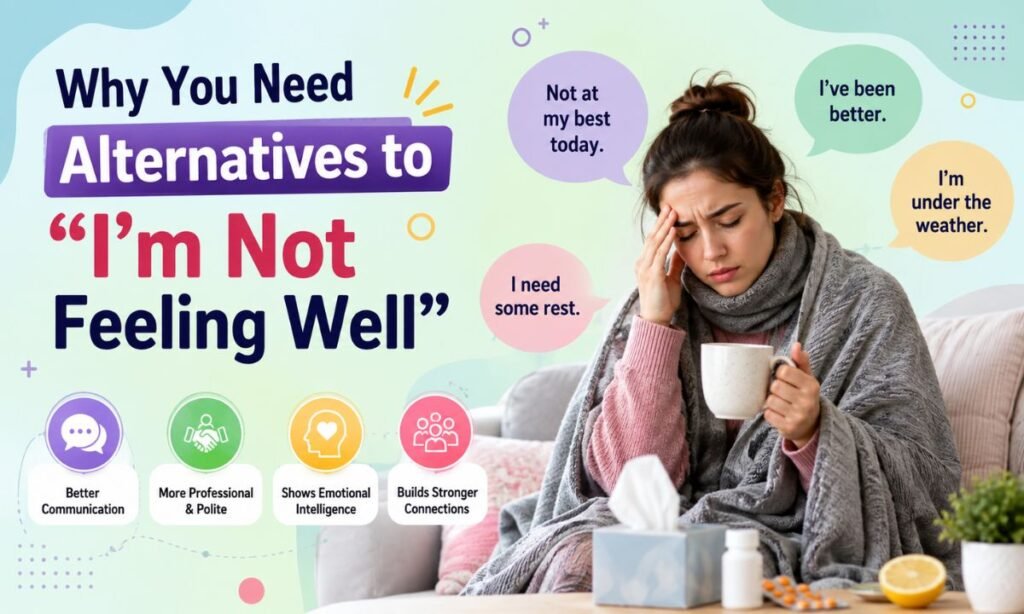
Repeating the same phrase every time you’re sick makes your communication sound flat and impersonal. Alternatives help you:
- Match your tone to the situation — formal for work, casual for friends.
- Add clarity — “battling a cold” tells people more than “not feeling well.”
- Avoid sounding repetitive in emails, texts, or conversations.
- Express the right level of severity — from “a bit unwell” to “feeling exhausted.”
- Build stronger, more human communication, especially in professional writing where word choice matters.
READ THIS “20 Other Ways to Say “I Hope You Are Doing Well”
Tips for Choosing the Right Phrase
- Consider your audience. Use formal phrasing for managers and clients; casual phrasing for friends and family.
- Match the severity. Don’t say “feeling drained” if you actually have a fever — be accurate.
- Think about context. A sick-day email needs to be brief and professional; a text to a friend can be more expressive.
- Avoid oversharing. You don’t need to explain every symptom, especially in professional settings.
- Keep it honest. Choose a phrase that reflects how you truly feel, not just one that sounds polished.
Full List of Alternatives
| # | Phrase | Best For | Tone |
|---|---|---|---|
| 1 | Feeling Under the Weather | Casual, work-friendly | Neutral |
| 2 | A Bit Unwell | Formal emails | Polite |
| 3 | Not at My Best Today | Work or social | Neutral |
| 4 | Coming Down With Something | Casual, early symptoms | Informal |
| 5 | Feeling Sick | General, everyday | Neutral |
| 6 | Feeling Off | Casual | Informal |
| 7 | Having a Rough Day Health-Wise | Friends, family | Informal |
| 8 | Feeling Run Down | Work or casual | Neutral |
| 9 | Not Up to Par | Formal, workplace | Polite |
| 10 | Feeling Weak Today | Casual, specific | Informal |
| 11 | A Little Out of Sorts | Casual, British English | Informal |
| 12 | Feeling Drained | Casual, emotional/physical | Informal |
| 13 | Battling a Cold | Specific illness | Neutral |
| 14 | Not Doing Too Well Today | Casual, honest | Informal |
| 15 | Feeling Fatigued | Formal, medical | Formal |
| 16 | Taking a Sick Day | Workplace announcement | Formal |
| 17 | Feeling Feverish | Specific symptom | Neutral |
| 18 | Having a Migraine | Specific symptom | Neutral |
| 19 | Feeling Exhausted | Casual or formal | Neutral |
| 20 | Need to Rest and Recover | Formal, work email | Polite |
1. Feeling Under the Weather
This is one of the most common idioms for feeling sick. It’s mild, polite, and works in almost any setting — casual or professional.
Example: “I’m feeling under the weather today, so I’ll be logging off early.”
2. A Bit Unwell
A slightly formal, understated way to say you’re not at 100%. Great for emails to managers or clients.
Example: “I’m a bit unwell this morning and may need to reschedule our call.”
3. Not at My Best Today
This phrase softens the message without hiding it. It works well when you want to explain reduced energy or focus.
Example: “I’m not at my best today, so please excuse any delayed replies.”
4. Coming Down With Something
Perfect for when symptoms are just starting and you’re not sure what’s wrong yet.
Example: “I think I’m coming down with something — my throat’s been sore since last night.”
5. Feeling Sick
Direct and simple. It’s less formal than “unwell” but still clear and widely understood.
Example: “I’m feeling sick today, so I won’t be coming into the office.”
6. Feeling Off
A casual way to say something feels wrong, even if you can’t pinpoint the exact symptom.
Example: “I’ve been feeling off since this morning — probably need some rest.”
7. Having a Rough Day Health-Wise
A more descriptive, conversational phrase that works well in texts to friends or family.
Example: “Having a rough day health-wise, so I’m skipping the gym tonight.”
8. Feeling Run Down
This implies low energy from stress, lack of sleep, or an oncoming illness. It’s common in both casual and workplace contexts.
Example: “I’ve been feeling run down all week and think I need a proper break.”
9. Not Up to Par
A polite, slightly formal phrase that avoids sounding dramatic while still communicating you’re not at your usual level.
Example: “I’m not up to par today, so I’ll keep today’s meeting short.”
10. Feeling Weak Today
Useful when fatigue or low energy is the main issue, rather than pain or nausea.
Example: “I’m feeling weak today — I think I need more fluids and rest.”
11. A Little Out of Sorts
A gentle, slightly old-fashioned phrase (common in British English) that implies you’re not quite yourself.
Example: “I’ve been a little out of sorts since yesterday, nothing serious though.”
12. Feeling Drained
Works for both physical and emotional exhaustion, making it versatile for many situations.
Example: “Work’s been intense and I’m feeling drained — taking it easy tonight.”
13. Battling a Cold
Specific and relatable. It tells people exactly what you’re dealing with without going into detail.
Example: “I’m battling a cold this week, so I might sound a bit stuffy on calls.”
14. Not Doing Too Well Today
An honest, conversational phrase that works well with people you’re close to.
Example: “Not doing too well today — think I’ll stay in and rest.”
15. Feeling Fatigued
A more formal, almost medical way to describe exhaustion. Common in professional or health-related writing.
Example: “I’ve been feeling fatigued lately and plan to see a doctor this week.”
16. Taking a Sick Day
This isn’t a symptom description — it’s a clear, professional announcement that you won’t be working.
Example: “I’ll be taking a sick day today and will follow up on emails tomorrow.”
17. Feeling Feverish
Specific and useful when a fever is the main symptom you’re experiencing.
Example: “I’m feeling feverish, so I’m going to rest and monitor my temperature.”
18. Having a Migraine
Direct and specific — useful when a headache is severe enough to affect your day.
Example: “I’m having a migraine, so I need to step away from my screen for a while.”
19. Feeling Exhausted
Works for both physical tiredness and mental burnout, making it flexible across contexts.
Example: “I’m feeling exhausted after this week — I’ll need the weekend to recover.”
20. Need to Rest and Recover
A forward-looking phrase that focuses on what you’re doing about it, not just how you feel.
Example: “I need to rest and recover today, so I’ll pick this up again tomorrow.”
Frequently Asked Questions
Is “I’m not feeling well” grammatically correct? Yes, it’s correct and commonly used in both spoken and written English.
What’s a polite way to tell my boss I’m sick? Use a formal phrase like “I’m feeling unwell” or “I’ll be taking a sick day today.”
What’s a casual way to say I’m sick to a friend? Try “feeling off,” “under the weather,” or “having a rough day health-wise.”
Can I say “I’m not feeling well” in a formal email? Yes, it’s appropriate and neutral enough for professional emails.
What’s the difference between “unwell” and “sick”? “Unwell” is slightly more formal and softer, while “sick” is direct and commonly used casually.
Is “under the weather” too casual for work? No, it’s a widely accepted idiom that works fine in most workplace communications.
Conclusion
You don’t have to rely on the same phrase every time you’re feeling sick. Whether you need something formal for a work email, something specific to describe your symptoms, or something casual for a quick text, these 20 alternatives give you the flexibility to communicate clearly and naturally. Pick the phrase that matches your tone, your audience, and how you actually feel — and you’ll never sound repetitive again.