

Every December, the same small question pops up on cards, emails, and social media posts. Should you write “Happy Holiday” or “Happy Holidays”? One extra letter seems tiny, but it changes the meaning of your message.
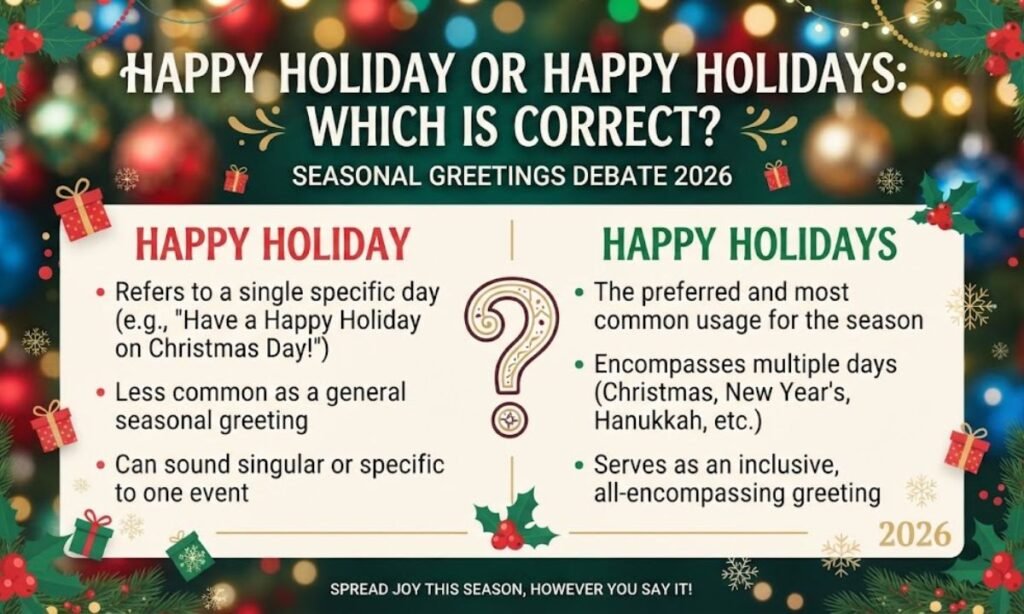
So, Happy Holiday or Happy Holidays: which is correct? In most cases, “Happy Holidays” is the right choice. It is the standard seasonal greeting, and it covers the whole festive period. “Happy Holiday” is also correct, but only in a narrower situation, such as wishing someone well on a single day or a single trip.
This guide explains the difference in plain English. You will see clear examples, a comparison table, capitalization rules, and the mistakes people make most often. By the end, you will know exactly which version fits your message.
Quick Answer (Happy Holiday or Happy Holidays): Use “Happy Holidays” for the general season, groups of people, and business messages. Use “Happy Holiday” only for one specific day or one vacation.
What Does “Happy Holidays” Mean?
“Happy Holidays” is a seasonal greeting. It wishes someone joy across the whole holiday period, not just one date. In the United States and Canada, that period usually runs from Thanksgiving through New Year’s Day.
The word “holidays” is plural on purpose. It points to several celebrations sitting close together on the calendar. Depending on who you are talking to, that might include Christmas, Hanukkah, Kwanzaa, Diwali in some years, the winter solstice, and New Year’s Eve.
That is why the phrase works so well as a general greeting. You do not need to know what the other person celebrates. The wish still fits.
Here is how to think about it:
- It is inclusive, because it does not name one religion or tradition.
- It is flexible, because it works for a whole month, not one day.
- It is friendly, because it sounds warm without being too formal.
Examples of “Happy Holidays” Used Correctly
Read these short examples. Notice how each one speaks to a season or a group, not a single date.
- “Happy Holidays, everyone! Thank you for a great year.”
- “Wishing you and your family Happy Holidays and a peaceful new year.”
- “Our office will close early on December 23. Happy Holidays from all of us.”
- “Happy Holidays to our customers, partners, and friends.”
- “She waved and said, ‘Happy Holidays!’ as she left the shop.”
Each sentence covers a stretch of time or many people. That is the key idea behind the plural form.
What Does “Happy Holiday” Mean?
“Happy Holiday” is singular. It refers to one holiday, one day off, or one vacation. Because of that, it appears less often in seasonal greetings.
The meaning also changes depending on where you live. In British English, “holiday” often means a vacation, so “Have a happy holiday” can simply mean “enjoy your trip.” In American English, “holiday” usually means a public or religious observance, like Independence Day.
There is also a famous example. The Irving Berlin song “Happy Holiday” appeared in the 1942 film Holiday Inn, and its singular title was chosen to celebrate a series of individual holidays throughout the year. So the singular form has real history behind it.
Examples of “Happy Holiday” Used Correctly
These examples show the singular form working as intended.
- “Have a happy holiday in Italy! Send us photos.”
- “It’s a bank holiday on Monday. Enjoy your happy holiday and rest well.”
- “Wishing you a happy holiday at the beach this weekend.”
- “Happy holiday to you on Eid, Diwali, or whatever you celebrate today.”
Each sentence points to one trip or one day. If your message covers more than that, switch to the plural.
Happy Holiday vs Happy Holidays — Core Comparison
A quick side-by-side view makes the choice much easier. Use this table when you are unsure.
| Feature | Happy Holidays | Happy Holiday |
| Grammar | Plural | Singular |
| Main meaning | The whole holiday season | One day or one trip |
| Best for | Cards, emails, social media, groups | Vacations, a single named holiday |
| Tone | Warm and inclusive | Personal and specific |
| How common it is | Very common | Less common |
| Regional note | Popular in the US and Canada | Common in the UK for vacations |
| Safe for business use? | Yes | Sometimes, but rarely needed |
The pattern is simple. If you are speaking about the season, choose the plural. If you are speaking about one occasion, choose the singular.
So when people ask whether Happy Holiday or Happy Holidays is the better option for everyday use, the answer is almost always the plural version.
Why “Happy Holidays” Became the Standard Greeting
The plural greeting did not become popular by accident. Several practical reasons pushed it to the top.
1. It covers a crowded calendar. Between late November and early January, many communities celebrate different events. One short phrase lets you include all of them.
2. It works for people you do not know well. Customers, neighbors, and coworkers may follow different traditions. “Happy Holidays” avoids guessing, so nobody feels left out.
3. Businesses adopted it early. Retailers, banks, and schools serve mixed audiences. A neutral greeting was easier to print on cards, signs, and ads.
4. It fits multiple dates in a row. Thanksgiving, Christmas, and New Year’s Day sit only weeks apart. A seasonal wish makes sense for all three.
5. It is short and easy to say. Two words, warm tone, no explanation needed.
Some people prefer “Merry Christmas” and feel that it is more traditional. That is a perfectly normal preference. The point is not that one greeting is right for everyone. The point is that “Happy Holidays” is the safest general option when you are not sure.
Did You Know? Greeting choices often depend on age, region, and personal habits. Neither phrase is rude, so a kind tone matters more than the exact wording.
ALSO READ “Gluing or Glueing: Which One Is Actually Right?“
When to Use “Happy Holidays” — Practical Contexts
Now let’s look at real situations. Knowing the context helps you settle Happy Holiday or Happy Holidays fast.
Professional Emails and Business Communication
For Happy Holiday or Happy Holidays at work, remember your audience is usually mixed. Clients, teammates, and managers may all celebrate differently. “Happy Holidays” keeps your tone polite and professional.
Use it in these places:
- Email signatures during December
- Out-of-office replies
- Client thank-you notes
- Company newsletters
- Team chat messages
Example email closing:
Thank you for your support this year. Wishing you Happy Holidays and a prosperous new year.
Keep the message short. A brief, sincere line always reads better than a long paragraph.
Greeting Cards and Social Media
When choosing Happy Holiday or Happy Holidays for cards and posts, remember they often reach many people at once. That makes the plural form the natural pick.
For printed cards, “Happy Holidays” fits neatly on the front and pairs well with a personal note inside. For social media, it works in captions, stories, and comments.
Try these caption ideas:
- “Happy Holidays from our home to yours.”
- “Sending warm wishes and Happy Holidays to everyone here.”
- “Happy Holidays! Grateful for this community.”
Add a hashtag or two if you like. Avoid stuffing a post with too many. Two or three are plenty.
Greeting Strangers or Acquaintances
With Happy Holiday or Happy Holidays for strangers, the plural wins. When you greet a cashier, neighbor, or delivery driver, you rarely know their traditions. A quick “Happy Holidays!” is friendly and low-risk.
It also feels natural in speech. You can say it with a smile while walking away, and it lands well every time.
If you do know what someone celebrates, you can name it directly. For example, “Happy Hanukkah” or “Merry Christmas” feels more personal when you are sure. Otherwise, the general phrase is a kind default.
When to Use “Happy Holiday” — Practical Contexts
The singular form has its own useful moments. Here are the two main ones.
Referring to a Personal Trip or Vacation
This is the most common use, especially in British English. If a friend is heading off on a trip, “Have a happy holiday” is a warm send-off.
Examples:
- “Have a happy holiday, and don’t forget sunscreen.”
- “We’re off on holiday next week.”
- “I hope your holiday in Turkey is wonderful.”
Notice that “holiday” here means a vacation, not a festive season. American readers may say “Have a great vacation” instead.
Wishing Someone Well on a Specific Named Holiday
Sometimes you want to greet someone on just one day. The singular fits that situation well.
Examples:
- “Happy holiday! Enjoy the long weekend.”
- “Wishing you a happy holiday on Labor Day.”
- “Happy holiday to everyone celebrating today.”
In these cases, the sentence points to one date. If you can name the holiday, that is often even better, such as “Happy Thanksgiving” or “Happy Diwali.”
Pro Tip: Ask yourself one question before you write: “Am I talking about one day or many?” One day means singular. Many days or a whole season means plural.
Capitalization Rules for Happy Holidays
Capitalization adds another layer to Happy Holiday or Happy Holidays. The good news is that the rules are simple.
Rule 1: Capitalize both words in a greeting card or heading. “Happy Holidays” is a set phrase, so both words usually start with capital letters.
Rule 2: Capitalize the first word in a sentence. Example: “Happy holidays, everyone!” This style is also acceptable, especially in casual writing.
Rule 3: Use lowercase in the middle of a sentence when it is not a formal greeting. Example: “We hope you have happy holidays this year.”
Rule 4: Always capitalize named holidays. Christmas, Hanukkah, Kwanzaa, Thanksgiving, and New Year’s Day are proper nouns.
Rule 5: No apostrophe is needed. “Happy Holidays” is plural, not possessive. Write “holidays,” not “holiday’s.”
Here is a fast reference table:
| Situation | Correct | Incorrect |
| Card or title | Happy Holidays | happy holidays (in a title) |
| Start of a sentence | Happy holidays to you! | happy Holidays to you! |
| Mid-sentence wish | I wish you happy holidays. | I wish you Happy Holidays’s. |
| Named holiday | Happy Thanksgiving | happy thanksgiving |
Style guides differ a little, so pick one style and keep it consistent within a single piece of writing.
Common Mistakes to Avoid
Even careful writers slip up on Happy Holiday or Happy Holidays during December. Watch out for these frequent errors.
- Using the singular for the whole season. “Happy Holiday, team!” sounds like you are wishing them one day off. Use the plural.
- Adding an apostrophe. Writing “Happy Holiday’s” or “Happy Holidays'” is wrong. No apostrophe belongs there.
- Mixing up capitalization. Avoid odd forms like “happy Holidays” or “Happy holidays'” in the same document.
- Confusing British and American meanings. In the UK, “holiday” can mean vacation. Adjust your wording for your audience.
- Assuming everyone celebrates the same thing. A broad greeting is safer when you are unsure.
- Overusing the phrase. Repeating it five times in one short email feels forced. Say it once or twice.
- Skipping proofreading. Tiny typos are easy to miss when you write fast. A quick reread saves embarrassment.
Correcting these takes only a few seconds, and your message will look polished.
Quick Examples You Can Copy
Need something ready to send? Use these short lines and adjust them to fit your voice.
For coworkers:
- “Happy Holidays, team! Enjoy your well-earned rest.”
- “Wishing you Happy Holidays and a bright start to the new year.”
For friends and family:
- “Happy Holidays! Can’t wait to see you soon.”
- “Sending love and Happy Holidays to all of you.”
For customers:
- “Thank you for being part of our year. Happy Holidays!”
- “We appreciate you. Happy Holidays from our entire team.”
For a vacation send-off (singular):
- “Have a happy holiday, and send us a postcard!”
Whenever you wonder about Happy Holiday or Happy Holidays, pick the plural for greetings and the singular for one trip or one day. That habit alone solves most cases.
Regional Differences: Happy Holiday or Happy Holidays Around the World
The choice between Happy Holiday or Happy Holidays can shift slightly depending on where your reader lives. Language habits travel differently in each country.
| Region | Common Usage | Notes |
| United States | “Happy Holidays” for the season | “Holiday” means a festive or public day |
| Canada | “Happy Holidays” and “Season’s Greetings” | Very similar to the US |
| United Kingdom | “Happy Christmas” or “Have a good holiday” | “Holiday” often means vacation |
| Australia | “Happy holidays” and “Merry Christmas” | Summer break makes “holiday” a trip word |
| India and Pakistan | “Happy Holidays” in business messages | Named festivals are usually greeted directly |
In short, Happy Holiday or Happy Holidays is mostly a US and Canada topic in the festive sense. Elsewhere, people lean on the name of the festival or on the vacation meaning.
A Simple Decision Checklist
Not sure which one to send? Walk through these steps. Each one gives a fast answer to Happy Holiday or Happy Holidays in a real situation.
- Writing to a group? Choose “Happy Holidays.” A group usually means many traditions.
- Writing a card? Choose “Happy Holidays.” Cards travel to different homes.
- Wishing someone a good trip? Choose “Happy Holiday.” It refers to one vacation.
- Naming one date? Use the holiday’s name, or “Happy Holiday” if the name is unclear.
- Working in a business setting? Choose “Happy Holidays.” It stays polite and neutral.
For most people, the first three steps solve the Happy Holiday or Happy Holidays question in seconds.
Why This Small Detail Matters for Your Writing
You might wonder if one letter is worth the attention. It is. Readers notice small errors, especially in formal messages. A clean greeting shows care.
Here is why it counts:
- It builds trust. Accurate writing makes your brand or your name look careful.
- It avoids confusion. The singular can seem like you are wishing only one day of joy.
- It helps search visibility. People search for Happy Holiday or Happy Holidays every winter, which shows how often the doubt appears.
- It keeps tone consistent. A card that mixes forms can look rushed.
Think of it as a tiny polish step. It costs nothing and improves the whole message.
Real-Life Scenarios: Happy Holiday or Happy Holidays
Let’s test the rule in everyday moments. In each case, the Happy Holiday or Happy Holidays choice becomes obvious.
Scenario 1: The office newsletter. You are writing to fifty colleagues. Use “Happy Holidays” in the header. Many people, many traditions.
Scenario 2: A friend flies to Spain tomorrow. Text “Have a happy holiday!” You mean the trip, so the singular fits.
Scenario 3: A shop owner greets customers at the door. Say “Happy Holidays!” It is quick, warm, and fits anyone walking in.
Scenario 4: A note on a single long weekend. Write “Happy holiday, enjoy the break.” One day off, one holiday.
Scenario 5: A social media brand post. Go with “Happy Holidays.” The audience is wide, and the season is the theme.
Once you practice, the Happy Holiday or Happy Holidays decision becomes automatic. You will stop second-guessing yourself.
Frequently Asked Questions
Happy Holiday or Happy Holidays: Which Is Correct?
“Happy Holidays” is the standard seasonal greeting. Use “Happy Holiday” only for one day or one vacation.
Is “Happy Holiday” grammatically wrong?
No. It is correct when you mean a single holiday or a trip.
Why do people say “Happy Holidays” instead of “Merry Christmas”?
It covers several celebrations at once, so it suits mixed audiences. It also saves you from guessing what someone celebrates.
Do you capitalize “Happy Holidays”?
Yes, in cards, titles, and greetings, both words are usually capitalized. In casual sentences, lowercase “holidays” is also fine.
Is there an apostrophe in “Happy Holidays”?
No. The word is a plural, not a possessive.
Is Happy Holiday or Happy Holidays better for work emails?
“Happy Holidays.” It is polite, neutral, and widely accepted in professional settings.
What is the difference between British and American use?
In the UK, “holiday” often means vacation. In the US, it usually means a festive or public observance.
Can I say “Happy Holidays” after New Year’s Day?
It is best used until early January. After that, the season has passed, so a simple “Happy New Year” fits better.
Happy Holiday or Happy Holidays: which is better for a greeting card?
“Happy Holidays” is the usual pick because cards go to many people at once.
Is “Happy Holidays” offensive?
No. It is a kind, general wish, and most people take it as friendly.
Final Takeaways
Here is everything in a nutshell:
- “Happy Holidays” is plural, seasonal, and inclusive. It is the best all-purpose greeting.
- “Happy Holiday” is singular. Use it for a single day or a vacation.
- Capitalize both words in cards and titles, and never add an apostrophe.
- The Happy Holiday or Happy Holidays choice depends on scope: one day or many.
- Choose the greeting that fits your audience, and keep your tone sincere.
- When in doubt, go with the plural.
In the end, the question of Happy Holiday or Happy Holidays comes down to one idea: singular for one, plural for many. Keep that rule in mind, and your seasonal messages will always sound natural and correct.
So go ahead and write that card, send that email, or post that caption. Whether you say Happy Holiday or Happy Holidays, the warmth behind your words is what people remember most. Happy Holidays to you and yours!