
We all lean on “even though” way too much. You write one paragraph, use it twice, and suddenly your sentence feels flat. It happens to almost every writer, student, or content creator at some point.
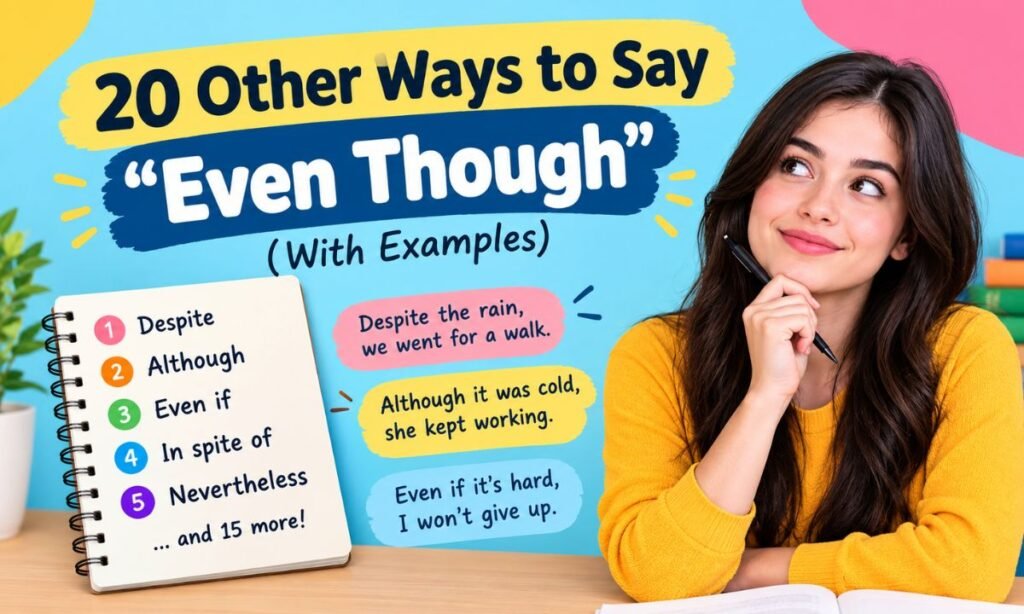
This guide gives you 20 solid alternatives to “even though” with real examples so your writing sounds fresh, natural, and varied. You will also learn when each phrase fits best and which ones to avoid in formal writing.
What Does “Even Though” Mean?
“Even though” is a concessive conjunction. It connects two ideas where one seems surprising given the other. You use it to admit a fact while still stating something that contrasts with it.
For example: “Even though it rained all day, we still went camping.” The rain would normally stop a camping trip, but it didn’t. That’s the whole point of the phrase. It signals contrast.
You’ll find “even though” all over emails, essays, news articles, and everyday conversation. It’s a subordinating conjunction, meaning it introduces a dependent clause that can’t stand alone as a full sentence.
Is It Professional/Polite to Say “Even Though”?
Yes, “even though” is perfectly professional and polite. It works fine in emails, reports, and formal writing. There’s nothing rude or casual about it.
That said, using it repeatedly in the same document can make your writing feel repetitive. A reader might not notice it once, but they’ll spot it fast if it shows up five times in one page.
Some workplaces prefer slightly more formal alternatives like despite the fact that or notwithstanding for legal or business documents. Others are fine with “even though” throughout. It really depends on your audience and tone.
Advantages and Disadvantages of Using “Even Though”
Every phrase has its strengths and weak spots. Here’s a quick breakdown before you decide when to use “even though” and when to swap it out.
Advantages:
- Clear and simple. Almost every English speaker understands it instantly.
- Works in speech and writing. You can use it casually or formally.
- Sets up contrast fast. It tells the reader right away that a twist is coming.
- Beginner-friendly. New English learners pick it up quickly.
Disadvantages:
- Overused in writing. Many students and writers fall back on it too often.
- Can feel repetitive. Using it multiple times in one paragraph gets tiring.
- Lacks nuance. It doesn’t always match the tone of academic or legal writing.
- Predictable. Readers can guess what’s coming next, which weakens impact.
Why You Need Alternatives to “Even Though”
Repetition kills good writing. If every contrast in your essay starts with “even though,” your reader starts skimming instead of reading closely.
Alternatives also help you match tone. “Albeit” sounds more formal than “even though.” “Even so” feels more conversational. Having options means you can pick the phrase that actually fits the moment instead of defaulting to the same one every time.
There’s also an SEO and readability angle here. Search engines and readers both reward varied, natural language over repeated patterns. Mixing up your transition words keeps content engaging and keeps you off the radar of anyone scanning for repetitive, robotic writing.
Tips for Choosing the Right Phrase
Picking the right alternative isn’t random. A few quick checks will point you to the best fit every time.
- Check your tone. Formal writing calls for words like “notwithstanding” or “despite the fact that.” Casual writing works better with “though” or “even so.”
- Watch your sentence position. Some phrases like “although” and “even if” work at the start of a sentence. Others, like “nevertheless” and “that said,” usually come at the beginning of a new sentence, not mid-clause.
- Think about strength of contrast. “Regardless of the fact that” hits harder than a soft “while.”
- Read it out loud. If it sounds clunky when spoken, it probably needs a swap.
- Avoid repeating the same swap twice. Rotate through a few options across your piece.
ALSO READ “Unregister vs Deregister: The Precise Difference“
Full List of Alternatives
Here’s a quick-reference table before we break each one down individually.
| # | Alternative | Best Used In |
|---|---|---|
| 1 | Although | Formal and casual writing |
| 2 | Though | Casual speech and writing |
| 3 | Even if | Hypothetical situations |
| 4 | Despite the fact that | Formal writing |
| 5 | In spite of the fact that | Formal writing |
| 6 | While | Formal and casual |
| 7 | Whereas | Comparisons, formal |
| 8 | Albeit | Formal, academic |
| 9 | Notwithstanding | Legal, formal |
| 10 | Regardless of the fact that | Strong contrast |
| 11 | Though still | Casual |
| 12 | Even so | Mid-conversation contrast |
| 13 | That said | Business, casual |
| 14 | All the same | Conversational |
| 15 | At the same time | Balanced contrast |
| 16 | Be that as it may | Formal, slightly old-fashioned |
| 17 | Nonetheless | Formal and semi-formal |
| 18 | Nevertheless | Formal writing |
| 19 | Though it may be true that | Academic, persuasive |
| 20 | Granted that | Debate, argument writing |
1. Although
“Although” is the closest match to “even though” and works in almost the same spot in a sentence. It’s slightly more formal but still common in everyday writing.
Example: Although she was exhausted, she finished the marathon.
You can swap it in almost anywhere you’d use “even though” without changing the meaning at all.
2. Though
“Though” is the more casual cousin of “although.” It can start a sentence, sit in the middle, or even land at the end.
Example: He didn’t get the job, though he interviewed well.
This one’s great for conversational tone or informal blog posts where you want a relaxed feel.
3. Even if
“Even if” leans hypothetical. It talks about something that might happen, not something that already did.
Example: Even if it snows tomorrow, we’re still driving to the mountains.
Use this when the contrast is about a possibility, not a confirmed fact.
4. Despite the fact that
This phrase adds weight and formality. It’s longer, which makes it feel more deliberate and serious.
Example: Despite the fact that ticket prices rose, the concert sold out in minutes.
Save it for reports, essays, or professional emails where a bit of formality helps.
5. In spite of the fact that
Nearly identical to “despite the fact that,” this version feels a touch more old-school and formal.
Example: In spite of the fact that the team was short-staffed, they hit their deadline.
It works well in academic writing but can feel a bit stiff in casual conversation.
6. While
“While” usually signals time, but it also works as a contrast word. Context makes the meaning clear.
Example: While the app is free, the premium features cost extra.
This phrase is short, clean, and fits naturally into most writing styles.
7. Whereas
“Whereas” highlights a direct comparison between two things rather than a surprising twist.
Example: She prefers mornings, whereas her brother works best at night.
It’s a strong pick for comparison-heavy writing like reports or research papers.
8. Albeit
“Albeit” packs a contrast into one short word. It’s formal and often used mid-sentence.
Example: The plan worked, albeit slower than expected.
You’ll see this a lot in academic and professional writing where brevity matters.
9. Notwithstanding
This one sounds legal because it often is. It’s the most formal option on this list.
Example: Notwithstanding the delays, the project launched on schedule.
Use it in contracts, formal reports, or anywhere you want serious, official tone.
10. Regardless of the fact that
This phrase adds strong emphasis. It tells the reader the contrast really mattered.
Example: Regardless of the fact that he was new, he outsold the entire team.
It works best when you want to stress how unexpected the outcome really was.
11. Though still
This combo softens the contrast a bit, adding a sense that something persists despite the odds.
Example: The signal was weak, though still usable for a video call.
Great for casual writing where you want a gentler transition.
12. Even so
“Even so” usually opens a new sentence rather than connecting a clause. It builds on the previous idea.
Example: The reviews were mixed. Even so, the book became a bestseller.
This phrase adds a natural pause, which helps with pacing in longer paragraphs.
13. That said
Popular in business writing and casual speech alike, “that said” softens a contrast while staying professional.
Example: The budget is tight. That said, we can still hit our targets.
It’s a great pick for emails, presentations, and conversational blog content.
14. All the same
This phrase feels warm and conversational, often used to show something remains true anyway.
Example: It was a small gesture. All the same, it meant a lot to her.
Use it when you want a softer, more personal tone.
15. At the same time
This phrase balances two ideas without making either one dominate.
Example: The job pays well. At the same time, the hours are brutal.
It works well when you want to present both sides fairly.
16. Be that as it may
A bit old-fashioned, this phrase acknowledges a point before moving past it.
Example: Be that as it may, we still need to finish the report today.
It fits formal writing or speeches where a touch of gravity helps.
17. Nonetheless
“Nonetheless” is a strong, clean transition word that works in both formal and semi-formal writing.
Example: The team lost the game. Nonetheless, their effort impressed the coach.
It reads smoothly and doesn’t feel forced, even in shorter sentences.
18. Nevertheless
Very close to “nonetheless” in meaning, this word leans slightly more formal and traditional.
Example: Sales dropped last quarter. Nevertheless, the company expanded into new markets.
Reserve this one for reports, essays, and professional communication.
19. Though it may be true that
This longer phrase works well in persuasive or academic writing where you’re conceding a point before countering it.
Example: Though it may be true that the plan has risks, the potential reward is worth it.
It’s ideal for debate essays or arguments where you want to sound balanced.
20. Granted that
Common in debates and argumentative writing, this phrase admits a point before pivoting to your own.
Example: Granted that the cost is high, the long-term savings justify it.
Use this when you want to sound fair-minded while still making your case.
FAQs
Is “even though” grammatically correct to use at the start of a sentence? Yes. “Even though it was late, she kept working” is grammatically correct.
Can I use “although” and “even though” interchangeably? Mostly yes, though “even though” adds slightly stronger emphasis on the contrast.
What’s the most formal alternative to “even though”? “Notwithstanding” is generally considered the most formal option.
Is “even so” the same as “even though”? Not exactly. “Even so” usually starts a new sentence rather than joining a clause.
Which alternative works best for essays? “Although,” “despite the fact that,” and “nevertheless” all work well in academic writing.
Can I use these phrases in casual conversation? Yes, especially “though,” “even so,” “that said,” and “all the same.”
Final Thought
“Even though” is a useful phrase, but leaning on it constantly makes your writing feel repetitive. The 20 alternatives above give you room to match tone, formality, and rhythm to whatever you’re writing.
Next time you catch yourself reaching for “even though” a third time in one page, try swapping in “nevertheless,” “albeit,” or “that said” instead. Small changes like this make a big difference in how polished and natural your writing sounds.