

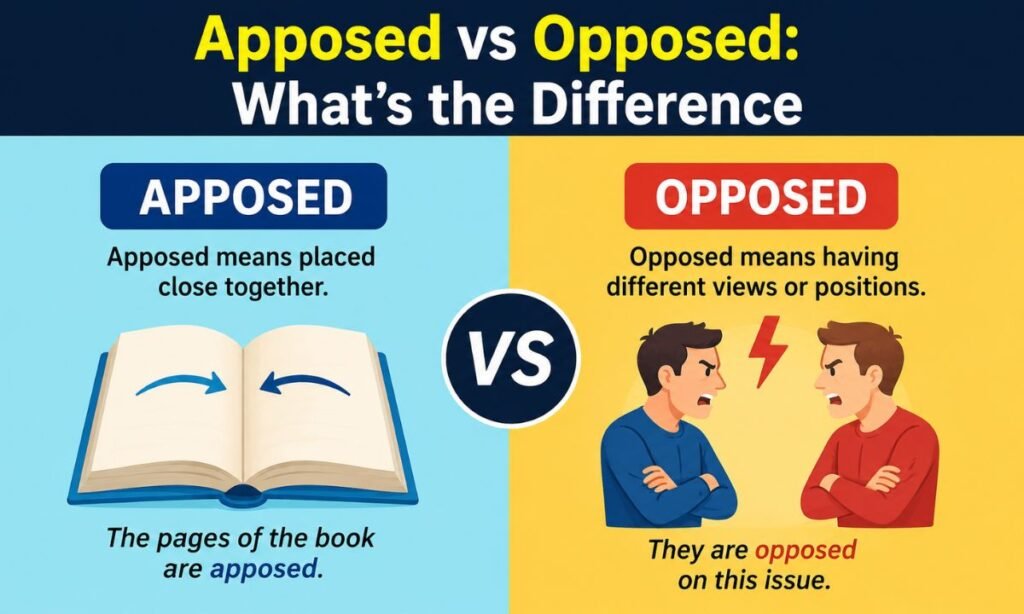
If you’ve ever paused mid-sentence wondering whether to write “apposed” or “opposed,” you’re not alone. These two words differ by just one letter, yet they mean almost opposite things. One describes things sitting quietly side by side. The other describes things clashing head-on.
Mixing them up won’t just look like a typo — it can flip the meaning of your sentence entirely. This guide breaks down both words in plain English, shows you exactly when to use each one, and gives you simple tricks so you never confuse them again.
Apposed vs Opposed: What’s the Difference?
Here’s the short answer before we go deeper:
- Apposed means placed next to, close to, or side by side. It’s a specialized term found mostly in medical, scientific, and anatomical writing.
- Opposed means against, in disagreement with, or in conflict with something. It’s one of the most common words in everyday English.
Think of it this way: apposed is about position, opposed is about opinion. Two puzzle pieces sitting edge to edge are apposed. Two people arguing over politics are opposed. Once that distinction clicks, the confusion disappears.
What Does “Apposed” Mean?
Definition of Apposed
Apposed is the past tense and past participle of the verb “appose,” meaning to place things close together or side by side, usually so they touch or align without merging into one. It describes physical positioning, not emotion or disagreement.
You’ll rarely hear this word in casual conversation. It lives almost exclusively in scientific, medical, and technical writing, where precise spatial description matters.
Origin of Apposed
Apposed comes from the Latin word appōnere, formed from ad- (“to” or “near”) and ponere (“to place”). Literally, it means “to place near.” This root explains why apposed always relates to closeness and proximity rather than resistance.
The word entered English through scientific and medical Latin, which is why it still feels formal and technical today.
Common Usage of Apposed
Apposed shows up most often in:
- Medical and surgical writing (describing tissue or wound edges)
- Biology and anatomy (describing cell membranes or structures)
- Scientific diagrams and technical documentation
- Formal academic writing
It is not a word most people use in daily speech, emails, or casual writing.
Real-world usage examples:
- Surgeons describe wound edges as apposed before stitching them closed.
- Biologists describe cell membranes as apposed when they sit directly against each other.
- Anatomists use it to describe bones or tissues positioned next to one another.
ALSO READ THIS:20 Other Ways to Say “Happy Sunday” (With Examples)
Examples of Apposed in Sentences
- The surgeon carefully apposed the wound edges before suturing.
- The two cell membranes remained apposed but not fused.
- In the diagram, the labels were apposed to each corresponding section.
- The tissue layers were apposed along the boundary line.
- Researchers observed the apposed surfaces under a microscope.
Visual Representation of Apposed
Picture two sheets of paper laid flat, edge touching edge, with nothing overlapping and nothing pushing against the other. That’s apposed — calm, aligned, and cooperative in position. There’s no tension in the image, only closeness.
What Does “Opposed” Mean?
Definition of Opposed
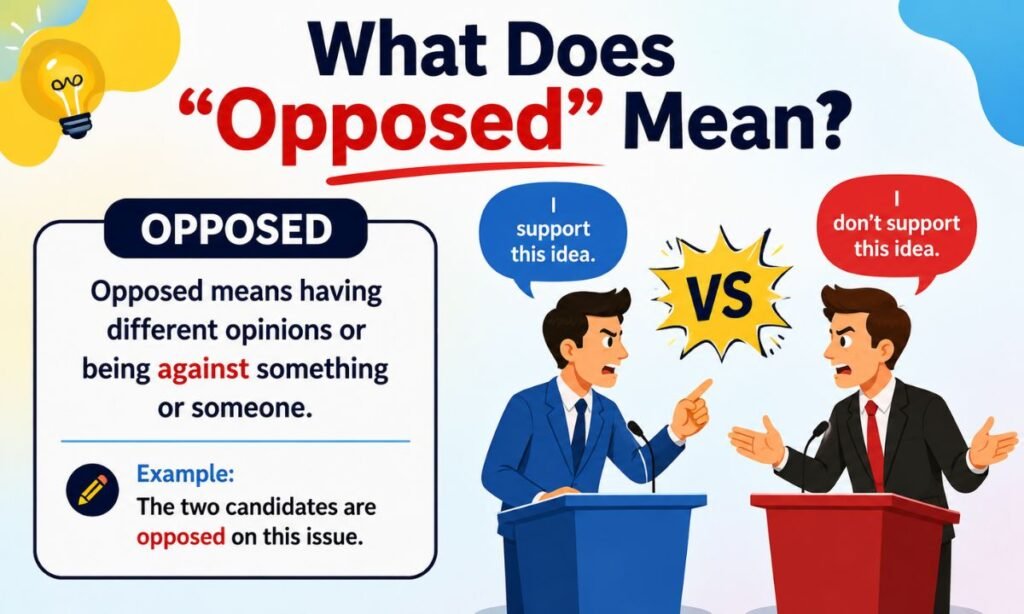
Opposed means being against something, disagreeing with it, or standing in conflict with it. It can describe people, ideas, groups, or even physical forces working against each other. Unlike apposed, opposed carries emotional or argumentative weight.
Origin of Opposed
Opposed comes from the Latin opponere, built from ob- (“against”) and ponere (“to place”). Literally, it means “to place against.” This is the same root family as “opposite” and “opposition,” which is a helpful clue when you’re trying to remember the meaning.
Common Usage of Opposed
Opposed appears constantly in everyday English, including:
- Politics and debates
- Business and workplace disagreements
- Personal opinions and casual conversation
- Legal and formal writing
Common usage examples:
- Expressing disagreement with a policy or decision
- Describing two competing teams, ideas, or forces
- Signaling resistance to a plan, law, or proposal
Examples of Opposed in Sentences
- She opposed the new company policy during the meeting.
- Many residents are opposed to the construction project.
- He strongly opposed the proposed tax reform.
- I’m not opposed to the idea, but I’d like more details first.
- The two nations remained opposed on trade terms.
Visual Representation of Opposed
Picture two people standing on opposite sides of a table, arms crossed, each pushing back against the other’s argument. That’s opposed — tension, resistance, and disagreement built into the image.
Key Differences Between Apposed and Opposed
Meaning Difference
Apposed means “placed beside” or “positioned next to.” Opposed means “against” or “in conflict with.” One is neutral and spatial; the other is confrontational and conceptual.
Usage Difference
Apposed is a niche, technical word used mainly in medical and scientific contexts. Opposed is a general-purpose word used in nearly every type of writing and speech.
Emotional Tone
Apposed carries no emotional charge — it simply describes location. Opposed almost always carries emotional or argumentative weight, signaling disagreement, resistance, or conflict.
Frequency in English
Opposed is one of the more common words in the English language. Apposed is rare and specialized, so rare that many native speakers have never used it in writing.
Side-by-Side Comparison Table
| Feature | Apposed | Opposed |
| Core meaning | Placed side by side | Against or in conflict |
| Latin root | appōnere (to place near) | opponere (to place against) |
| Common field | Medicine, biology, anatomy | Everyday language, politics, business |
| Emotional tone | Neutral | Confrontational |
| Frequency of use | Rare | Very common |
| Example sentence | “The wound edges were apposed.” | “She opposed the new law.” |
| Best used by | Doctors, scientists, researchers | Everyone |
Tips to Remember the Difference
Word Association Trick
Link “apposed” with “appositive” — a grammar term for words placed next to each other for extra description. Link “opposed” with “opposition,” a word everyone already knows means conflict.
Root Memory Trick
Remember: ap- means “near” (as in “approach”), while op- means “against” (as in “opponent”). If you can recall these two prefixes, you’ll always pick the right word.
Context Clue Strategy
Ask yourself one question before writing the word: Am I describing where something sits, or how someone feels about it? If it’s about position, use apposed. If it’s about opinion or conflict, use opposed.
Common Mistakes and Misconceptions
Mistake 1: Using Opposed Instead of Apposed
Because opposed is far more familiar, writers often default to it even in medical or technical contexts, incorrectly writing “the tissue was opposed” instead of “the tissue was apposed.”
Mistake 2: Thinking They Are Variants of the Same Word
Some assume apposed is simply a formal or old-fashioned spelling of opposed. In reality, they come from two different Latin roots with opposite meanings.
Mistake 3: Using Apposed in Everyday Writing
Apposed sounds overly technical outside scientific contexts. Using it in casual emails or general writing can confuse readers who expect the more common word “opposed.”
Case Study: Writing Error in Academic Draft
A biology student once submitted a lab report stating that two cell membranes were “opposed” during observation. The reviewer flagged the sentence immediately — the membranes were sitting next to each other, not in conflict. Replacing “opposed” with “apposed” fixed the meaning and made the report scientifically accurate.
Practical Tips for Writers
When to Use Apposed
Use apposed only when describing physical closeness or positioning, especially in:
- Medical reports and surgical notes
- Scientific research papers
- Anatomical or biological descriptions
When to Use Opposed
Use opposed whenever you’re expressing disagreement, resistance, or conflict, including in:
- Everyday conversation
- Business communication
- Debates, opinions, and formal arguments
How to Avoid Confusion
- Test the sentence with “side by side” — if it still makes sense, use apposed.
- Test the sentence with “against” — if it still makes sense, use opposed.
- When in doubt, default to opposed, since it fits nearly every non-technical context.
Examples to Solidify Understanding
Apposed in Scientific Context
“The endothelial cells remained tightly apposed under the microscope, allowing for efficient nutrient exchange.”
Opposed in Real Life Context
“The community strongly opposed the new highway project due to noise concerns.”
Mixed Comparison Example
“While the two lab samples were apposed on the slide for comparison, the two research teams were opposed on how to interpret the results.” This single sentence shows both words working correctly side by side — one describing placement, the other describing disagreement.
Bonus Section: Mini Quiz
Choose the correct word:
- The surgeon ___ the wound edges before closing the incision. (apposed / opposed)
- She was strongly ___ to the new company policy. (apposed / opposed)
- The two cell membranes were ___ but not fused. (apposed / opposed)
- Voters ___ the proposed tax increase. (apposed / opposed)
- The tissue layers remained ___ along the boundary line. (apposed / opposed)
Answers:
- Apposed
- Opposed
- Apposed
- Opposed
- Apposed
Why These Answers Work
Each correct answer matches its context: sentences describing physical placement (wound edges, cell membranes, tissue layers) require “apposed,” while sentences describing disagreement or resistance (policy, tax increase) require “opposed.” Checking whether the sentence is about position or opinion instantly reveals the right word.
Frequently Asked Questions
Is “apposed” a real word?
Yes, it’s a legitimate English word used mainly in medical and scientific writing to describe things placed side by side.
Can apposed and opposed ever mean the same thing?
No, they come from different Latin roots and describe opposite concepts — closeness versus conflict.
Which word is more common in everyday English?
Opposed is far more common and appears in conversation, writing, politics, and business regularly.
How do I know which word to use quickly?
Ask if you’re describing location (apposed) or disagreement (opposed), then pick accordingly.
Is apposed used outside of medicine?
Rarely. It occasionally appears in botany, physics, or engineering, but medicine and biology are its main homes.
Does pronunciation help tell them apart?
Slightly. Apposed is pronounced “uh-POHZD” while opposed is pronounced “uh-POHZD” too, so pronunciation alone won’t help — context is the real clue.
Conclusion
The difference between apposed and opposed comes down to one simple idea: position versus opposition. Apposed describes things resting peacefully side by side, most often in medical or scientific writing. Opposed describes disagreement, resistance, or conflict, and it’s a word you’ll use constantly in everyday life.
Next time you’re unsure which word fits, ask yourself whether you’re describing where something sits or how someone feels about it. Get that answer right, and you’ll never confuse these two words again.