

Ever stopped mid-sentence and wondered if it is gluing or glueing? You are not alone. It looks like a tiny spelling slip, but it trips up students, crafters, and writers every single day.
Here is the quick answer. Both forms exist, but gluing is the one most people use in both American English and British English. Glueing is a rare variant that you will see now and then.
The confusion starts with the silent e at the end of “glue”. Some words keep that e when you add -ing, and some drop it. Glue usually drops it, just like “argue” becomes “arguing”.
So, gluing or glueing: which one is actually right? Let’s look at the simple rules and real examples, so you never have to second-guess your spelling again.
Gluing vs Glueing — The Only Correct Spelling You Need to Know
Let’s settle this fast. When you’re writing the present participle of the verb “to glue,” the word you want is gluing. Drop the silent “e” before you add “ing,” and you’ve got it right every single time.
I know it feels weird. Your eyes want to see that “e” sitting there because “glue” has it, and dropping it seems like you’re breaking the word. But English does this all the time with words that end in a silent “e.”
Think about “make” becoming “making” or “write” becoming “writing.” Nobody spells those as “makeing” or “writeing.” Gluing follows that exact same pattern, even though the double vowel sound makes it look strange.
Major dictionaries, style guides, and grammar checkers all point the same direction. Gluing is standard in American English, and it has become the dominant spelling in British English too, even though glueing used to hold more ground there decades ago.
Why the Spelling Confusion Still Happens Today
If the rule is this clear, why do so many smart, careful writers still second guess themselves? It comes down to how our brains process patterns, and honestly, “glue” is a bit of a troublemaker among English words.
The Brain Wants Symmetry
Your brain likes things that look balanced. “Glue” has that “ue” ending, and adding “ing” right onto it (glueing) feels like it keeps the word looking whole. Dropping the “e” makes “gluing” look lopsided, almost like a typo.
This is a visual habit, not a grammar rule. Your eyes are pattern matching, not spelling checking. Once you notice that’s what’s happening, it gets a lot easier to override the instinct and write it correctly.
The Rule That Actually Applies
The actual spelling rule is simple. When a verb ends in a silent “e,” you usually drop that “e” before adding a suffix that starts with a vowel, like “ing.” “Glue” ends in a silent “e,” so it follows the rule and becomes gluing.
This isn’t a random exception. It’s the same inflection rule that governs hundreds of other English verbs. Once you see “glue” as just another word following a normal pattern, the confusion tends to fade fast.
But What About “Cueing” or “Queueing”?
Here’s where people get thrown off. “Cue” can become either “cuing” or “cueing,” and both are accepted. “Queue” almost always becomes “queueing” or “queuing,” and dictionaries list both too.
So why does “glue” not get the same flexibility? Mostly because usage data shows gluing pulled far ahead of glueing decades ago, while words like “cue” and “queue” never settled as cleanly. Language doesn’t always play fair, but that’s the honest answer.
ALSO READ “Happy Holiday or Happy Holidays: Which Is Correct? 2026“
Gluing vs Glueing in American and British English\
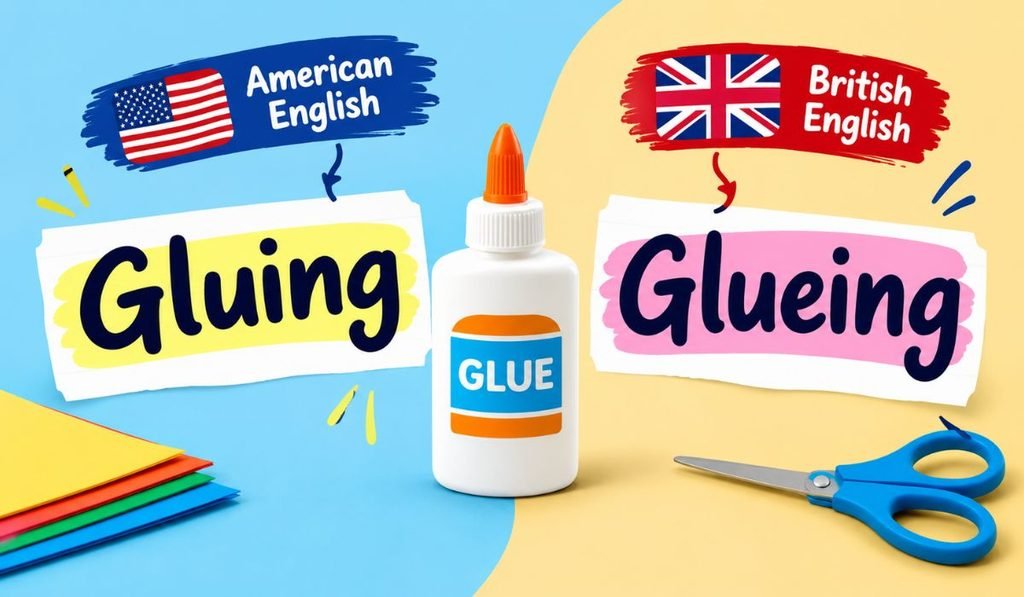
You might be wondering if this is one of those American versus British spelling splits, like “color” and “colour.” It’s close, but not quite the same story.
Regional Usage Table
| Region | Preferred Spelling | Notes |
|---|---|---|
| American English | Gluing | Strongly preferred, has been for over a century |
| British English | Gluing | Now the majority spelling in modern writing |
| Older British texts | Glueing | Common before the mid-1900s, rare today |
| Academic and business writing (both regions) | Gluing | Treated as the only “safe” choice |
| Casual or informal writing | Either can appear | Gluing still recommended |
What Dictionaries Say
Merriam-Webster lists gluing as the main entry, with glueing noted as a secondary, less common variant. Oxford dictionaries follow a similar path, showing gluing as standard while acknowledging glueing still exists in some British usage.
Grammar checking tools like Grammarly and Microsoft Word will flag glueing as a likely error in most cases. That’s a strong signal on its own. If your spell checker keeps underlining it, that’s not a glitch, that’s the tool doing its job correctly.
Where the Rule Comes From: A Short Etymology of “Gluing”
Understanding where a word comes from usually makes the spelling stick better in your memory. So let’s take a quick trip back in time with “glue.”
Old French Roots
“Glue” traces back to the Old French word “glu,” which itself came from Late Latin “glus” or “gluten,” meaning a sticky substance. English borrowed the word centuries ago and kept much of its shape, including that silent “e” at the end.
That Latin root, gluten, might look familiar since it’s the same word we use today for the sticky protein in wheat. Both words share the same idea of something that binds or sticks things together.
E-Dropping During Inflection
Once “glue” settled into English as a verb, it followed the same inflectional pattern as other “e” ending verbs. Writers dropped the silent “e” when adding “ing,” matching words like “true” becoming “truing” or “due” following similar logic.
This wasn’t a special rule made just for “glue.” It’s part of a much bigger, consistent system in English spelling that keeps double vowels from stacking up awkwardly in the middle of words.
Why Some Old Texts Use “Glueing”
Older printed books, especially from the 1800s and early 1900s, show glueing appearing fairly often. Spelling wasn’t standardized as tightly back then, and many writers simply kept the “e” because it visually matched the root word “glue.”
Over time, especially after dictionaries and style guides became more influential, gluing pulled ahead and became the accepted norm. The older spelling never fully vanished, but it became the exception instead of the rule.
What “Gluing” Actually Means in Real-Life Language
Now that the spelling question is settled, let’s talk about what this word is actually doing for you in a sentence.
General Definition
Gluing means the act of sticking two or more things together using an adhesive substance. It’s the present participle form, so you use it when you’re describing an ongoing or continuous action.
For example, “She is gluing the poster to the wall” tells you the action is happening right now, in progress, not finished yet.
Technical Meaning in Specific Fields
In woodworking and construction, gluing refers to a specific bonding process using wood glue, epoxy, or adhesive resin to join materials permanently. In bookbinding, it describes attaching pages to a spine using specialized binding glue.
In manufacturing and industrial settings, gluing can even refer to automated adhesive application on a production line, where machines apply glue with precise pressure and timing instead of human hands.
Expanded Uses in Everyday Language
Gluing isn’t just about physical objects anymore. People use it figuratively too, like “gluing a team together” or “gluing your eyes to the screen,” meaning attention or focus that’s fixed and hard to break away from.
This figurative use shows up a lot in casual conversation, social media captions, and even marketing copy, which is part of why getting the spelling right matters so much for anyone writing content online.
Where You’ll See “Gluing” in Real Life
You’ll bump into this word way more often than you’d think once you start paying attention. Let’s look at a few everyday spots.
Home Repairs
Broken mug handle? Loose chair leg? Gluing is usually step one before step two, which is waiting an uncomfortably long time for it to dry. Home repair guides use this word constantly, from furniture fixes to fixing a cracked phone case.
School Projects
Ask any parent about glitter and glue sticks and you’ll get a story. Gluing shows up in almost every art class instruction sheet, science fair project guide, and craft tutorial aimed at kids.
Professional Workshops
Carpenters, upholsterers, and model builders talk about gluing techniques constantly, from clamp pressure to drying time to choosing the right adhesive strength for the material. It’s a core skill word in these trades.
Digital Usage
Search engines see thousands of monthly searches for terms like “gluing wood,” “best glue for gluing plastic,” or “how long does gluing take to dry.” If you’re writing SEO content, that search volume alone tells you the correct spelling matters for ranking.
Examples of Correct Usage of “Gluing”
Seeing the word in action helps it stick in your memory, no pun intended. Here are examples across different contexts.
Physical Usage
- “He spent the whole afternoon gluing the model airplane wings back together.”
- “Be careful when gluing glass, since some adhesives don’t bond well with smooth surfaces.”
Industrial Usage
- “The factory upgraded its gluing equipment to handle faster production speeds.”
- “Gluing processes in furniture manufacturing require precise clamp time to avoid weak joints.”
Figurative Usage
- “That song has been gluing itself to my brain all week.”
- “Their shared love of hiking ended up gluing the whole friend group together.”
Past Tense and Other Forms
The past tense is simply “glued,” not “glueed” or “gluied.” So you’d say “I glued the frame yesterday,” never anything close to those other spellings. The noun form stays “glue,” and the adjective form is usually just “glued,” as in “a glued seam.”
Why “Glueing” Is Not Standard — And Why Using It Hurts Your Writing
You might be thinking, “It’s just one letter, does it really matter that much?” Honestly, yes, especially in certain settings.
Academic and Professional Issues
Teachers, professors, and editors are trained to catch spelling inconsistencies. Using glueing in an academic paper or professional report can come across as careless, even if the rest of your writing is solid. First impressions matter, and spelling is often the first thing people judge.
Business Writing Problems
In business emails, proposals, or product descriptions, small spelling slips chip away at your credibility. A client reading “glueing instructions” instead of “gluing instructions” might not consciously notice, but it can subtly signal a lack of polish.
Software and Grammar Tools Flag It
Most modern grammar checkers, including built in tools in Word and Google Docs, will underline glueing as a likely mistake. If you’re writing content that needs to pass editorial review or an AI detection pass, that flag can slow down your workflow and raise unnecessary questions.
Memory Tricks to Always Spell “Gluing” Correctly
Rules are great, but memory tricks are what actually save you at 11 PM when you’re rushing to finish a draft. Here are a few that work.
The “Drop the E” Rule
Picture yourself literally peeling the “e” off the end of “glue” before you slap “ing” on it. This tiny mental image, glue minus e plus ing, is one of the fastest ways to lock the spelling in.
The “U Does the Work” Trick
Remember that the “u” in “glue” already carries the long “oo” sound. You don’t need the “e” to hang around anymore once “ing” shows up, because the “u” is doing all the heavy lifting on pronunciation.
The Visual Shortcut
Try writing both versions side by side. Gluing looks cleaner, shorter, and more balanced once you get used to it. Glueing starts to look cluttered by comparison, almost like it’s carrying extra baggage it doesn’t need.
The Finger Test
Type the word “glue” on your keyboard, then physically remove your finger from the “e” key before typing “ing.” It sounds silly, but muscle memory built through repetition is one of the most reliable ways to fix a spelling habit long term.
Phrase Association
Build a quick phrase like “gluing is winning” in your head. Both words end the same way, and rhyme based tricks like this tend to stick (pun very much intended) far longer than dry grammar rules alone.
Common Misspellings Related to Gluing
Gluing isn’t the only word in this family that trips people up. A few related spelling stumbles show up constantly too.
Words People Often Get Wrong
- Glueing (should be gluing)
- Glued’s (unnecessary apostrophe, should just be “glued”)
- Gluin (missing the second “g”)
- Gluied (incorrect past tense, should be “glued”)
- Glewing (an older, now obsolete spelling almost never used today)
Why These Mistakes Occur
Most of these errors trace back to the same root issue, people trying to keep the base word “glue” fully intact instead of applying the standard e-dropping rule. Once that rule clicks, most of these related mistakes tend to disappear on their own.
Quick Reference Table: Gluing vs Glueing
| Form | Correct Spelling | Notes |
|---|---|---|
| Base verb | Glue | Unchanged |
| Present participle | Gluing | Standard in American and modern British English |
| Alternate participle | Glueing | Rare, older British variant, not recommended |
| Past tense | Glued | Same in both spelling styles |
| Noun form | Glue | Refers to the adhesive itself |
| Adjective form | Glued | As in “a glued joint” |
Frequently Asked Questions
Is glueing ever correct? Yes, in older or informal British writing it occasionally appears, but gluing is the standard, recommended spelling today.
Why does gluing look like it’s missing a letter? Because English drops the silent “e” before adding “ing” to most verbs ending in “e,” and “glue” follows that same rule.
Do American and British English disagree on this word? Not much anymore. Gluing has become the majority spelling in both regions, unlike words such as “colour” versus “color.”
What’s the past tense of glue? The past tense is “glued.” It never changes, no matter which participle spelling you use.
Will Grammarly flag glueing as wrong? Most grammar tools will flag it or suggest gluing instead, since it’s the more widely accepted spelling.
Can I use glueing in creative or casual writing? You can, but it may read as old fashioned or slightly off to modern readers, so gluing is still the safer choice.
Is there a British-only rule that says glueing is correct? No official British style guide currently requires glueing over gluing. Modern usage data favors gluing across the board.
Does spell check always catch glueing? Usually, yes, but it’s still worth double checking manually since some tools miss less common variants depending on settings.
Final Takeaways
At the end of the day, gluing is the spelling you want in your back pocket. It follows a normal English rule, it’s backed by every major dictionary, and it’s what your readers, teachers, and clients expect to see.
Glueing isn’t a total myth, it shows up in some older British texts, but it’s the exception, not the standard. Next time your fingers hesitate over the keyboard, remember the trick: drop the “e,” trust the “u,” and keep on gluing with confidence.
Got a spelling pet peeve of your own that drives you a little crazy? I’d love to hear about it, drop a comment or send it my way.
2 thoughts on “Gluing or Glueing: Which One Is Actually Right?”