
If you’ve ever paused mid-sentence wondering whether to write “is used,” “has been used,” or “was used,” you’re not alone. These three forms look similar but carry different meanings about time, relevance, and context. Get them mixed up, and your writing can send the wrong signal — even if the grammar looks “close enough.”
This guide breaks down each form in plain English, shows you exactly when to use it, and gives you quick tests you can apply while writing. No fluff — just the rules, examples, and tricks that make this topic click for good.
Is Used vs Has Been Used vs Was Used: Core Meaning Explained Clearly
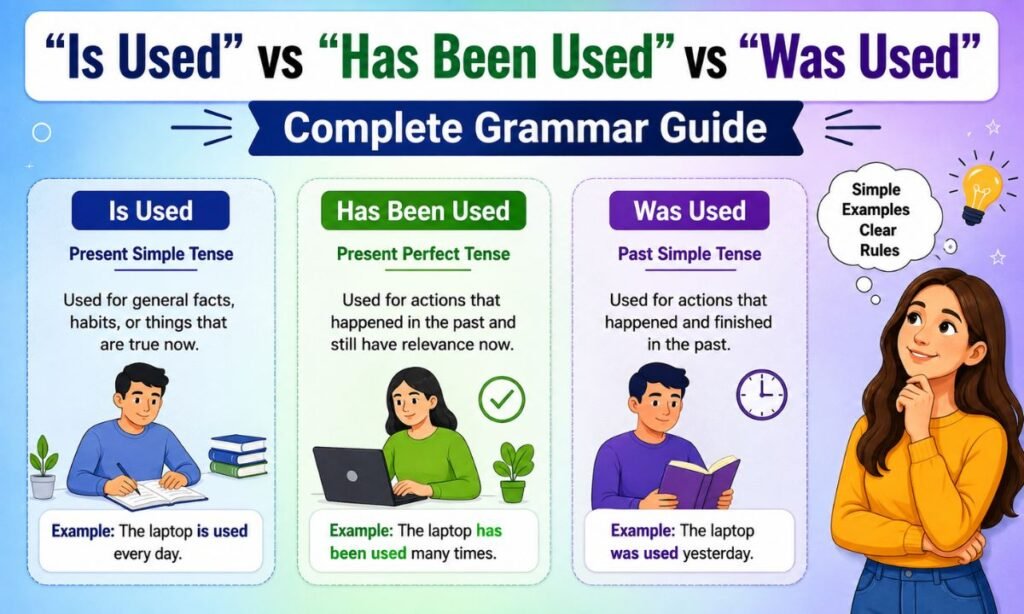
At the core, these three phrases differ by tense and time connection:
- Is used — present tense. Describes something happening now, generally, or habitually.
- Has been used — present perfect tense. Links a past action to the present moment; it started before now and still matters.
- Was used — past tense. Describes something that happened and finished in the past, with no direct link to now.
The confusion usually isn’t about grammar rules — it’s about time logic. Once you train yourself to ask “does this still apply now, or is it fully in the past?”, the right choice becomes obvious.
“Is Used” Meaning in Real English
What it really means in practice:
“Is used” is the passive form of the present simple tense. It describes:
- A general fact or habit
- Something that is true right now, on an ongoing basis
- A standard practice, function, or purpose
Real examples:
- This machine is used to cut metal sheets.
- English is used as the official language in many countries.
- This app is used by millions of people daily.
Where you’ll see it most:
- Instruction manuals and product descriptions
- Scientific and technical writing
- General statements of fact
“Has Been Used” Meaning in Real English
What it really means:
“Has been used” is present perfect passive. It connects a past action to the present — the action started earlier and its effect, relevance, or use continues now (or has just been completed with present significance).
Real examples:
- This method has been used for decades in classrooms.
- The tool has been used successfully in three different projects.
- This password has been used before; please choose a new one.
Where it shows up:
- Reports and case studies
- Academic and research writing
- Reviews and testimonials describing lasting impact
“Was Used” Meaning in Real English
What it really means:
“Was used” is simple past passive. It describes an action that happened at a specific, finished point in time — with no direct claim about the present.
Real examples:
- This room was used as a storage space last year.
- The old bridge was used by farmers before the highway opened.
- That software was used in the 2020 version of the app.
Where you’ll see it:
- Historical accounts and narratives
- News stories about completed events
- Descriptions of outdated or replaced items
ALSO READ “20 Other Ways to Say “Nice to E-Meet You”
Is Used vs Has Been Used vs Was Used: Side-by-Side Clarity Table
| Form | Tense | Time Focus | Present Relevance? | Example |
|---|---|---|---|---|
| Is used | Present simple passive | Now, always, habitually | Yes — ongoing | This tool is used daily. |
| Has been used | Present perfect passive | Past → connects to now | Yes — still relevant | This tool has been used since 2010. |
| Was used | Past simple passive | Finished, specific past time | No — action is over | This tool was used last year. |
The Timeline Trick That Makes Everything Click
Here’s the fastest way to choose the right form: draw a mental timeline.
- Right now, always, or habitually? → Use “is used.”
- Started in the past and still matters, or just happened with a present result? → Use “has been used.”
- Happened and ended at a specific past point, disconnected from now? → Use “was used.”
Think of it as a straight line with “now” marked at the right end.
- “Is used” sits directly on the “now” point.
- “Has been used” is a line stretching from the past up to now.
- “Was used” is a dot somewhere in the past, cut off from now.
This visual habit removes the guesswork almost instantly.
Active vs Passive Voice: Why These Forms Exist
All three phrases are passive voice structures. In passive voice, the subject receives the action instead of performing it.
- Active: Someone uses this tool. → Passive: This tool is used.
- Active: Someone has used this method. → Passive: This method has been used.
- Active: Someone used this room. → Passive: This room was used.
Why passive exists in real life:
- The doer is unknown, unimportant, or obvious from context.
- The focus needs to stay on the object or result, not the performer.
- It sounds more formal and objective — common in technical, academic, and news writing.
Real-World Usage: Where You Actually Hear These Forms
In technology and software
- This feature is used to sync data across devices.
- This API has been used in production since last quarter.
- The old server was used until the migration was complete.
In education
- This textbook is used in most high schools.
- This teaching method has been used for over 20 years.
- The old syllabus was used before the curriculum update.
In healthcare
- This medication is used to treat high blood pressure.
- This treatment has been used in thousands of patients.
- That drug was used before safer alternatives were developed.
In news reporting
- This term is used to describe the new policy.
- Emergency funds have been used to support flood victims.
- The stadium was used as a shelter during the storm.
Questions and Negatives: How These Forms Change Shape
Questions
| Form | Question Structure | Example |
|---|---|---|
| Is used | Is + subject + used? | Is this tool used often? |
| Has been used | Has + subject + been used? | Has this method been used before? |
| Was used | Was + subject + used? | Was this room used yesterday? |
Negatives
| Form | Negative Structure | Example |
|---|---|---|
| Is used | is not (isn’t) used | This app isn’t used anymore. |
| Has been used | has not (hasn’t) been used | This code hasn’t been used yet. |
| Was used | was not (wasn’t) used | This device wasn’t used last week. |
Time Markers: The Secret Signal Words You Must Watch
Time markers are the fastest clue to picking the correct form. Train your eye to spot these words.
“Is used” markers:
- always, usually, often, generally, every day, currently
“Has been used” markers:
- since, for (a period), already, recently, so far, up to now, yet
“Was used” markers:
- yesterday, last year, in 2020, ago, at that time, back then
Common Mistakes (And Why They Happen)
Mistake: Mixing past time with present perfect
❌ This tool has been used yesterday. ✅ This tool was used yesterday.
Present perfect cannot pair with a finished, specific past time marker like “yesterday.”
Mistake: Using past simple for ongoing relevance
❌ This method was used for years and still works today. ✅ This method has been used for years and still works today.
If the action’s effect continues into the present, present perfect is correct.
Mistake: Subject agreement errors
❌ The tools is used daily. ✅ The tools are used daily.
Match the auxiliary verb to a singular or plural subject.
Mistake: Confusing “used to” with “was used”
❌ This room used to be used as an office and it’s confusing. ✅ This room was used as an office.
“Used to” describes a past habit; “was used” describes a passive action. Don’t stack them unnecessarily.
Case Study: A Classroom Mistake That Changed Meaning
A student once wrote a report stating: “This software has been used in 2019.” A teacher marked it wrong — and rightly so. Because “2019” is a specific, closed past date, the correct form is “was used in 2019.” Changing just one word (“has been” to “was”) shifted the sentence from grammatically confused to perfectly clear. This single correction taught the whole class the golden rule: specific past dates need simple past, not present perfect.
American vs British English Usage
Both American and British English follow the same core rules for these three forms. However, a few subtle differences appear:
- British English tends to favor present perfect (“has been used”) more often in everyday speech, even when American English might use simple past.
- American English speakers commonly say, “Did you use this yet?” while British speakers often say, “Have you used this yet?”
- Both dialects agree that specific past time markers (yesterday, last week) require simple past — this rule doesn’t change across regions.
Pronunciation and Natural Speech Flow
In natural spoken English, these forms often contract or blend:
- “Is used” often sounds like “‘s used” in fast speech.
- “Has been used” frequently contracts to “‘s been used.”
- “Was used” keeps its full form but the “s” in “was” is pronounced softly, almost like a “z” sound.
Practicing these forms out loud helps you internalize the rhythm, which naturally improves your writing accuracy too.
Verbs Commonly Used in Passive Structures
These three forms aren’t limited to the verb “use.” The same tense logic applies across many common verbs:
- is made / has been made / was made
- is built / has been built / was built
- is written / has been written / was written
- is designed / has been designed / was designed
- is tested / has been tested / was tested
Once you master the logic with “use,” you can apply the exact same pattern to any passive verb structure.
Practical Tips That Actually Work
Think about time first
Before choosing a form, ask: is this happening now, connected to now, or fully finished in the past? Time logic always comes before grammar rules.
Look for time markers first
Words like “yesterday,” “since,” or “always” often give away the correct tense before you even think about the rule.
Prefer active voice when possible
Passive voice is useful, but overusing it can make writing feel stiff. Use active voice when the doer matters.
Read it aloud
If a sentence sounds awkward when spoken, it’s often a sign the tense doesn’t match the timeline.
Mini Quiz: Test Your Understanding
Choose the correct form for each sentence:
- This app _______ (is used / was used) by over a million people today.
- The old factory _______ (was used / has been used) as a warehouse in 1995.
- This method _______ (has been used / was used) successfully for the past five years.
- That car _______ (is used / was used) in the movie last month.
- This tool _______ (has been used / is used) daily by our team.
Answers: 1. is used, 2. was used, 3. has been used, 4. was used, 5. is used
FAQs
1. What is the main difference between “is used,” “has been used,” and “was used”?
“Is used” describes the present, “has been used” links past action to the present, and “was used” describes a finished past action.
2. When should I use “is used” in a sentence?
Use it for facts, habits, or actions happening right now or generally, such as daily routines or standard functions.
3. What does “has been used” really show in English?
It shows an action that started in the past and still has relevance, effect, or connection to the present moment.
4. When is “was used” the correct choice?
Use it when describing something that happened and ended at a specific past time, with no link to now.
5. Can I say “has been used yesterday”?
No. “Yesterday” is a specific finished time, so the correct form is “was used yesterday.”
6. Is “is used” more formal than “used to”?
They serve different purposes. “Is used” describes present passive action, while “used to” describes a past habit that no longer happens.
7. Why do people prefer “has been used” in academic writing?
It connects past research or methods to present relevance, which fits the ongoing nature of academic discussion.
8. What are the most common mistakes with these forms?
Mixing specific past markers with present perfect and using past simple when present relevance is intended are the top errors.
9. Do native speakers use these forms in everyday conversation?
Yes, native speakers switch between them naturally based on context, though contractions are common in casual speech.
10. How can I quickly choose the correct form while writing?
Check the time marker in the sentence first — it usually tells you instantly which tense fits.
Conclusion
“Is used,” “has been used,” and “was used” all describe the same basic action — being used — but at different points on the timeline. “Is used” lives in the present, “has been used” bridges the past and present, and “was used” stays firmly in a finished past. Once you train yourself to spot time markers and ask whether an action still matters now, choosing the right form becomes automatic. Keep this guide handy, run through the quiz whenever you’re unsure, and your writing will stay accurate, clear, and professional every time.