
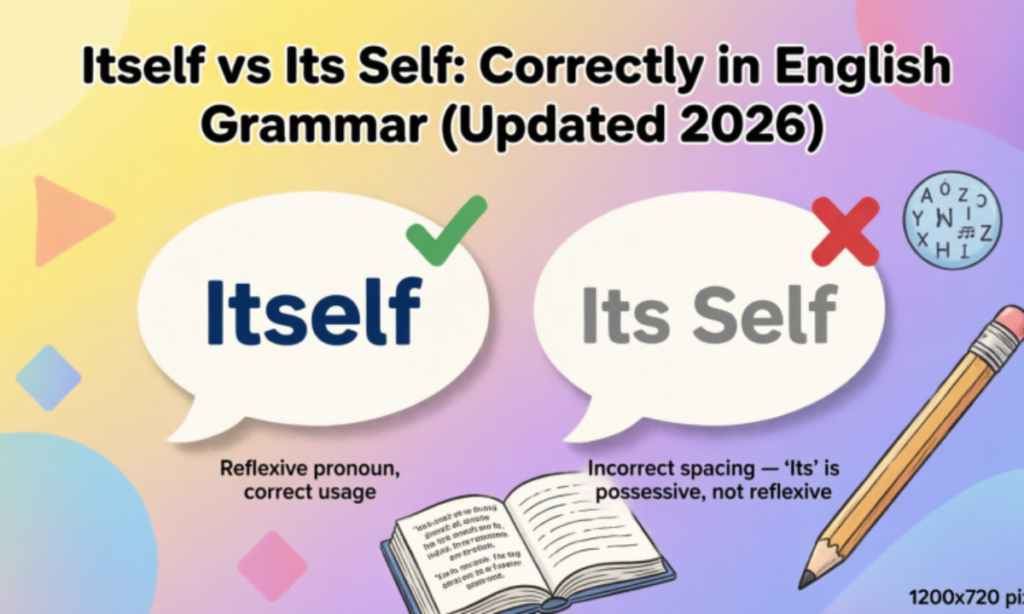
Understanding Itself vs Its Self can be confusing because both forms look and sound similar. However, they have different uses in English grammar and should not be used interchangeably.
Itself is usually a reflexive pronoun used when something refers back to a thing or object. Learning the correct usage helps you write clearer and more natural sentences.
In this guide, you will learn the main differences through simple rules and examples. By understanding Itself vs Its Self, you can avoid common grammar mistakes and use both forms correctly.
Its Self vs Itself: The Quick Answer You Need First
Let’s not bury the answer. Itself is the correct reflexive pronoun in modern English. You use it any time something acts on its own body, identity, or existence, like “the cat cleaned itself” or “the software updated itself.”
Its self is two separate words, and it’s grammatically rare. It only pops up when self is being used as an actual noun, usually in philosophy, psychology, or literary writing, to talk about identity or consciousness.
Here’s the simplest way to remember it:
● Talking about an action? Use itself.
● Talking about identity or “the self” as a concept? You might see its self.
● Writing an email, a blog post, a report, or basically anything normal? Use itself, every time.
That covers 99% of what you’ll ever need. The rest of this guide walks through the why, so the rule actually sticks.
Why the Difference Between Itself and Its Self Matters
Small grammar slips add up. One “its self” in a report or a college essay won’t ruin your life, but it does make writing feel a little less polished, kind of like showing up to a nice dinner with a stain on your shirt. Nobody says anything, but they notice.
Getting this right also matters for clarity. “Its self” and “itself” don’t always mean the same thing, so mixing them up can quietly change your sentence’s meaning without you realizing it.
There’s also the confidence factor. Once you know this rule cold, you stop second-guessing yourself every time you type a sentence with “it” in it. That’s one less thing to worry about when you’re trying to write fast and sound sharp.
And honestly, this is one of those grammar rules that people quietly judge you on. Teachers, editors, hiring managers reading your cover letter. Getting it right just makes your writing feel more trustworthy.
ALSO READ THIS:20 Other Ways to Say “Get Well Soon” (With Examples)
Understanding Reflexive Pronouns in English
What Are Reflexive Pronouns?
A reflexive pronoun is a word that sends the action of a sentence back to the subject. In plain terms, the subject and the object are the same thing.
Think of “myself,” “yourself,” “himself,” “herself,” “itself,” “ourselves,” “themselves.” Every single one of these ends in “-self” or “-selves,” and every one does the same job: showing that whoever (or whatever) is doing the action is also receiving it.
“She taught herself Spanish.” She is the teacher and the student. “The dog scratched itself.” The dog scratched, and the dog got scratched. That’s the whole idea behind reflexive pronouns.
Simple Rule
Here’s a shortcut that works almost every time. If the subject and the object of the sentence are the exact same person or thing, you need a reflexive pronoun.
If you can ask “who else could this be talking about?” and the answer is “nobody, it’s the same one,” that’s your cue. Itself fits when “it” is both doing something and having it done to it.
Example Diagram
| Sentence | Subject | Action | Object | Same Thing? |
| The machine repaired itself. | The machine | repaired | itself | Yes → reflexive |
| The machine repaired its parts. | The machine | repaired | its parts | No → possessive |
| The team praised itself. | The team | praised | itself | Yes → reflexive |
| The team praised its coach. | The team | praised | its coach | No → possessive |
Once you see it laid out like this, the pattern practically explains itself.
What “Itself” Really Means in English Grammar
Core Function
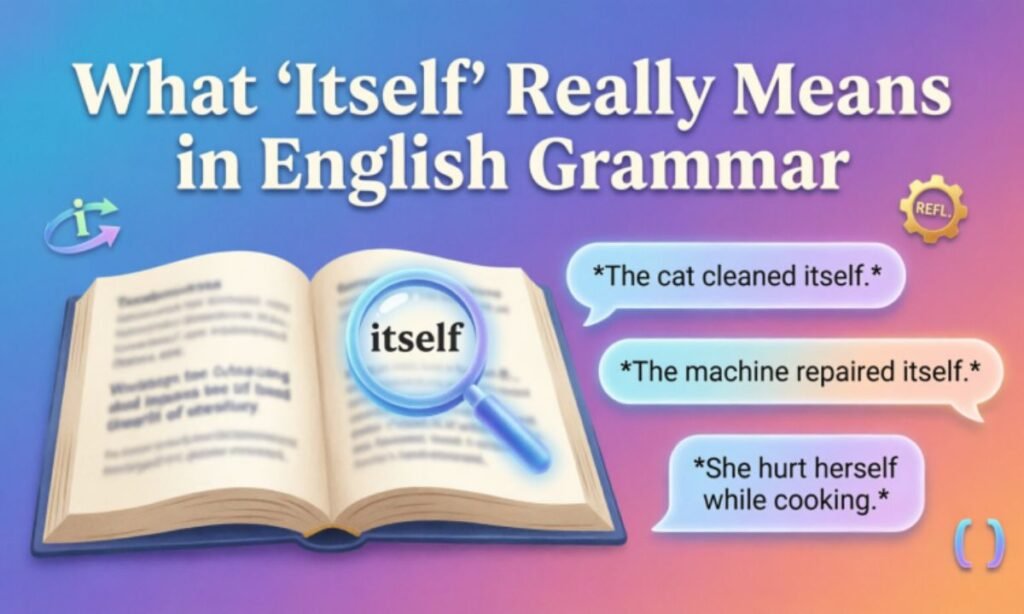
Itself is built from “it” plus “self,” and grammar rules say it always gets written as one solid word, no space, no apostrophe. It’s classified as a reflexive pronoun, and it’s used whenever something nonhuman, an object, animal, company, idea, or system, acts on itself or is being emphasized.
There’s no wiggle room on the spelling here. “It’s self” (with an apostrophe) is always wrong, because that would turn “it’s” into a contraction of “it is,” which makes the sentence nonsense. “Its self” (two words, no apostrophe) is technically real in narrow contexts, but for standard writing, itself is the only option.
Everyday Examples
You run into itself constantly without noticing:
● The oven turns itself off after two hours.
● The company prides itself on fast shipping.
● Nature has a way of healing itself.
● The router restarts itself when the connection drops.
● The idea justifies itself once you see the results.
Notice how natural these sound. That’s because itself is doing exactly what it’s built for: pointing the action back to where it started.
Emphatic Use of Itself (Not Just Reflexive)
Here’s something a lot of grammar explainers skip. Itself doesn’t only show reflexive action. Sometimes it’s used purely for emphasis, to underline a noun that already appeared in the sentence.
In this emphatic role, itself isn’t doing anything grammatically necessary. You could remove it and the sentence would still work. It’s there to add weight, like tapping the table when you make a point.
Example:
“The design itself was flawless, even if the marketing wasn’t.” Here, “itself” isn’t reflecting an action back onto “the design.” It’s stressing that we’re talking specifically about the design, as opposed to everything around it.
Another one: “The problem itself is simple; it’s the timing that’s hard.” Same idea. Itself is spotlighting “the problem” and setting it apart from other factors.
This emphatic use is common in business writing and persuasive essays, because it lets you draw a sharp line between one idea and everything surrounding it.
When “Its Self” Appears in English
Philosophical Usage
In philosophy and psychology, writers sometimes treat “self” as a standalone noun, meaning identity, consciousness, or the essence of a being. In that context, “its self” can be grammatically valid, because “self” is functioning as a thing being described, not a reflexive marker.
You’ll see this in academic texts discussing consciousness: “The organism becomes aware of its self.” Here, “its self” means the organism’s own sense of identity, not an action bouncing back onto the organism.
Writers like William James and Carl Jung explored ideas of “the self” this way, treating it almost like a noun you could examine, question, or develop. That’s a very different job than the reflexive pronoun itself.
Literary or Poetic Use
Poetry and older literature sometimes split “its self” on purpose, for rhythm, emphasis, or a slightly formal, antique feel. It’s a stylistic choice more than a grammar rule.
You might see something like: “The forest, in its self, held no fear of the storm.” That reads as intentionally poetic rather than a typo. It’s rare, and it’s a deliberate move by the writer, not something you’d use in a birthday card or a work email.
Outside of these two lanes, philosophy and creative writing, “its self” basically doesn’t belong anywhere in modern English.
Its vs It’s vs Itself: The Most Common Confusion
This is where most people actually trip up, and it’s worth slowing down for.
● Its = possessive. Shows ownership. “The dog wagged its tail.”
● It’s = contraction of “it is” or “it has.” “It’s raining.” “It’s been a long day.”
● Itself = reflexive or emphatic pronoun. “The dog wagged itself out of the leash.”
Key Fact
Its never gets an apostrophe when it’s showing possession. This trips up so many writers because almost every other possessive in English uses an apostrophe (Sarah’s car, the dog’s bone). “Its” is the exception, and it’s exactly why “it’s” and “its” get swapped so often.
Here’s a quick trick: if you can replace the word with “it is” and the sentence still makes sense, use “it’s.” If not, you need “its.” And if the sentence needs a reflexive action, skip both and reach for “itself.”
How to Test If You Should Use Itself or Its Self
Step 1: Ask “Is it acting on itself?”
Read your sentence and check whether the subject is doing something to itself. If yes, you need the reflexive pronoun itself, one word, no exceptions.
“The system corrected _____ automatically.” The system is correcting the system. That’s reflexive. Itself is your answer.
Step 2: Is “self” a noun meaning identity or consciousness?
If you’re not describing an action but instead talking about identity, being, or consciousness as a concept, “self” might be functioning as a noun. That’s your signal that “its self” could apply.
Ask yourself: could I replace “self” with a word like “identity” or “essence” and keep the meaning? If yes, you’re in the rare its self territory.
Example
“The AI questioned its self-awareness.” Here “self” is part of a compound noun (“self-awareness”), describing identity, not an action. Compare that to: “The AI corrected itself after the error.” That’s a plain reflexive action. Same word “it,” two completely different jobs.
Case Study: Modern Writing vs Philosophical Writing
Modern English (99.9% usage)
In blog posts, business writing, news articles, texting, emails, basically anything you’ll write day to day, itself is the form you want. Corpus studies of English usage consistently show itself dominating by an overwhelming margin, appearing millions of times more often than its self across major English databases.
Style guides from Merriam-Webster to the Chicago Manual of Style treat itself as the only standard reflexive form. If you’re writing for a general audience, this isn’t even a close call.
Philosophical or Academic Writing
In contrast, academic papers exploring identity, consciousness, or metaphysics occasionally need “its self” precisely because they’re discussing “the self” as a subject of study, not describing an action. This is a narrow, specialized use case.
Even inside academic writing, “its self” is far less common than “itself.” It only shows up when the sentence is specifically about identity as a concept.
Observation
The pattern here is consistent: context decides the word. Action-based sentences almost always want itself. Identity-based, abstract sentences occasionally want its self. When in doubt, default to itself, since it’s correct in nearly every situation you’ll actually encounter.
Common Mistakes with Itself and Its Self
Mistake: Using “It’s Self”
This one’s an easy trap because “it’s” looks so normal with an apostrophe everywhere else in English. But “it’s self” breaks down the moment you expand the contraction: “it is self” makes no sense. Drop the apostrophe entirely here.
Mistake: Using “Its Self” in Normal Writing
Writing “the machine turned its self off” in a work email or website copy reads as a mistake, not a stylistic choice, because there’s no philosophical or identity discussion happening. It’s simply describing an action, so it needs itself.
Mistake: Overusing Reflexive Pronouns
Some writers sprinkle “itself” into sentences where it isn’t needed at all. “The report itself itself proves the point” is redundant. Use itself once, and only when the sentence actually calls for reflection or emphasis.
Mistake: Confusing Emphasis and Reflexive Use
Because itself can serve two different jobs (reflexive and emphatic), writers sometimes misplace it or add it where neither function applies. If removing “itself” doesn’t change the meaning and there’s no action bouncing back to the subject, double check that it belongs there at all.
Real-Life Uses of Itself
Business Writing
Companies use itself constantly in marketing and reporting: “The brand prides itself on quality.” “The product sells itself.” This kind of language shows up in press releases, LinkedIn posts, and internal memos every single day.
Technology
Tech writing leans on itself heavily too, since software and devices are always “updating themselves,” “restarting itself,” or “correcting itself.” If you write documentation, product descriptions, or release notes, you’ll use this word constantly.
Everyday Conversation
In casual speech, itself keeps things natural: “The weather can’t decide itself,” “The cat put itself to bed.” It’s such a normal part of spoken English that most native speakers use it correctly without ever thinking about the grammar behind it.
Academic Writing
Outside of philosophy specifically, academic writing across science, history, and social studies uses itself the standard way: “The experiment repeated itself under controlled conditions.” Academic writing only reaches for “its self” in the narrow identity-focused contexts covered earlier.
Language Fact: Where “Itself” Comes From
Reflexive pronouns in English trace back to Old English, where “self” originally functioned as an intensifying word attached loosely to pronouns. Over centuries, English speakers fused these combinations into single words, giving us myself, yourself, himself, herself, and itself as we know them today.
Interestingly, “itself” wasn’t always standard. Older English sometimes used “it self” as two words, closer to how “its self” occasionally survives now in niche writing. Modern English simplified and standardized the reflexive forms, which is exactly why itself is now the dominant, expected spelling.
Common Misconceptions About Its Self
Myth: “Its self” is just old English
Not quite. While older texts did split “it self” more often, modern “its self” isn’t a leftover spelling. It’s a distinct grammatical structure used specifically when “self” functions as a noun about identity, not a general old-fashioned version of itself.
Myth: Both forms are interchangeable
They’re not, and treating them as interchangeable is exactly what causes writing to look sloppy. Itself and its self serve different grammatical purposes, and swapping one for the other usually changes or breaks the sentence’s meaning.
Myth: “Its self” is correct if it looks formal
Formality doesn’t decide correctness here. A sentence like “the company improved its self” isn’t more sophisticated for splitting the word, it’s simply incorrect, because there’s no identity or consciousness being discussed, just an action.
Quick Grammar Reference Table
| Form | Type | When to Use | Example |
| Itself | Reflexive pronoun | Subject acts on itself | The car started itself. |
| Itself | Emphatic pronoun | Adds emphasis to a noun | The idea itself was risky. |
| Its self | Noun phrase | Discussing identity/consciousness | The mind studies its self. |
| Its | Possessive pronoun | Shows ownership | The bird lost its feather. |
| It’s | Contraction | “It is” or “it has” | It’s getting late. |
Practical Writing Tips for Perfect Usage
Tip 1: Replace the word mentally
Swap the word out with “it is” in your head. If that makes sense, you need “it’s.” If it doesn’t, you’re dealing with either “its” or “itself,” and you can move to the next check.
Tip 2: Read sentences aloud
Your ear catches more than your eye does. “The system fixed its self” sounds clunky out loud in a way it might not on the page. If it sounds off when spoken, it probably needs itself instead.
Tip 3: Check spacing
Before you hit publish, scan for a stray space between “its” and “self.” Unless you’re specifically writing about identity or consciousness, that space almost always needs to disappear.
Tip 4: Trust patterns, not instincts
Your gut can be wrong, especially with a rule this small and easy to overthink. When you’re unsure, default to itself. It’s correct in the overwhelming majority of real writing situations, and that pattern is a safer bet than guessing.
Frequently Asked Questions
Is “itself” ever grammatically correct?
Yes, but only when “self” is used as a noun meaning identity or consciousness, mostly in philosophy or literary writing.
Is “it’s self” ever correct?
No. That would mean “it is self,” which doesn’t make sense as a sentence.
Why does “its” not use an apostrophe like other possessives?
It’s an exception in English grammar, grouped with other possessive pronouns like “his,” “hers,” and “theirs,” none of which take an apostrophe.
Can I use “itself” for emphasis, not just reflexive action?
Yes. Itself can highlight a noun for emphasis, even when nothing is technically acting on itself.
What’s the fastest way to check which one I need?
Ask if something is acting on itself. If yes, use itself. If you’re discussing identity as a concept, its self might apply.
Conclusion
The gap between itself and its self comes down to one question: are you describing an action, or are you talking about identity as a concept? For almost everything you’ll ever write, emails, articles, reports, casual texts, itself is the correct, standard choice. Its self only earns its place in philosophy, psychology, or deliberately poetic writing.
Keep the quick tests from this guide in your back pocket, read your sentences out loud when you’re unsure, and default to itself whenever in doubt. Once this rule clicks, you’ll never have to pause over “it” again.