

Ever typed a sentence, stopped, and stared at one word? You know the feeling is right. But the spelling looks off. That’s exactly what happens with resignate and resonate. One word carries real meaning. The other doesn’t exist at all.
This guide clears up the confusion for good. You’ll learn which word is correct, why the mix-up keeps happening, and how to use it with total confidence in emails, speeches, captions, and everyday chats.
Suggested visual: a simple side-by-side graphic, “resignate” crossed out in red next to a checkmarked “resonate,” captioned “Resignate or Resonate: only one is real.”
Resignate or Resonate: Why This Mix-Up Happens Everywhere
You’re not the only one typing “resignate” by accident. This slip shows up in emails, social captions, and even business pitches. It happens because two different words get blended into one in your head.
Your brain hears “resign” and the real word close together in sound. It quietly merges them. The result is a term that feels familiar but doesn’t actually exist in any dictionary.
Content creators, students, and marketers all make this same error. I’ve caught myself typing it fast, not noticing until I reread the line the next morning. It’s a small hiccup, but it’s an easy one to fix once you spot the pattern.
The good news is simple. Once you see why the slip happens, you stop making it. Your word choice gets sharper, and your writing starts working for you instead of quietly working against you.
The Core Mix-Up: What People Think They’re Saying vs. What They Actually Say
Here’s the short version. People mean to describe a message that connects. Their mouth or their fingers produce “resignate” instead. It’s a classic case of sound-alike confusion between two words that share a rhythm.
Think about how fast you type or speak on a normal day. Your brain reaches for the closest familiar shape. “Resign” is a common word you use often. The made-up version follows the same pattern, even though it isn’t real.
Here’s a quick side by side so the gap is obvious:
| What You Mean | What Comes Out | Is It Correct? |
|---|---|---|
| The song connects with me | “This song resignates with me” | No |
| Her speech had emotional impact | “Her speech resignated with the crowd” | No |
| The message truly connects | “This message resonates with readers” | Yes |
| The idea creates a strong echo | “This idea resonates across industries” | Yes |
Once you see it laid out like this, the pattern jumps out fast. The made-up spelling never appears on the correct side. Not once. That’s your biggest clue you’re dealing with a common error, not a real alternative spelling.
This mix-up also shows up more in speech than in careful writing. Say both words out loud slowly and you’ll hear how close they land. That closeness is exactly what tricks your ear, and eventually your keyboard too.
ALSO READ “Ingrained or Engrained – What’s the Real Difference?“
Why People Keep Using “Resignate” (Even Though It Isn’t a Real Word)
So why does this error stick around so long? A handful of simple reasons explain most of it, and none of them are about intelligence or carelessness.
1. Sound blending. English speakers merge similar-sounding words all the time. “Resign” and the correct term share enough letters and rhythm to blur together in casual speech, especially when you’re talking fast.
2. Familiar word endings. Words like designate, originate, and relegate all end in “-inate” or “-ate.” Your brain assumes the wrong version fits the same family, even though it’s an outsider with no real membership card.
3. Autocorrect doesn’t always catch it. Some spellcheck tools flag it right away. Others let it slide, especially inside fast typing on phones or social apps where autocorrect learns your habits instead of correcting them.
4. Repeated exposure online. If you’ve seen the wrong spelling used by other people online, your brain quietly files it away as normal. Repetition can trick anyone into treating a wrong word as familiar and safe.
5. Verbal habit. Some people learned to say it wrong early on, maybe from a teacher, a coworker, or a favorite podcast host, and the habit just never got corrected along the way.
None of these reasons make the word real. But they do explain why smart, careful writers still trip on it from time to time. I know I have. 😅 The fix isn’t about being smarter. It’s about building a small habit of double checking.
Is “Resignate” a Real Word? The Unfiltered Answer
Let’s settle this clearly and skip the hedging. No, this spelling is not a real English word. It doesn’t appear in Merriam-Webster, Oxford, Cambridge, or Collins. Not one major dictionary lists it as valid, past tense or present.
If you search for it, you’ll mostly find pages explaining that it’s a mistake, not pages defining it. That silence from the dictionaries says everything you need to know about where it stands.
Why It Fails Linguistically
Real English words follow certain patterns when they form and settle into use over time. The wrong version breaks a few of those rules right away, and it’s worth understanding exactly how.
- It has no accepted Latin root of its own to draw meaning from
- It doesn’t connect cleanly to “resign” in any actual definition
- No historical record shows it ever entering standard usage
- Style guides and grammar checkers consistently flag it as an error
Basically, this spelling is a linguistic ghost. It sounds like it should be real, but there’s nothing solid holding it up. Think of it like a shortcut your brain built between two real words, then mistakenly treated as its own separate destination.
Linguists call this kind of thing a blend error, sometimes a malapropism when it happens in speech. It’s more common than people assume, and plenty of respected writers have caught themselves doing it too.
The Correct Word: What “Resonate” Actually Means
Now for the word that actually deserves your attention. Resonate is a true, well-documented English verb with two main meanings that work together in interesting ways.
Literal meaning: to produce or continue producing sound through vibration. Think of a bell ringing across a quiet room, or a guitar string humming long after you pluck it.
Figurative meaning: to connect deeply with someone emotionally, intellectually, or creatively. This is the version you probably reach for most in daily life, at work, and in casual conversation.
Here’s a simple way to remember both sides:
- A sound echoes and lingers in the air when something resonates literally
- An idea echoes and lingers in your mind when something resonates figuratively
Both uses trace back to the same root idea: something that keeps sounding, keeps reaching, keeps landing well after the first impact. That’s the whole heart of the word, and it’s a genuinely elegant one once you notice it.
Resignate or Resonate Examples: Correct vs Incorrect Usage
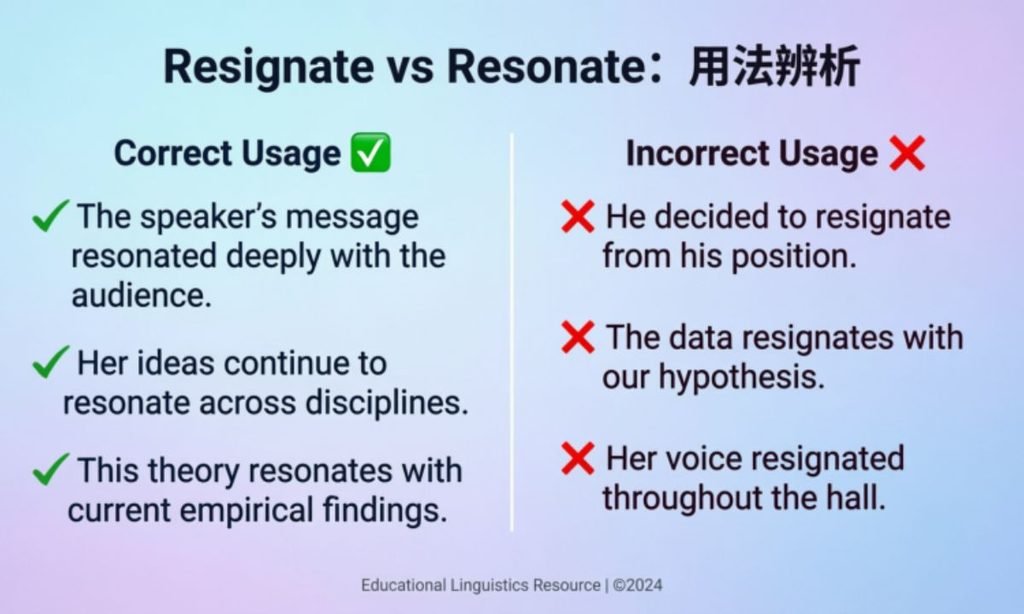
Seeing real examples makes the difference click fast, faster than any rule ever could. Below is a clear comparison table you can bookmark and reuse whenever you need a quick check.
| Incorrect Spelling | Correct Word |
|---|---|
| “Her words really resignated with me.” | “Her words really resonated with me.” |
| “This ad campaign resignates with teens.” | “This ad campaign resonates with teens.” |
| “I hope my message resignates with you.” | “I hope my message resonates with you.” |
| “The melody resignated through the hall.” | “The melody resonated through the hall.” |
| “His story didn’t resignate with the panel.” | “His story didn’t resonate with the panel.” |
Notice something? Every single correct column reads smoothly out loud. Every incorrect one feels slightly off once you already know the truth. That small instinct you feel is worth trusting from now on, every time you write.
A few more everyday sentences using the real word, pulled from the kind of writing you see daily:
- “That quote resonates with everything I believe.”
- “Great brand messaging resonates long after you close the ad.”
- “Her honesty resonated with the whole room.”
- “The chorus resonates louder every time you hear it live.”
Notice how each sentence pairs the word with “with.” That small pattern is one of the fastest ways to check yourself while writing quickly.
Resonate Synonyms and Similar Words
Sometimes you want variety instead of repeating the same word over and over in one piece of writing. These synonyms and related phrases carry a similar feeling, depending on the context you’re working in.
| Synonym | Best Used When |
|---|---|
| Strike a chord | Talking about emotional connection |
| Echo | Referring to sound or repeated ideas |
| Connect | Simple, everyday emotional link |
| Reverberate | Physical sound or lasting cultural impact |
| Ring true | Something feels honest and relatable |
| Linger | An idea or feeling that stays with you |
| Strike home | A message that lands with real force |
| Click | A casual way to say something makes sense |
Mixing these into your writing keeps things fresh and readable. You don’t need to lean on one single word every sentence. A little variety makes your writing feel more natural, less robotic, and easier for readers to enjoy without noticing a pattern.
Try swapping in one of these the next time you draft an email or a caption. Your message will still land the same way, just with a bit more texture and rhythm behind it.
What Dictionaries and Style Guides Say
Every major English dictionary confirms the same thing, without exception. The correct term is a standard, accepted verb across formal and informal writing everywhere.
- Merriam-Webster defines it as producing sound through vibration, and figuratively, evoking a strong response in a listener or reader
- Oxford English Dictionary lists both the literal and emotional meanings as fully standard across British and American use
- Cambridge Dictionary highlights the common phrase pairing it with “with someone” as widely used in everyday speech
- AP Style and Chicago Manual of Style both accept the word without restriction in journalism, publishing, and academic writing
None of these sources list the made-up spelling anywhere in their pages. That silence is consistent across every serious language reference you can check today. If a word doesn’t appear in any of these places, it’s safe to assume it isn’t standard English at all.
Etymology: How the Word Evolved from Latin to Today
Words have histories, and this one has a genuinely interesting story behind it. It comes from the Latin resonare, built from “re” meaning again, and “sonare” meaning to sound.
Put together, the original sense was simple: to sound again, to echo back. Early English speakers used it mostly in the literal way, describing bells, caves, and instruments that produced echoing sound across open space.
Over the centuries, writers stretched the meaning further outward. By the time modern English took shape, the term had picked up its emotional and intellectual layer too, alongside its older physical one.
Today, the figurative use is actually far more common than the original literal one. That’s a pretty interesting shift if you sit with it for a second. A word about physical echoes became a word about emotional ones, and sound plus feeling ended up sharing the same verb.
Where This Word Shows Up Most: Marketing, Music, and Everyday Talk
Once you start noticing this word, you’ll spot it everywhere. It shows up constantly across a handful of industries, each for a slightly different reason.
Marketing and branding lean on it heavily. A campaign that connects with its audience gets called successful. A campaign that misses the mark just falls flat, no matter how much money went into it. Brands chase that emotional link because it drives loyalty far more than any discount ever could.
Music and performance use the literal sense constantly, alongside the emotional one. A note can echo physically through a concert hall. A lyric can also strike a chord with a listener’s own life story. Musicians often talk about wanting both at once, a sound that fills the room and a message that stays with people long after the show ends.
Everyday conversation leans almost entirely on the figurative meaning. You’ll hear it in therapy sessions, coaching calls, book clubs, and casual catch ups with friends. Someone shares a struggle, and you say it hits close to home. That’s the same idea wearing a more casual outfit.
Leadership and public speaking treat this quality as a core skill to build, not a lucky accident. Speakers who move a room usually practice specific habits, like pausing, using plain language, and telling smaller stories instead of big abstract statements. The word choice matters, but the delivery matters just as much.
Seeing the pattern across these different worlds helps the meaning stick even more. It’s not a fancy or rare term. It’s a working word doing real jobs in ordinary life, day after day.
How to Use “Resonate” Correctly in Everyday Life
You don’t need a grammar degree to use this word well. A few simple habits will keep you consistent every single time you sit down to write.
- Pair it with “with.” Most natural sentences follow the pattern of connecting it to a person or a group.
- Match your tense carefully. The word shifts form depending on whether you’re describing something happening now, before, or later.
- Use it for emotional or sound-based impact only. Don’t stretch it to mean simple agreement or basic liking, since that waters down the meaning.
- Read your sentence out loud. If it sounds awkward or clunky, you probably need a synonym instead of forcing the word to fit.
- Double check before publishing. A quick scan catches typos like the wrong spelling before readers ever see them and judge your writing for it.
Here’s a quick tense reference you can save for later:
| Tense | Example |
|---|---|
| Present | “This idea resonates with me.” |
| Past | “Her speech resonated with the crowd.” |
| Continuous | “The message is resonating widely online.” |
| Future | “This campaign will resonate with younger buyers.” |
Keep this table nearby the next time you’re editing a longer piece. It takes the guesswork out of tense once and for all.
Suggested visual: a small infographic showing the four tense forms in a row, captioned “Resonate through every tense: present, past, continuous, future.”
Writing Messages That Truly Resonate
Using the correct word is step one. Making your actual message land with real force is a whole different skill, and it’s worth learning on its own.
Strong writing that connects usually shares a few common traits. It feels specific, not generic or borrowed from somewhere else. It taps into something readers already feel but haven’t said out loud yet themselves.
Think about the last message that genuinely stuck with you for days afterward. Chances are it wasn’t fancy or dressed up. It was honest, clear, and a little personal, almost like a friend was talking directly to you.
A few practical ways to boost this in your own work:
- Tell a small, specific story instead of a vague, general statement
- Speak directly to “you,” the reader, instead of addressing a general crowd
- Cut extra words that don’t add real meaning to the sentence
- End with something memorable, not just something informative
Writers who master this rarely rely on big vocabulary. They rely on honesty, timing, and knowing exactly what their reader is already feeling before they even open the page.
Communication Tips to Make Your Messages Resonate
Beyond writing, this applies to speaking too. Whether it’s a meeting, a podcast, or a casual chat with a friend, these habits help your ideas connect and actually stick around afterward.
- Slow down on key points. Rushing buries the parts of your message that matter most to the listener.
- Use pauses on purpose. Silence gives your audience space to absorb what you just said before you move on.
- Match tone to content. A serious idea delivered too casually can lose its weight and get brushed aside.
- Ask a real question. Questions invite people into the conversation instead of just talking at them the whole time.
- Repeat your core message once. Repetition helps ideas settle in and stay long after the conversation ends.
I’ve noticed this myself in casual conversations more than anywhere else. The moments people remember are rarely the polished ones. They’re the honest, slightly imperfect ones that felt real and unscripted in the moment.
Personalization Tips: Make Your Writing Fit Your Own Voice
Rules only get you so far. The real goal is making this word feel like a natural part of how you already talk and write, not a borrowed phrase pasted on top.
Start by noticing your own writing habits. Do you lean formal, or do you write like you’re texting a close friend? Match your synonym choices to that existing voice instead of forcing a word that feels stiff in your usual style.
Try keeping a short running list of your favorite alternatives, the ones from earlier in this guide that feel most like you. Some writers love “strike a chord.” Others prefer something plainer, like “connect” or “click.” There’s no single right answer here, just the one that sounds most like you when read out loud.
Test new phrasing on a real reader before it goes public. Send a draft to a friend or coworker and ask what actually landed for them. Their honest reaction tells you far more than any grammar rule ever could about what truly works.
Small habits build up fast over time. Read your work out loud once before publishing. Keep a short personal list of go-to synonyms nearby. Notice which specific phrases get real replies or reactions, then lean into those patterns a little more each time you write.
Practice: Exercises to Master “Resonate”
Practice locks this in fast, usually faster than reading rules ever could on their own. Try these short exercises to build the habit permanently over the next few days.
Exercise 1: Fill in the blank Complete each sentence with the correct form of the word.
- “Her poem really ______ with the audience.”
- “I hope this article ______ with you by the end.”
- “The song has been ______ with fans for years now.”
Exercise 2: Spot the error Find the mistake hiding in each sentence below.
- “This message resignates with everyone who hears it.”
- “His story didn’t resignate the way he hoped it would.”
Exercise 3: Rewrite it Rewrite these sentences using a synonym from earlier in this guide instead.
- “Her words resonated with the whole team.”
- “The theme resonates across every single chapter.”
Doing this a few times trains your brain to reach for the right word automatically, without even thinking about it. Within a week or two, the wrong spelling stops showing up in your writing altogether.
Conclusion
So here’s the bottom line. Resonate is the correct word, backed by every major dictionary and centuries of Latin roots behind it. The other spelling simply isn’t real, no matter how natural it feels when you’re typing fast.
Once you understand where the confusion comes from, it’s easy to fix for good. Practice the examples, trust your instincts, and read your sentences back before hitting send. Your writing will feel clearer, sharper, and far more credible from here on out.
FAQs
Is “resignate” ever correct? No, it’s not a recognized word in any standard English dictionary.
What does “resonate with someone” mean? It means something connects deeply with a person emotionally or intellectually.
Where does “resonate” come from? It comes from the Latin word resonare, meaning to sound again.
Can “resonate” describe sound and emotion both? Yes, it covers literal echoing sound and figurative emotional connection.
Why do people confuse resignate and resonate? The words sound alike, and the wrong spelling mimics familiar “-inate” patterns.
Is “resonated” the correct past tense? Yes, “resonated” is the standard past tense form of the word.
Are there good synonyms for resonate? Yes, options include connect, echo, strike a chord, and reverberate.
Do style guides accept “resonate” in formal writing? Yes, AP Style and Chicago Manual of Style both accept it fully.
1 thought on “Resignate or Resonate? The Bold Guide to the Right Word”