

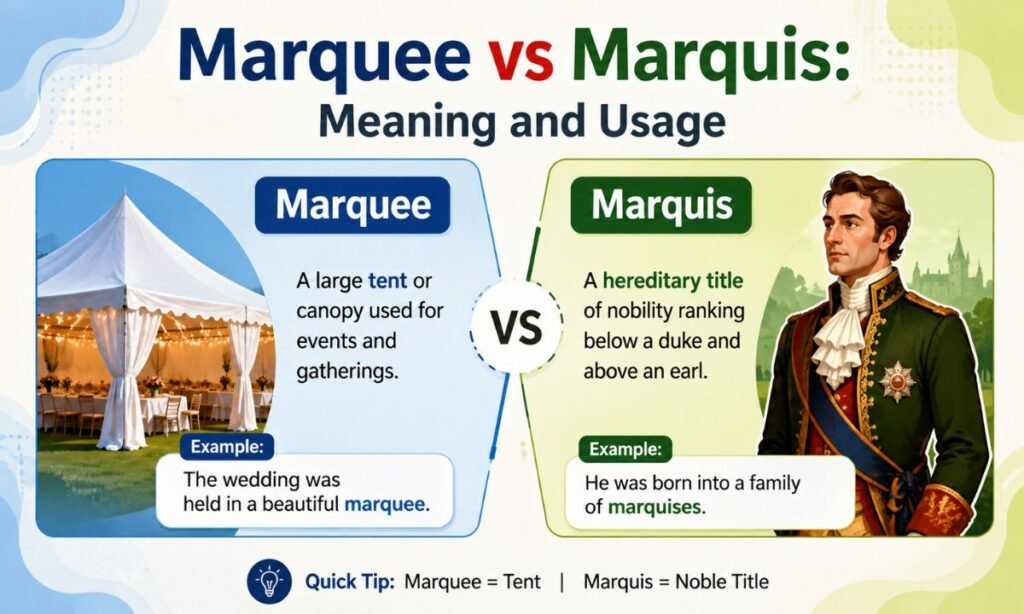
If you’ve ever paused mid-sentence wondering whether you need a marquee or a marquis, you’re not alone. These two words sound almost identical when spoken aloud, yet they belong to completely different worlds — one lights up a theater entrance, the other once ruled over European estates.
This guide breaks down everything you need to know about marquee vs marquis: definitions, origins, real-world examples, common mistakes, and a simple memory trick so you never mix them up again.
Why “Marquee vs Marquis” Confuses So Many Writers
English is full of homophones — words that sound the same but mean different things — and marquee/marquis is one of the trickiest pairs. Both words trace back to the same French root, both are nouns, and both are pronounced almost identically as “mar-KEE.” That overlap is exactly why spell-checkers, students, copywriters, and even seasoned editors slip up.
Why your brain mixes them up
- Shared pronunciation: Both words end in that same soft “-kee” sound, so your ear can’t tell them apart.
- Shared etymology: They both descend from the French word marquis/marquise, so the visual spelling overlap feels natural.
- Different frequency of use: Marquee shows up constantly in everyday American English (movie theaters, event tents, marketing copy), while marquis appears mostly in historical or literary contexts — so your brain defaults to the word it sees more often.
- Autocorrect confusion: Many word processors “correct” one term into the other, especially in British English where marquess is also in play.
Once you understand where each word came from and how it’s used today, the confusion disappears almost instantly.
What Is a Marquee? Meaning, Usage, and Real Examples
Definition of Marquee
A marquee is a noun with two primary meanings in modern English:
- A large tent used for outdoor events such as weddings, festivals, or exhibitions (common in British English).
- A rooflike canopy or sign above the entrance of a theater, hotel, or casino, often displaying the name of a performer or event (common in American English).
Marquee also functions as an adjective, meaning “leading,” “headline,” or “star-level” — as in a “marquee player” or “marquee event.”
Origin of the Word “Marquee”
Marquee entered English in the late 17th century from the French word marquise, which itself was the feminine form of marquis. English speakers mistook the final “-s” in marquise for a plural ending and treated “marquee” as the singular form — essentially a spelling accident that stuck. The original French marquise referred to an officer’s field tent, which explains the tent-related meaning that survives in British English today.
Modern usage in real life
Marquee is everywhere in daily language, from event planning to entertainment marketing:
- Wedding and event industries use it to describe large tents.
- Theater and hospitality industries use it for entrance signage.
- Sports and entertainment media use it as an adjective for star power.
- Tech and business writing use “marquee” to describe a flagship product or headline client.
READ THIS “20 Other Ways to Say “Happy Birthday”
Real-world examples
- The couple hired a striped marquee for their garden wedding reception.
- The theater’s marquee announced the opening night of the new musical.
- Signing a marquee free agent instantly boosted ticket sales for the team.
- The company’s marquee product remains its cloud storage platform.
Digital meaning of Marquee
In web and software development, “marquee” also refers to an older HTML tag (<marquee>) that made text scroll across a webpage, and to the “marching ants” selection outline in graphic design tools like Photoshop. Neither usage is common in formal writing, but both explain why “marquee” shows up so often in tech contexts.
Key takeaway
Marquee = a tent, a theater sign, or something top-billed. It’s almost always tied to entertainment, events, or prominence — never to nobility.
What Is a Marquis? Meaning, History, and Cultural Role
Definition of Marquis
A marquis is a nobleman who ranks below a duke and above a count (or earl, in the British system). It is a hereditary title used across several European monarchies, particularly in France, Spain, and Italy.
Historical origin
The title originated in medieval France to describe a lord who governed a “march” — a border territory that required extra military responsibility because it bordered hostile or foreign lands. The word comes from the Old French marchis, related to marche (“frontier” or “boundary”), the same root that gives us “margin” and “mark.”
Rank in hierarchy (simplified)
| Rank | Male Title | Female Title | Position |
|---|---|---|---|
| 1 | King/Emperor | Queen/Empress | Sovereign |
| 2 | Duke | Duchess | Highest nobility |
| 3 | Marquis | Marquise | Below duke, above count |
| 4 | Count/Earl | Countess | Mid-level nobility |
| 5 | Viscount | Viscountess | Below count |
| 6 | Baron | Baroness | Lowest hereditary title |
Responsibilities in history
Historically, a marquis held real administrative and military duties, not just a ceremonial label:
- Defending border territories from invasion.
- Collecting taxes and managing land on behalf of the crown.
- Commanding local troops during conflicts.
- Serving as a political representative of the monarchy in frontier regions.
Regional variations
The exact spelling and role of this title shift depending on the country:
- France: Marquis (male), Marquise (female).
- Britain/Ireland: Marquess (male), Marchioness (female) — a distinct spelling of the same rank.
- Spain: Marqués (male), Marquesa (female).
- Italy: Marchese (male), Marchesa (female).
- Germany: The equivalent title is Markgraf (margrave).
Modern usage
Today, “marquis” mostly appears in historical fiction, genealogy research, royal family reporting, and literature. Some European families still hold the title ceremonially, even though it carries no political power in most modern nations.
Example sentences
- The marquis inherited his father’s estate along with the family title.
- Historians studied how the marquis managed border defenses in the 1600s.
- In the novel, the marquis is portrayed as both charming and ruthless.
Key takeaway
Marquis = a noble rank, tied to history, land, and hereditary power. It has nothing to do with tents, signs, or entertainment.
Marquee vs Marquis — Core Differences Explained
| Feature | Marquee | Marquis |
|---|---|---|
| Part of speech | Noun (also adjective) | Noun |
| Meaning | Tent, theater sign, or “top-billed” | Noble rank below duke, above count |
| Pronunciation | mar-KEE | mar-KEE / mar-KWIS |
| Origin | French marquise (misread plural) | Old French marchis (“border lord”) |
| Common region | American & British English | Historical/European contexts |
| Typical use | Events, entertainment, marketing | History, literature, genealogy |
| Feminine form | N/A | Marquise |
Simple memory trick
Think of the double E in marquEE as standing for Entertainment and Entrance — the two places you’ll always find a marquee (a movie entrance sign or an event tent).
Think of the IS in marquIS as standing for a person, just like “he is a nobleman.” If you’re talking about a person with a title, it’s marquis.
Why Context Changes Everything in Marquee vs Marquis Usage and Examples
Same pronunciation, different world
Because these words sound alike, context is the only real clue to which one a speaker means. If someone says “mar-kee” while discussing weddings, movies, or business, they almost certainly mean marquee. If the conversation is about European history, royal lineage, or noble titles, marquis is the correct word.
Why meaning shifts instantly
- A sentence about structures or signage → marquee.
- A sentence about people, titles, or inheritance → marquis.
- A sentence describing something as the star or headline attraction → marquee (adjective use).
- A sentence describing rank within a peerage system → marquis.
This single distinction — object/event versus person/title — resolves almost every confusion instantly.
Common Mistakes in Marquee vs Marquis Usage and Examples
- Writing “the wedding marquis” instead of “the wedding marquee.”
- Referring to a theater sign as a “marquis.”
- Calling a nobleman a “marquee” in historical writing.
- Confusing marquis with marquess without realizing they’re regional spellings of the same title.
- Using “marquee” as an adjective incorrectly, such as “a marquis event” instead of “a marquee event.”
- Letting autocorrect silently swap one term for the other in formal documents.
Case Study: Real-World Misuse in Digital Content
A common scenario in content marketing involves event-planning companies publishing blog posts about “marquis weddings” instead of “marquee weddings.” This error is widespread enough that it regularly appears in search results, wedding vendor websites, and even paid advertising copy.
What went wrong
Writers likely associate “marquis” with elegance and luxury — the word sounds sophisticated — and mistakenly apply it to describe premium tents or high-end events, when the correct term is “marquee.”
Impact
- Search engines may rank the page for the wrong keyword intent, since users searching “marquis” are typically researching nobility, not tents.
- Readers familiar with the correct term may lose trust in the brand’s credibility.
- The mismatch can hurt on-page SEO relevance, since Google’s algorithms increasingly reward topical accuracy.
Historical Insight: Why These Words Share French Roots
Language evolution path
Both words descend from the same Old French root related to “march” or “boundary.” Over centuries, the term split into two branches:
- One branch stayed tied to nobility and land governance — becoming marquis.
- The other branch shifted toward objects: first a nobleman’s ceremonial tent (marquise), then any large event tent, and eventually the modern theater canopy — becoming marquee.
Why English split them
English borrowed both words at different points and from different contexts. “Marquis” arrived through direct references to French and European nobility, staying close to its original meaning. “Marquee,” on the other hand, was borrowed almost by accident — an -s was misread as a plural marker — and its meaning drifted toward physical structures rather than people.
Semantic Neighbors of Marquee vs Marquis
Words related to Marquee
- Canopy
- Awning
- Tent
- Signage
- Billboard
- Headliner
- Flagship
Words related to Marquis
- Nobleman
- Peerage
- Marquess
- Duke
- Count
- Aristocrat
- Hereditary title
Regional Usage Differences
British English
In the UK, “marquee” almost always refers to a large tent used for weddings, garden parties, or corporate events. The theater-sign meaning is far less common. The noble title is typically spelled “marquess,” not “marquis.”
American English
In the US, “marquee” is used almost exclusively for theater, hotel, or casino signage, along with the “star-level” adjective meaning. Large event tents are more often just called “tents.” “Marquis” is used strictly for the noble title, usually in historical or literary contexts.
Key insight
| Region | Marquee meaning | Noble title spelling |
|---|---|---|
| United States | Theater/hotel sign, top-billed adjective | Marquis |
| United Kingdom | Large event tent | Marquess |
| France | N/A (not commonly borrowed back) | Marquis |
Mini Practice: Marquee vs Marquis Usage and Examples
Choose the correct word
- The band’s name lit up the theater’s ______.
- His grandfather was a ______ during the 18th century.
- They rented a striped ______ for the outdoor reception.
- The novel’s protagonist falls in love with a ______.
- She became the company’s ______ client after the merger.
Answers
- Marquee
- Marquis
- Marquee
- Marquis
- Marquee
Quick Cheat Sheet
Use Marquee when:
- Talking about a large tent for events.
- Describing a theater, hotel, or casino sign.
- Calling something the “star” or “headline” attraction.
Use Marquis when:
- Referring to a nobleman’s title.
- Writing about European history or peerage systems.
- Discussing a rank below duke and above count.
Frequently Asked Questions
Is marquee and marquis the same word? No. They are homophones with different spellings, meanings, and origins.
How do you pronounce marquis correctly? It’s typically pronounced “mar-KEE” in English, though the French pronunciation is closer to “mar-KEE” with a softer final sound.
What is the female version of marquis? The female version is “marquise.”
Is marquee British or American English? Both use it, but Americans mean a theater sign, while British speakers usually mean a large tent.
Can marquee be used as an adjective? Yes. It’s commonly used to mean “leading” or “star-level,” as in “marquee player.”
Conclusion
Marquee and marquis may sound identical, but they belong to entirely different categories: one describes a tent or a theater sign, the other describes a noble title steeped in European history. Once you remember that marquee relates to entertainment and structures while marquis relates to people and rank, you’ll never confuse them again. Keep this guide handy the next time you’re drafting a wedding invitation, a historical essay, or marketing copy — and let context be your final guide.