
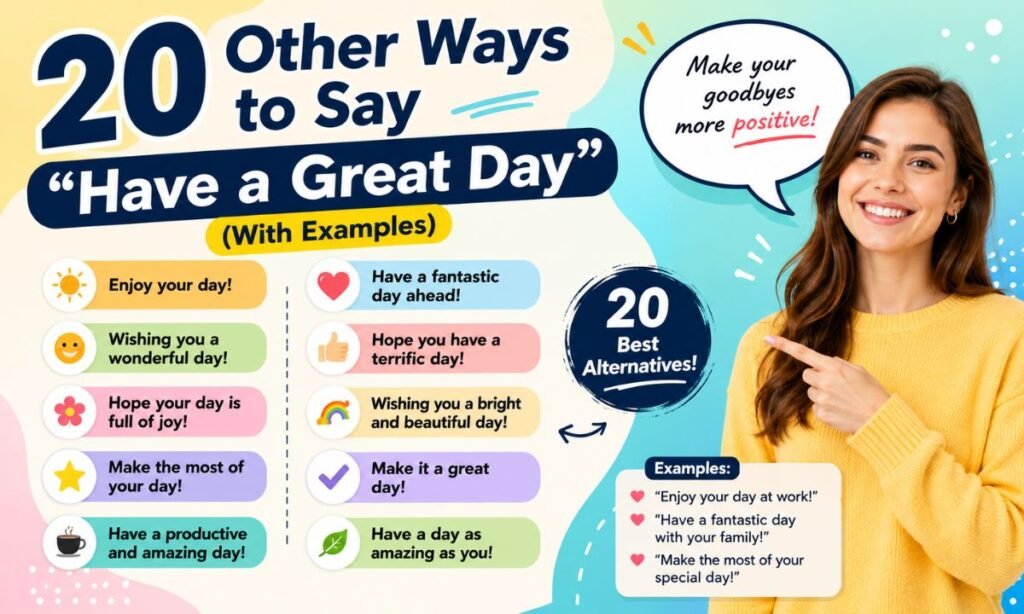
Saying “have a great day” is easy, but saying it the same way every single time can start to feel flat. Whether you’re wrapping up an email, saying goodbye to a coworker, or texting a friend, a fresh phrase can make your words feel more sincere and memorable.
This guide breaks down what “have a great day” really means, when it works best, and gives you 20 natural alternatives you can use in personal, professional, and casual conversations — each with a clear example.
What Does “Have a Great Day” Mean?
“Have a great day” is a friendly farewell phrase used to wish someone a pleasant, successful, or enjoyable rest of their day. It’s typically said at the end of a conversation, email, phone call, or in-person interaction.
The phrase carries goodwill. It tells the other person you hope things go smoothly for them, even after your interaction ends. It’s short, positive, and works in almost any setting — from a quick chat with a cashier to a closing line in a business email.
While simple, the phrase does more than fill space. It signals politeness, closes a conversation on a warm note, and leaves the other person with a small, positive impression.
Is It Professional or Polite to Say “Have a Great Day”?
Yes, “have a great day” is both professional and polite. It’s widely accepted in workplaces, customer service, emails, and everyday conversations because it’s neutral, friendly, and doesn’t require a personal relationship with the listener.
That said, professionalism depends on context:
- In emails: It works well as a closing line, especially in customer support, sales, or general correspondence.
- In meetings: It’s a natural way to end a call or wrap up an interaction.
- In casual settings: It feels warm without being overly familiar.
The phrase is safe enough for strangers, yet friendly enough for coworkers and clients. However, using it too often — especially in back-to-back emails to the same person — can start to feel automatic rather than genuine, which is one reason alternatives are worth having on hand.
Advantages and Disadvantages of Saying “Have a Great Day”
Like any common phrase, “have a great day” has strengths and limitations depending on how and where it’s used.
Advantages:
- Universally understood — everyone recognizes the phrase instantly, with no risk of confusion.
- Safe for any relationship — appropriate for strangers, coworkers, clients, and friends alike.
- Quick and efficient — perfect for closing conversations without overthinking.
- Positive tone — instantly adds warmth to an interaction.
- Works across formats — suitable for emails, texts, phone calls, and face-to-face conversations.
Disadvantages:
- Can sound repetitive — overused in customer service and email sign-offs, it can feel scripted.
- Lacks personalization — doesn’t reflect the specific relationship or moment.
- May feel insincere — when said too quickly or too often, it can come across as automatic rather than heartfelt.
- Limited emotional range — it doesn’t adapt well to more specific situations, like wishing someone luck or comfort.
Why You Need Alternatives for “Have a Great Day”
Relying on one phrase for every goodbye limits how genuine your communication feels. Here’s why having alternatives matters:
- Avoids sounding robotic. Repeating the same line in every email or conversation can make your communication feel automated, especially in professional settings.
- Adds personalization. Different phrases suit different relationships — a close friend and a client don’t need the exact same sign-off.
- Matches the tone of the moment. Some situations call for something calmer (“have a peaceful day”), while others call for more energy (“have an amazing day”).
- Improves professional communication. Varying your closing lines in emails makes your writing feel more thoughtful and less templated.
- Strengthens relationships. A well-chosen phrase shows attentiveness and genuine care, rather than a copy-paste response.
Tips for Choosing the Right Phrase
Picking the best alternative isn’t random — a few quick checks will help you choose naturally:
- Consider the relationship. Formal alternatives suit clients and coworkers; casual ones suit friends and family.
- Match the setting. Emails and business calls call for polished phrasing; texts and in-person chats allow more casual language.
- Think about the moment. If someone mentioned they’re stressed or busy, a phrase like “hope your day goes smoothly” fits better than “have an amazing day.”
- Keep it short. Long, overly wordy sign-offs can feel forced. Simplicity keeps the phrase genuine.
- Vary your language over time. If you talk to the same person often, rotate between a few phrases so it doesn’t feel repetitive
READ THIS “Marquee vs Marquis
Final List of Alternatives
Here’s a quick-reference table of all 20 alternatives, along with their best use case, before the detailed breakdown below.
| # | Alternative Phrase | Best Used For |
|---|---|---|
| 1 | Wishing you a wonderful day | Emails, formal messages |
| 2 | Hope you have a fantastic day | Casual conversations, texts |
| 3 | Have a lovely day | Friends, family, polite exchanges |
| 4 | Enjoy your day | Quick goodbyes, customer service |
| 5 | Have an amazing day | Upbeat, enthusiastic farewells |
| 6 | Wishing you a great rest of your day | Mid-day conversations |
| 7 | Hope your day goes well | Professional and casual settings |
| 8 | Have a beautiful day | Warm, heartfelt goodbyes |
| 9 | Take care and have a great day | Combining care with well wishes |
| 10 | Have a productive day | Workplace, business emails |
| 11 | Hope you have a smooth day | Busy or stressful situations |
| 12 | Have a cheerful day | Light, friendly interactions |
| 13 | Enjoy the rest of your day | Afternoon or evening goodbyes |
| 14 | Hope your day is filled with joy | Heartfelt, personal messages |
| 15 | Make it a great day | Motivational, energetic tone |
| 16 | Have a positive day | Encouraging, supportive tone |
| 17 | Wishing you a peaceful day | Calm, thoughtful goodbyes |
| 18 | Have a splendid day | Formal or slightly elegant tone |
| 19 | Hope today treats you well | Casual check-ins |
| 20 | Take it easy and have a great day | Relaxed, low-pressure farewells |
1. Wishing you a wonderful day
This phrase adds a touch of formality and warmth, making it ideal for emails or professional messages where you want to sound polished but sincere.
Example: “Thank you for your time today. Wishing you a wonderful day ahead.”
2. Hope you have a fantastic day
A more energetic alternative, this works well in casual conversations and text messages where you want to express genuine enthusiasm.
Example: “Good luck with your presentation! Hope you have a fantastic day.”
3. Have a lovely day
Soft and warm, this phrase suits friends, family members, and polite everyday exchanges, such as chatting with a neighbor or coworker.
Example: “It was great catching up with you. Have a lovely day!”
4. Enjoy your day
Simple and direct, this alternative is commonly used in customer service and quick, casual goodbyes.
Example: “Thanks for stopping by. Enjoy your day!”
5. Have an amazing day
This phrase carries more enthusiasm and works well when you want to sound especially upbeat or encouraging.
Example: “You’ve got this! Have an amazing day.”
6. Wishing you a great rest of your day
Perfect for conversations that happen partway through the day, this phrase acknowledges that part of the day has already passed.
Example: “It was nice talking with you this afternoon. Wishing you a great rest of your day.”
7. Hope your day goes well
A slightly more understated option, this works in both professional and casual settings without sounding overly cheerful.
Example: “Let me know if you need anything else. Hope your day goes well.”
8. Have a beautiful day
This alternative feels warm and heartfelt, making it a good choice for close friends, family, or meaningful goodbyes.
Example: “It meant a lot to see you today. Have a beautiful day.”
9. Take care and have a great day
Combining two friendly sentiments, this phrase shows both concern and good wishes, making it ideal for people you care about.
Example: “Drive safe! Take care and have a great day.”
10. Have a productive day
This phrase fits well in workplace settings, especially when wishing a colleague well before a busy day of tasks or meetings.
Example: “Good luck with the project deadline. Have a productive day.”
11. Hope you have a smooth day
Especially useful when someone has mentioned stress or a busy schedule, this phrase wishes them ease rather than excitement.
Example: “I know today’s packed for you. Hope you have a smooth day.”
12. Have a cheerful day
A lighter, friendlier alternative, this phrase suits casual interactions where a bit of positivity fits naturally.
Example: “Thanks for the chat! Have a cheerful day.”
13. Enjoy the rest of your day
Best used in the afternoon or evening, this phrase acknowledges that the day is partly over while still wishing the person well.
Example: “It was great seeing you at lunch. Enjoy the rest of your day.”
14. Hope your day is filled with joy
A more heartfelt and personal option, this phrase works well for close relationships or meaningful messages.
Example: “You deserve all good things today. Hope your day is filled with joy.”
15. Make it a great day
This phrase shifts the tone slightly by encouraging the person to take charge of their day, adding a motivational touch.
Example: “You’ve got everything you need to succeed. Make it a great day.”
16. Have a positive day
Encouraging and supportive, this phrase works well when someone might need a little extra optimism.
Example: “I believe things will go your way. Have a positive day.”
17. Wishing you a peaceful day
Ideal for calmer, more thoughtful goodbyes, this phrase suits situations where someone may need rest or quiet time.
Example: “Take some time for yourself today. Wishing you a peaceful day.”
18. Have a splendid day
A slightly more elegant or formal alternative, this phrase adds a touch of sophistication to your farewell.
Example: “It was a pleasure meeting you. Have a splendid day.”
19. Hope today treats you well
Casual and conversational, this phrase works naturally in everyday check-ins or quick messages.
Example: “Hey, just checking in. Hope today treats you well.”
20. Take it easy and have a great day
This relaxed phrase suits low-pressure situations, especially when you want to encourage someone to slow down.
Example: “No need to rush. Take it easy and have a great day.”
Frequently Asked Questions
Is “have a great day” too casual for work emails? No, it’s widely accepted in professional emails and considered polite in most workplace contexts.
What’s a more formal alternative to “have a great day”? “Wishing you a wonderful day” or “have a splendid day” both carry a more formal tone.
Can I use these phrases in text messages? Yes, casual options like “hope you have a fantastic day” or “enjoy your day” work well in texts.
Is it okay to repeat “have a great day” often? It’s fine occasionally, but repeating it too often can feel automatic, so rotating phrases keeps communication genuine.
What should I say instead of “have a great day” to someone who’s stressed? Try “hope you have a smooth day” or “wishing you a peaceful day” for a gentler tone.
Final Thoughts
“Have a great day” is a reliable, friendly phrase, but it doesn’t have to be your only option. Having a variety of alternatives lets you match your tone to the moment, the relationship, and the setting — whether that’s a formal email, a quick text, or a heartfelt goodbye.
Next time you’re about to end a conversation, try one of these 20 alternatives instead. A small change in wording can make your goodbye feel more thoughtful and leave a better impression.