

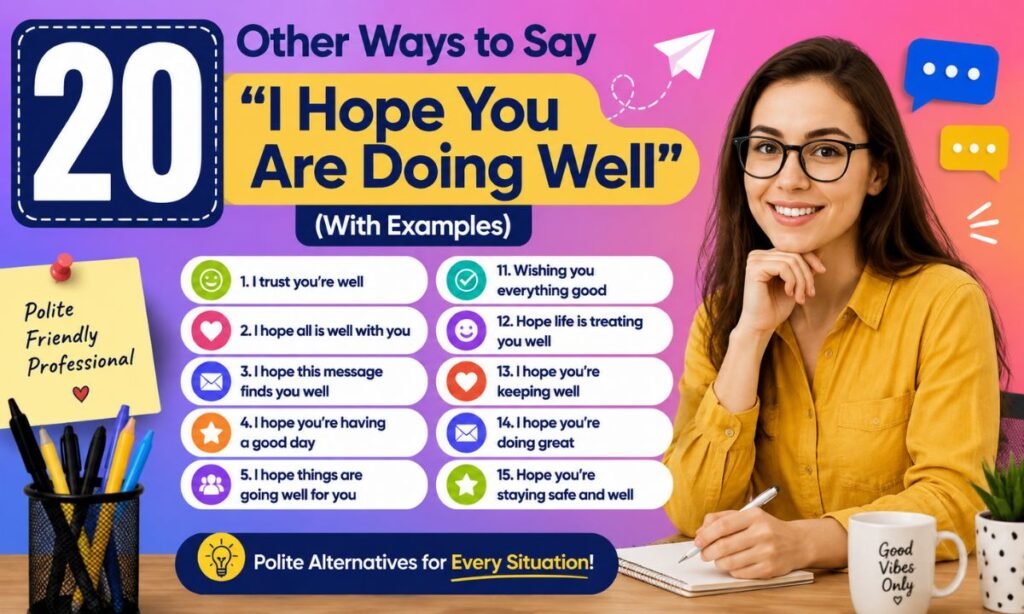
Starting an email with “I hope you are doing well” is second nature for most of us. It’s polite, safe, and easy to type without thinking. But when you send dozens of emails a week, that same line can start to feel stale — both to you and to the person reading it.
The good news is that you don’t have to keep recycling the same five words. There are dozens of warm, professional, and natural-sounding alternatives that say the same thing in a fresher way. This guide breaks down what the phrase actually means, when to use it, and gives you 20 practical alternatives with real examples you can copy into your next email, text, or LinkedIn message.
What Does “I Hope You Are Doing Well” Mean?
“I hope you are doing well” is a polite greeting used to open a conversation, usually in an email or message. It expresses a general wish for the recipient’s health, happiness, or overall wellbeing before you move into the main point of your message.
It doesn’t ask a direct question the way “How are you?” does. Instead, it’s a soft, low-pressure way to acknowledge the other person before getting down to business. That’s exactly why it’s so common in workplace emails — it signals warmth without requiring a detailed reply.
Is It Professional/Polite to Say “I Hope You Are Doing Well”?
Yes, it’s both professional and polite. The phrase works in almost any setting — job applications, client emails, follow-ups, and even messages to your boss. It’s neutral, respectful, and won’t offend anyone.
That said, “professional” doesn’t always mean “effective.” Because it’s used so widely, some readers skim right past it without registering it at all. It’s polite by default, but it’s not memorable. If you want your message to stand out or feel more personal, an alternative phrase — especially one tailored to the relationship or situation — often works better.
Advantages and Disadvantages
Before you decide whether to keep using this phrase or swap it out, it helps to weigh what it does well and where it falls short.
Advantages
- Universally accepted: It works in formal, semi-formal, and casual settings.
- Safe and non-intrusive: It doesn’t demand a detailed personal response.
- Sets a warm tone: It softens the transition into the actual message.
- Culturally familiar: Most native and non-native English speakers instantly understand it.
- Quick to write: No overthinking required, which is useful for high-volume communication.
Disadvantages
- Overused: It appears in almost every other email, making it easy to overlook.
- Can feel impersonal: It doesn’t reflect any real knowledge of the recipient’s situation.
- Sounds robotic in repetition: Sending the same opener to the same person repeatedly feels lazy.
- Lacks specificity: It doesn’t acknowledge context, like a recent project, holiday, or personal event.
- May read as filler: Some recipients see it as a formality rather than a genuine sentiment.
ALSO READ “20 Other Ways to Say “Have a Great Day”
Why You Need Alternatives to “I Hope You Are Doing Well”
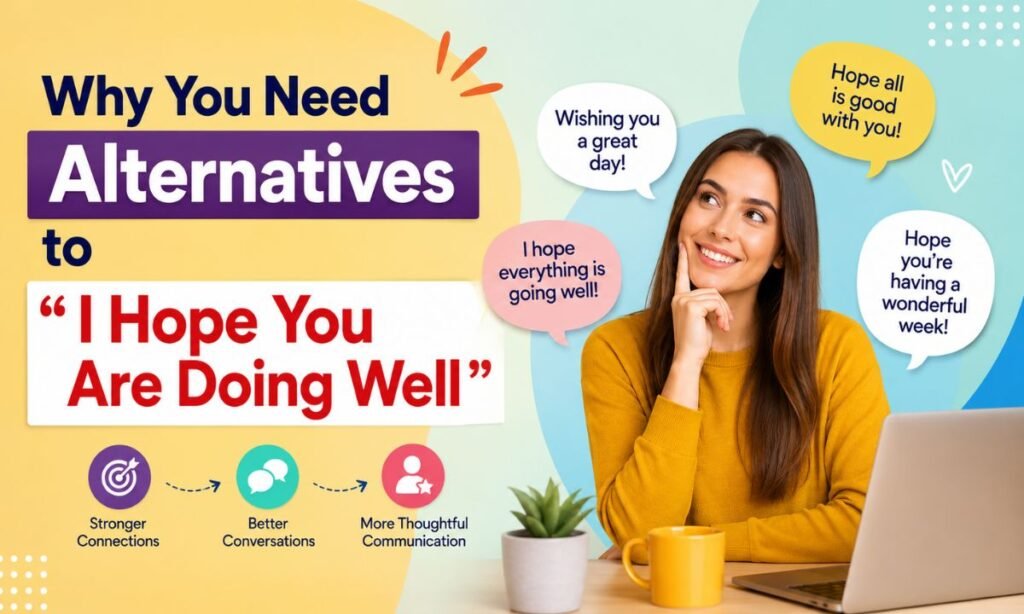
Language works best when it feels intentional. If every email you send opens with the exact same sentence, it can start to feel like a template rather than a real message from a real person. Alternatives help you:
- Sound more genuine and less scripted.
- Match your tone to the relationship (formal vs. casual).
- Avoid sounding repetitive to people you email often.
- Add a small personal touch that makes your message memorable.
- Stand out in a crowded inbox where everyone opens the same way.
Switching up your greeting is a small change, but it makes a noticeable difference in how your emails come across.
Tips for Choosing the Right Phrase
Not every alternative fits every situation. Use these quick guidelines to pick the right one:
- Match the formality level. Save casual lines like “Hope you’re doing great!” for coworkers or friends, and use more formal options like “I trust this message finds you well” for clients or executives.
- Consider the relationship. A close colleague can handle a warmer, more personal greeting than a first-time contact.
- Read the room. If the recipient recently went through a hard time, skip cheerful phrases and opt for something more empathetic.
- Keep it short. A greeting should take one line — it’s an opener, not the main message.
- Avoid repetition with frequent contacts. If you email someone weekly, rotate your openers so you don’t sound like a copy-paste bot.
- Let context guide word choice. Following up on a project? Mention it. Reconnecting after a while? Acknowledge the gap.
Final List of Alternatives
Here’s the complete list of 20 natural, professional, and casual ways to say “I hope you are doing well,” along with examples of how to use each one.
| # | Alternative Phrase | Best For |
|---|---|---|
| 1 | I Hope Everything Is Going Great | General, semi-formal |
| 2 | I Trust You’re Doing Well | Formal, business |
| 3 | I Hope Life Has Been Treating You Kindly | Personal, warm |
| 4 | I Hope All Is Well on Your End | Professional follow-ups |
| 5 | I Hope You’re Having a Wonderful Week | Casual, upbeat |
| 6 | I Hope Things Are Going Smoothly for You | Check-ins, projects |
| 7 | I Hope You’re Feeling Great | Casual, caring |
| 8 | I Hope You’ve Been Doing Well | Reconnecting |
| 9 | I Hope Your Day Is Going Well | Same-day messages |
| 10 | I Hope You’re in Good Spirits | Warm, personal |
| 11 | I Hope Everything Is Falling Into Place | Encouraging tone |
| 12 | I Hope You’re Staying Safe and Healthy | Empathetic |
| 13 | I Hope You’re Thriving | Confident, upbeat |
| 14 | I Hope You’re Keeping Well | Formal, British-style |
| 15 | I Hope You’re Enjoying Your Time | Vacation/leave context |
| 16 | I Hope All Is Going According to Plan | Project-related |
| 17 | I Hope This Message Finds You Well | Formal, traditional |
| 18 | I Hope You’re Doing Fantastic | Enthusiastic, casual |
| 19 | I Hope You’re Having a Productive Day | Work-focused |
| 20 | I Hope All Has Been Well With You | Reconnecting, semi-formal |
1. I Hope Everything Is Going Great
This phrase works well when you want a friendly, upbeat opener that isn’t tied to a specific day or event. It’s slightly more energetic than the original phrase while still keeping things professional.
Example: “Hi Sarah, I hope everything is going great on your end. I wanted to follow up on the proposal we discussed last week.”
2. I Trust You’re Doing Well
“Trust” adds a touch of formality and confidence, making this a strong choice for emails to senior colleagues, clients, or anyone you don’t know very well.
Example: “Dear Mr. Anderson, I trust you’re doing well. I’m reaching out regarding the contract renewal for next quarter.”
3. I Hope Life Has Been Treating You Kindly
This is a warmer, more personal alternative that works best with friends, family, or close colleagues you haven’t spoken to in a while.
Example: “Hey Marcus, I hope life has been treating you kindly. It’s been too long since we caught up!”
4. I Hope All Is Well on Your End
A great pick for follow-up emails, especially when checking in on a shared project or task. It subtly acknowledges that the other person has their own responsibilities too.
Example: “Hi Priya, I hope all is well on your end. Just checking in on the status of the report we discussed.”
5. I Hope You’re Having a Wonderful Week
This is ideal for emails sent midweek and adds a light, positive tone without being overly formal.
Example: “Hi team, I hope you’re having a wonderful week. Here’s a quick update on our progress so far.”
6. I Hope Things Are Going Smoothly for You
Perfect for project-based communication, especially when you know the recipient is juggling multiple tasks or deadlines.
Example: “Hi Daniel, I hope things are going smoothly for you. I wanted to check if you need any support with the client deliverables.”
7. I Hope You’re Feeling Great
A simple, caring line that works well in both personal and semi-casual professional messages, especially if you know the person has been unwell or stressed.
Example: “Hi Amanda, I hope you’re feeling great today. Let me know if you’d like to reschedule our call.”
8. I Hope You’ve Been Doing Well
Use this when reconnecting with someone after a gap in communication — it acknowledges time has passed without making it awkward.
Example: “Hi Tom, it’s been a while! I hope you’ve been doing well since we last spoke at the conference.”
9. I Hope Your Day Is Going Well
This phrase works best for same-day, real-time messages rather than long-term check-ins.
Example: “Hi Lisa, I hope your day is going well so far. Quick question about tomorrow’s meeting.”
10. I Hope You’re in Good Spirits
A warm, slightly more expressive way to check in on someone’s mood or wellbeing, suitable for both personal and light professional contexts.
Example: “Hi Rachel, I hope you’re in good spirits. I have some good news to share about the project.”
11. I Hope Everything Is Falling Into Place
This phrase carries an encouraging tone, ideal for someone going through a transition, like a new job, a move, or a big project launch.
Example: “Hi James, I hope everything is falling into place with the new office setup. Let me know if I can help.”
12. I Hope You’re Staying Safe and Healthy
An empathetic choice that’s especially relevant during flu season, extreme weather, or when checking in on someone going through a tough stretch.
Example: “Hi Grace, I hope you’re staying safe and healthy. Wanted to send over the documents we discussed.”
13. I Hope You’re Thriving
A confident, positive phrase that works well for congratulatory or motivational messages, particularly with people you admire or want to encourage.
Example: “Hi Coach Williams, I hope you’re thriving this season. Congratulations on the recent win!”
14. I Hope You’re Keeping Well
A slightly more formal, British-English-leaning phrase that fits well in traditional business correspondence or letters.
Example: “Dear Ms. Patel, I hope you’re keeping well. I’m writing to confirm our meeting scheduled for next Tuesday.”
15. I Hope You’re Enjoying Your Time
Best suited for messages sent to someone on vacation, leave, or a sabbatical — it acknowledges their break without pulling them back into work mode too abruptly.
Example: “Hi Ben, I hope you’re enjoying your time off. No rush at all, just wanted to loop you in for when you’re back.”
16. I Hope All Is Going According to Plan
This is a natural fit for project updates, event planning, or any scenario involving a timeline or set of milestones.
Example: “Hi Nina, I hope all is going according to plan with the product launch. Let me know if timelines have shifted.”
17. I Hope This Message Finds You Well
A classic, formal alternative often used in business letters and official correspondence. It’s slightly more traditional than the original phrase.
Example: “Dear Dr. Collins, I hope this message finds you well. I’m writing to request a reference for an upcoming application.”
18. I Hope You’re Doing Fantastic
A more enthusiastic, casual option best used with people you know well or in informal team communication.
Example: “Hey Alex, I hope you’re doing fantastic! Wanted to grab five minutes to chat about the new campaign.”
19. I Hope You’re Having a Productive Day
This phrase fits naturally into work emails, especially when you’re reaching out during business hours about a task or deliverable.
Example: “Hi Sam, I hope you’re having a productive day. Following up on the invoice sent last week.”
20. I Hope All Has Been Well With You
A great option for reconnecting after a longer gap, striking a balance between formal and familiar.
Example: “Hi Farah, I hope all has been well with you. It’s been a while since our last project together, and I wanted to reconnect.”
Frequently Asked Questions
Is “I hope you are doing well” grammatically correct? Yes, it’s grammatically correct and widely accepted in both spoken and written English.
Can I use these alternatives in a formal email? Yes, many of the phrases above — like “I trust you’re doing well” or “I hope this message finds you well” — are ideal for formal settings.
Should I use a different greeting every time I email the same person? It’s a good habit, especially for frequent contacts, since it keeps your messages from feeling repetitive or automated.
Is it okay to skip the greeting altogether? In very quick, informal exchanges (like Slack messages), yes. In emails, a short greeting still helps set a polite, professional tone.
Which alternative works best for a job application email? “I hope this message finds you well” or “I trust you’re doing well” are strong choices for formal applications.
Final Thoughts
“I hope you are doing well” isn’t a bad phrase — it’s just an overused one. With 20 alternatives to choose from, you now have options for every tone, relationship, and situation, whether you’re writing to a client, a coworker, or an old friend. The key is matching the phrase to the context: keep it formal for business, warm for personal messages, and specific whenever you can. Small changes like this make your communication feel more thoughtful — and that’s something every reader notices, even if they can’t quite put their finger on why.