

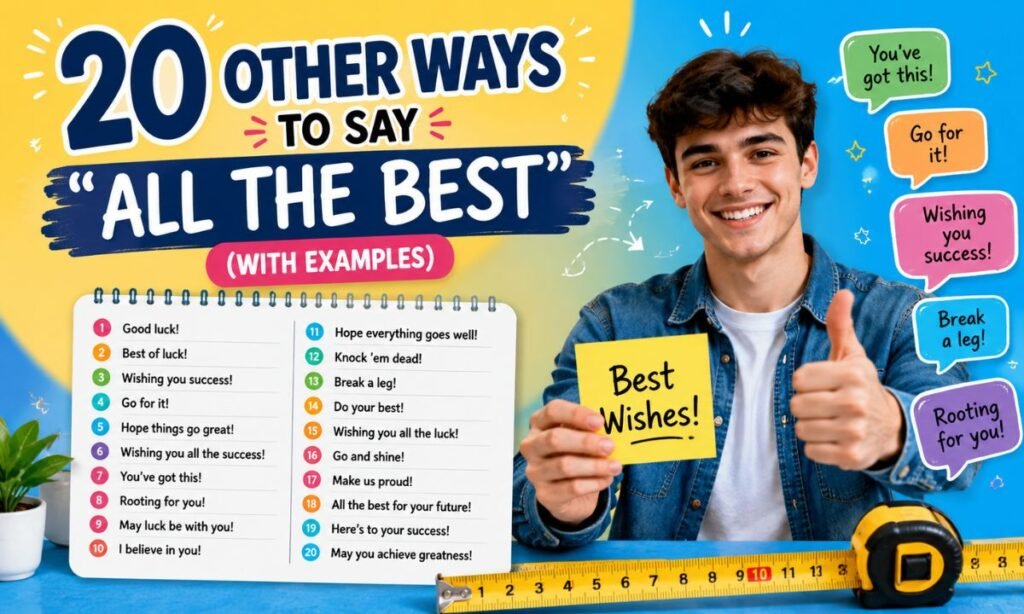
Saying “all the best” is easy. Saying it in a way that actually feels personal is harder — especially when you’re writing your tenth email of the day or signing off yet another farewell card.
If you’ve ever paused before hitting send, wondering whether “all the best” sounds too flat, too formal, or just plain repetitive, you’re not alone. It’s one of the most-used sign-offs in the English language, which means it’s also one of the easiest to overuse without realizing it.
This guide breaks down what the phrase really means, when it works, when it falls short, and gives you 20 fresh alternatives — each with real examples, tone notes, and best-use scenarios you can start using today. Whether you’re writing a professional email, a heartfelt card, or a quick text to a friend, you’ll walk away with a phrase that fits.
What Does “All the Best” Mean?
“All the best” is a short, friendly way of wishing someone success, happiness, or good fortune. It’s most often used to close a letter, email, or conversation, especially when someone is heading into something new — a job, an exam, a trip, or a major life change.
Grammatically, it’s an idiomatic expression. It doesn’t need a subject or a verb to make sense, which is part of why it slots so easily into almost any message. At its core, the phrase carries one simple idea: I hope things go well for you.
You’ll typically come across it in:
- Email sign-offs (“All the best, Sarah”)
- Farewell messages to coworkers or friends
- Greeting cards for graduations, weddings, or new jobs
- Casual conversation endings (“Alright, all the best with the move!”)
- Voicemail and text closings when wrapping up a conversation
Because it’s so versatile, it’s become something of a default choice — the phrase people reach for when they don’t want to overthink a sign-off. And that’s exactly why so many people go looking for alternatives: the phrase works, but it doesn’t always stand out.
Is It Professional/Polite to Say “All the Best”?
Yes — “all the best” is polite, safe, and widely accepted in both personal and professional settings. It works well in emails, cards, and everyday conversation without risking offense or sounding too casual. Most native speakers and style guides consider it a neutral, low-risk sign-off.
That said, it does have limits:
- In formal business writing, especially executive communication, legal correspondence, or first-time client outreach, it can feel slightly too casual compared to phrases like “warm regards” or “kind regards.”
- In emotionally significant moments — a eulogy, a serious illness, or a major life setback — it can come across as generic, since it’s used so often for low-stakes situations too.
- In romantic or deeply personal messages, it may feel distant compared to warmer, more specific phrasing that names the relationship or the moment directly.
- In repeated correspondence with the same person, using it every single time can start to feel like autopilot rather than genuine care.
So while “all the best” is rarely wrong, it isn’t always the right fit. Choosing an alternative that matches the tone and relationship makes your message land better and feel more considered.
ALSO READ:20 Other Ways to Say “Bro” (With Examples)
Why You Need Alternatives to “All the Best”
Here’s the honest truth: when a phrase gets used constantly, it starts to lose its impact. Readers skim past it without really registering it. Alternatives to “all the best” help you:
- Sound more genuine. A specific phrase shows you actually thought about the message instead of copy-pasting a default sign-off you use for everyone.
- Match the tone of the moment. Not every goodbye is the same — a promotion deserves different energy than a hospital visit, and a wedding calls for something different than a job interview.
- Avoid repetition. If you’re writing multiple messages a day — emails, cards, LinkedIn notes, client updates — varying your phrasing keeps your writing from feeling robotic or copy-pasted.
- Strengthen relationships. Thoughtful, specific words tend to be remembered longer than generic ones. People notice when you take the extra second to personalize a closing line.
- Fit different formality levels. Some alternatives suit corporate emails; others suit close friends. Having a range of options means you’re never stuck reaching for the same three words.
- Stand out in written communication. In a world of templated emails and auto-generated messages, a well-chosen phrase signals real effort.
In short, variety isn’t just about sounding better. It’s about communicating more accurately — matching your words to the actual moment instead of defaulting to whatever’s easiest.
Advantages and Disadvantages of Using “All the Best” and Its Alternatives
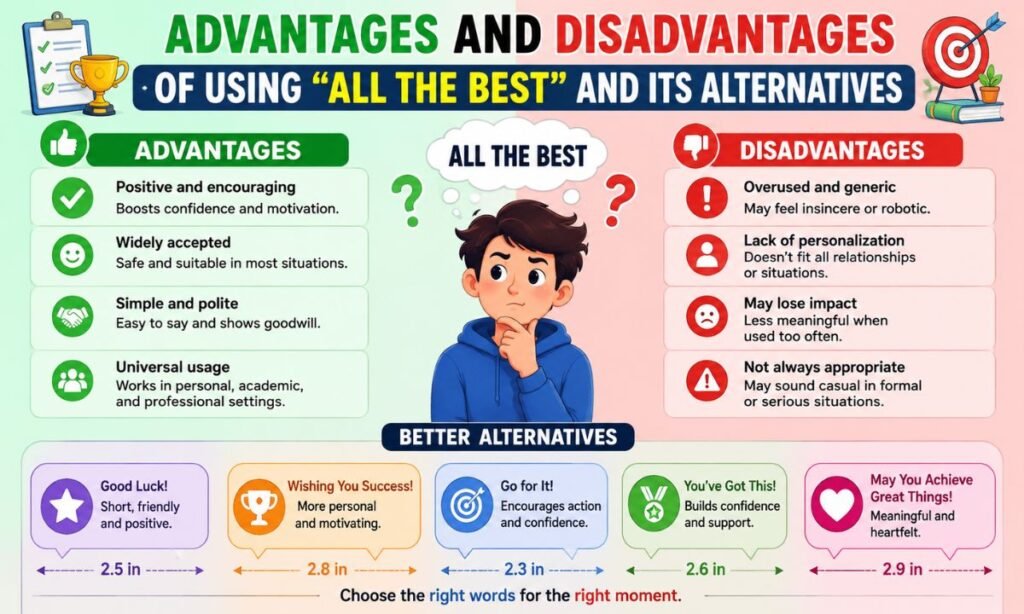
Before you swap in a new phrase, it helps to weigh the pros and cons of sticking with the original versus branching out into alternatives.
Advantages:
- “All the best” is universally understood — there’s virtually no risk of confusion across audiences, industries, or cultures.
- It’s quick and easy to use in any sign-off without overthinking word choice.
- Alternatives allow tone customization — you can go formal, casual, warm, or motivational depending on who you’re writing to.
- Alternatives reduce repetition fatigue, especially in professional settings where you write similar messages day after day.
- Some alternatives carry extra meaning. “Success to you” implies achievement, “take care” implies concern for wellbeing, and “keep shining” implies recognition of someone’s effort — letting you say more with roughly the same number of words.
- A well-chosen alternative can leave a stronger impression, especially in cards, farewells, and messages meant to be remembered.
Disadvantages:
- “All the best” can feel impersonal when overused, especially in close relationships where more warmth is expected.
- Some alternatives are too casual for formal settings — “take it easy,” for example, doesn’t belong in a corporate email to a client.
- Others can feel overly formal for casual friendships — texting “warm regards” to a close friend would feel oddly stiff.
- Choosing the wrong alternative can unintentionally shift the tone of your message, making it read as too stiff, too casual, or too sentimental for the situation.
- Learning a wide range of alternatives takes a bit of practice to know instinctively which phrase fits which context.
- Overusing “creative” alternatives can also backfire — sometimes simple and familiar really is the better choice.
Tips for Choosing the Right Phrase
Not every alternative works in every context. Use these guidelines to choose well every time:
- Match the formality level. Save phrases like “warm regards” or “wishing you continued success” for professional emails. Save “take it easy” or “have a great one” for friends and casual conversations.
- Consider the occasion. A new job deserves a different phrase than a farewell after a loss. A wedding calls for something warmer than a work deadline. Match tone to context every time.
- Think about your relationship. Close friends and family can handle warmer, more personal phrasing. Colleagues, clients, and acquaintances usually prefer neutral, polished language.
- Keep cultural context in mind. Some phrases, like “Godspeed,” carry religious or old-fashioned undertones that may not suit every audience or region.
- Don’t overdo it. One well-chosen phrase beats three stacked together at the end of a message. Simplicity often reads as more sincere than a long string of well-wishes.
- Read it out loud before sending. If it sounds unnatural when spoken, it’ll likely feel unnatural in writing too.
- Consider the medium. A phrase that works beautifully on a handwritten card might feel overly dramatic in a two-line text message.
Full List of Alternatives
Here’s a quick-reference table before we go through each phrase in detail.
| # | Phrase | Best For | Tone |
|---|---|---|---|
| 1 | Best Wishes | Cards, general emails | Warm, polite |
| 2 | Wishing You Well | Health, recovery, transitions | Gentle, caring |
| 3 | Good Luck | Exams, interviews, competitions | Casual, encouraging |
| 4 | Take Care | Farewells, casual goodbyes | Friendly, informal |
| 5 | Warm Regards | Professional emails | Formal, polished |
| 6 | Sending You My Best | Personal messages | Heartfelt |
| 7 | Take It Easy | Friends, casual chats | Relaxed |
| 8 | Hope It Goes Well | Before events, exams, meetings | Supportive |
| 9 | Godspeed | Big journeys, bold undertakings | Formal, dramatic |
| 10 | Have a Great One | Everyday goodbyes | Light, casual |
| 11 | Success to You | Career, business milestones | Motivational |
| 12 | Wishing You the Best | General, all-purpose | Sincere |
| 13 | All Good Wishes | Cards, letters | Traditional |
| 14 | Keep Shining | Encouragement, achievements | Uplifting |
| 15 | Here’s to Your Success | Toasts, celebrations | Celebratory |
| 16 | Wishing You Happiness | Weddings, personal milestones | Warm, personal |
| 17 | Have a Wonderful Day | Everyday interactions | Friendly |
| 18 | Wishing You Fortune | New ventures, business | Hopeful |
| 19 | Keep Up the Great Work | Workplace encouragement | Motivational |
| 20 | May You Thrive | Life transitions, farewells | Poetic, sincere |
Now let’s break each one down, including how it’s different from “all the best” and exactly when to reach for it.
1. Best Wishes
Meaning: A classic, warm way to wish someone happiness and success.
“Best wishes” is one of the most common alternatives out there — and for good reason. It works in almost any context: cards, emails, texts, and spoken farewells. It carries the same broad, all-purpose feel as “all the best,” so it’s an easy, low-risk swap.
Best used for: General messages, greeting cards, semi-formal emails.
Avoid when: You want something more specific or emotionally distinct — “best wishes” can feel just as generic as the original phrase if overused.
Examples:
- Best wishes on your new adventure.
- Best wishes for a speedy recovery.
- Best wishes to you and your family this holiday season.
2. Wishing You Well
Meaning: A gentle, caring way to express hope for someone’s wellbeing.
This phrase leans slightly more personal than “best wishes,” making it a strong fit when health, comfort, or emotional wellbeing is the focus rather than achievement or success.
Best used for: Recovery messages, life transitions, check-ins with someone going through change.
Avoid when: The context is achievement-focused, like a competition or exam — it can feel slightly mismatched there.
Examples:
- Wishing you well as you settle into your new home.
- Just wishing you well during this busy season.
- Wishing you well — let me know if you need anything.
3. Good Luck
Meaning: A simple, direct wish for a positive outcome.
“Good luck” is short, casual, and instantly understood. It’s perfect for moments with a clear, specific result — a test, interview, or competition — where “all the best” might feel a bit too broad.
Best used for: Exams, interviews, sports, presentations, auditions.
Avoid when: Writing formal business correspondence, where it can sound slightly too casual.
Examples:
- Good luck with your interview tomorrow!
- Good luck on the exam — you’ve got this.
- Good luck at the game this weekend.
4. Take Care
Meaning: A caring farewell that shows concern for someone’s wellbeing.
“Take care” works well as a casual sign-off, especially when you won’t be in touch for a while. It’s friendly without being overly formal, and it puts the focus on the other person’s wellbeing rather than a specific outcome.
Best used for: Casual goodbyes, ending phone calls, closing informal emails.
Avoid when: The situation calls for something more celebratory or achievement-focused.
Examples:
- Take care, and see you soon.
- Take care of yourself this week.
- Take care — talk soon!
5. Warm Regards
Meaning: A polished, professional way to close a message with kindness.
If “all the best” feels slightly too casual for a business email, “warm regards” is a solid step up in formality while still feeling personable rather than cold. It’s a favorite in corporate and client-facing communication.
Best used for: Professional emails, client communication, formal letters.
Avoid when: Messaging close friends or family — it can come across as unexpectedly stiff.
Examples:
- Warm regards, and thank you for your time.
- Warm regards, looking forward to our next meeting.
- Warm regards from the entire team.
6. Sending You My Best
Meaning: A heartfelt, personal expression of goodwill.
This phrase feels more intentional than a generic sign-off — it implies you’re actively thinking of the person right now, not just following a script you use for everyone.
Best used for: Personal messages, close friends, emotional support.
Avoid when: Formal or first-time professional communication, where it can feel slightly too intimate.
Examples:
- Sending you my best as you start this new chapter.
- Sending you my best for a smooth recovery.
- Sending you my best today and always.
7. Take It Easy
Meaning: A relaxed, informal way to say goodbye.
This one is strictly casual — great for friends or coworkers you’re close with, but not for formal writing. It carries a laid-back, low-pressure energy that “all the best” doesn’t quite capture.
Best used for: Texts, casual chats, informal farewells.
Avoid when: Writing to clients, superiors, or anyone in a formal context.
Examples:
- Take it easy this weekend!
- Alright, take it easy — catch you later.
- Take it easy and rest up.
8. Hope It Goes Well
Meaning: A supportive wish before an upcoming event.
Unlike phrases used at the very end of a conversation, this one works especially well right before someone heads into something — a meeting, a date, a big decision — rather than as a closing farewell.
Best used for: Before interviews, presentations, appointments.
Avoid when: The event has already happened — this phrase is forward-looking by design.
Examples:
- Hope it goes well at the doctor’s today.
- Hope it goes well — let me know how it turns out.
- Hope it goes well with the client meeting.
9. Godspeed
Meaning: A formal, almost old-fashioned wish for safety and success on a journey or major undertaking.
“Godspeed” carries a dramatic, slightly poetic tone that instantly elevates the emotional weight of a message. It works best for major transitions or send-offs, not everyday goodbyes, and it does carry mild religious undertones worth being aware of.
Best used for: Big life changes, long journeys, bold new ventures.
Avoid when: The situation is low-stakes or casual — it can come across as overly theatrical.
Examples:
- Godspeed on your journey ahead.
- Godspeed as you start this new business.
- Godspeed to you and your team.
10. Have a Great One
Meaning: A light, casual way to wish someone a good day or event.
This phrase is common in everyday spoken English — quick, breezy, and low-pressure. It’s less about long-term success and more about wishing someone well in the immediate moment.
Best used for: Casual conversations, service interactions, quick goodbyes.
Avoid when: The situation calls for something more meaningful or specific, like a major life event.
Examples:
- Thanks for stopping by — have a great one!
- Have a great one, see you tomorrow.
- Have a great one out there.
11. Success to You
Meaning: A motivational wish focused specifically on achievement.
This phrase puts the spotlight directly on success rather than general wellbeing, making it ideal for career milestones, competitions, or anything with a clear win-or-lose outcome.
Best used for: Business ventures, career changes, competitions.
Avoid when: The moment is more about comfort or wellbeing than achievement.
Examples:
- Success to you in your new role.
- Success to you as you launch the business.
- Wishing success to you and your entire team.
12. Wishing You the Best
Meaning: A sincere, all-purpose expression of goodwill.
Very close to “all the best” in meaning, but the slight rewording makes it feel a touch more personal and less like a stock phrase people have heard a thousand times.
Best used for: General farewells, emails, greeting cards.
Avoid when: You want a phrase that’s clearly distinct from “all the best” — the similarity is both its strength and its limitation.
Examples:
- Wishing you the best in your future endeavors.
- Wishing you the best as you move forward.
- Wishing you the best, always.
13. All Good Wishes
Meaning: A traditional, slightly formal way to close a letter or card.
This phrase has an old-school charm, often seen in handwritten notes or formal greeting cards rather than quick digital messages. It reads as thoughtful and deliberate.
Best used for: Letters, formal cards, traditional correspondence.
Avoid when: Texting or messaging casually — it can feel out of place in a quick digital exchange.
Examples:
- All good wishes for your wedding day.
- All good wishes as you begin retirement.
- All good wishes to you this holiday season.
14. Keep Shining
Meaning: An uplifting way to encourage someone to keep doing well.
This phrase works best when celebrating someone’s talent, effort, or personality — not just wishing them luck, but affirming who they are and the impact they’re already having.
Best used for: Encouragement messages, celebrating achievements, motivational notes.
Avoid when: Formal business writing — it’s better suited to warm, personal messages.
Examples:
- Keep shining — you’ve earned every bit of this success.
- Keep shining in everything you do.
- Keep shining, the world needs your energy.
15. Here’s to Your Success
Meaning: A celebratory phrase often used like a toast.
This works especially well in spoken settings — toasts, speeches, or verbal congratulations — as well as written celebration messages tied to a specific win or milestone.
Best used for: Toasts, celebrations, promotions.
Avoid when: The moment isn’t celebratory — this phrase assumes something worth toasting to.
Examples:
- Here’s to your success in the new role!
- Here’s to your success — you’ve earned it.
- Here’s to your success this year and beyond.
16. Wishing You Happiness
Meaning: A warm, personal wish focused on emotional wellbeing rather than achievement.
This is a great choice for milestones centered on personal life rather than career — weddings, births, new homes — where “all the best” can feel a little too neutral.
Best used for: Weddings, personal milestones, family celebrations.
Avoid when: The context is professional or achievement-based rather than personal.
Examples:
- Wishing you happiness in your new home.
- Wishing you happiness as you start this journey together.
- Wishing you happiness today and always.
17. Have a Wonderful Day
Meaning: A friendly, everyday well-wish.
Simple and universally appropriate, this phrase suits nearly any casual interaction, from emails to in-person goodbyes. It’s lighter and more immediate than “all the best,” which often implies a longer-term wish.
Best used for: Everyday interactions, customer service, casual emails.
Avoid when: The situation calls for a longer-term or more significant wish, like a farewell or major transition.
Examples:
- Thanks again — have a wonderful day!
- Have a wonderful day, see you next time.
- Have a wonderful day ahead.
18. Wishing You Fortune
Meaning: A hopeful wish for prosperity or success, often tied to new ventures.
Slightly less common than other phrases on this list, “wishing you fortune” adds a distinctive touch, especially for business-related or entrepreneurial messages.
Best used for: New businesses, financial milestones, entrepreneurial ventures.
Avoid when: The context isn’t related to prosperity or business — it can feel oddly specific otherwise.
Examples:
- Wishing you fortune as you launch your startup.
- Wishing you fortune and success in the year ahead.
- Wishing you fortune on this new path.
19. Keep Up the Great Work
Meaning: A motivational phrase recognizing ongoing effort and encouraging continued success.
Unlike phrases meant for endings or farewells, this one works well as ongoing encouragement mid-project or mid-relationship — perfect for workplace feedback rather than a final goodbye.
Best used for: Performance reviews, coaching, workplace encouragement.
Avoid when: You’re saying goodbye for good — this phrase implies continuation, not closure.
Examples:
- Keep up the great work — the team really notices your effort.
- Keep up the great work on this project.
- Keep up the great work, it’s paying off.
20. May You Thrive
Meaning: A poetic, sincere wish for long-term wellbeing and growth.
This phrase feels more meaningful than a quick sign-off, making it ideal for significant farewells or major life transitions where you want your words to carry real weight.
Best used for: Farewells, retirements, life transitions.
Avoid when: The situation is casual or everyday — it’s best saved for moments that matter.
Examples:
- May you thrive in this next chapter of life.
- May you thrive wherever this new path leads you.
- May you thrive, and know you’ll be missed.
How to Use These Phrases in Different Contexts
The same phrase can land differently depending on where you use it. Here’s a quick breakdown by format.
In emails: Stick to phrases that read well in text and don’t rely on tone of voice to land — “warm regards,” “wishing you continued success,” and “best wishes” all work cleanly in written form. Save more emotional phrases like “sending you my best” for people you know well.
In text messages: Short and casual wins here. “Take care,” “good luck,” and “have a great one” fit the quick, informal nature of texting. Longer, more poetic phrases like “may you thrive” can feel out of place in a two-line message.
In greeting cards: Cards are one of the few formats where longer, more sentimental phrases genuinely shine. “All good wishes,” “wishing you happiness,” and “may you thrive” all read beautifully in handwritten notes, where you have space and time to be thoughtful.
In speeches or toasts: Spoken settings call for phrases with rhythm and warmth. “Here’s to your success” and “godspeed” both work well out loud, especially at celebrations, weddings, or farewell gatherings.
In workplace feedback: When you’re encouraging someone mid-project rather than saying goodbye, forward-looking phrases like “keep up the great work” or “hope it goes well” fit better than farewell-style phrases like “all the best,” which implies an ending.
Common Mistakes to Avoid
Even with a long list of alternatives, it’s easy to slip up. Watch out for these common missteps:
- Mismatching formality. Using “take it easy” with a client or “warm regards” with a close friend both create an odd tonal gap.
- Stacking too many phrases. Ending a message with “best wishes, take care, all the best!” feels cluttered rather than warm. One well-chosen phrase is enough.
- Using dramatic phrases for small moments. Saying “Godspeed” before someone’s Tuesday dentist appointment reads as over-the-top rather than sincere.
- Defaulting to the same phrase every time. Even a great alternative loses its impact if it becomes your new automatic sign-off for every message.
- Ignoring the relationship. A phrase that works for a coworker might feel too formal for a sibling, and vice versa. Always factor in who you’re actually talking to.
FAQs
Is “all the best” grammatically correct? Yes, it’s a fixed idiomatic phrase and doesn’t require a subject or verb to be correct.
Can I use “all the best” in a formal business email? Yes, but “warm regards” or “kind regards” often sound more polished for formal correspondence.
What’s a more personal alternative to “all the best”? “Sending you my best” or “wishing you happiness” feel warmer and more personal.
Is “good luck” the same as “all the best”? They’re similar, but “good luck” focuses on a specific outcome, while “all the best” is broader.
What should I say instead of “all the best” for a coworker leaving the company? “May you thrive” or “wishing you continued success” both work well for farewells.
Is it okay to repeat “all the best” in multiple emails to the same person? It’s fine occasionally, but varying your phrasing keeps your messages feeling fresh and thoughtful.
Which alternative works best for a wedding card? “Wishing you happiness” or “all good wishes” both suit weddings and personal celebrations well.
Is “Godspeed” too formal for everyday use? Yes, it’s best saved for major journeys or big life transitions rather than casual goodbyes.
Conclusion
“All the best” will always be a safe, polite choice — but it doesn’t have to be your only one. Whether you’re writing a quick text, a formal email, or a heartfelt card, the right alternative can make your message feel more personal, more fitting, and more memorable.
Next time you’re about to type “all the best,” pause for a second. Think about who you’re writing to, what the moment calls for, and how formal or personal the message should feel. Then pick the phrase from this list that fits best. Your message — and the person reading it — will be better for it.