

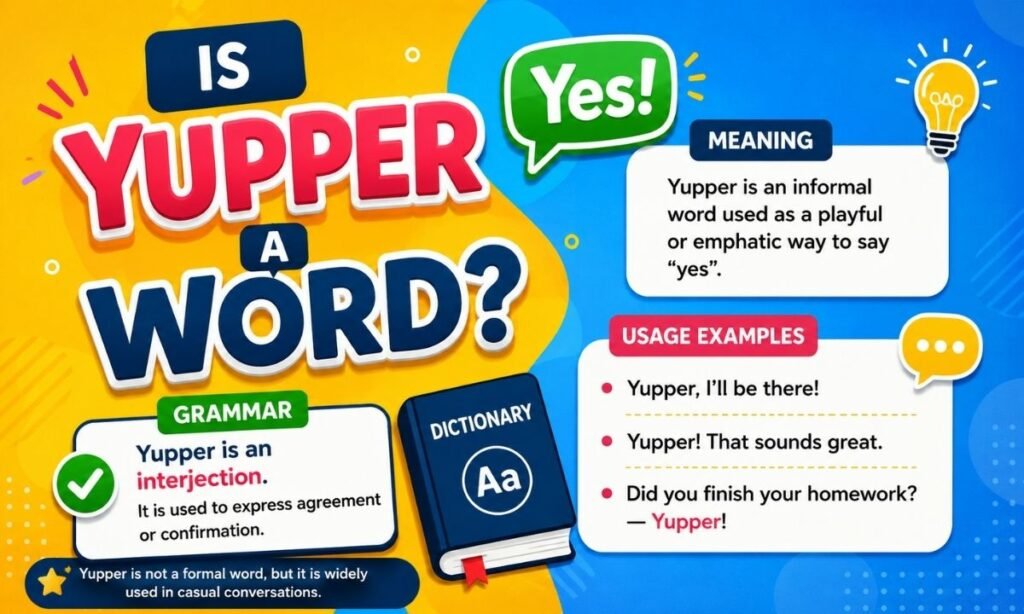
Have you ever seen the word “yupper” and wondered if it is actually correct? If you are asking, Is Yupper a Word?, you are not alone. This unusual term can be confusing because it is not commonly used in everyday English.
In this guide, we will answer Is Yupper a Word? and explain what it means. We will also look at where the word comes from and how people use it in conversations.
“Yupper” is an informal word that is sometimes used as a playful or casual way to say “yes” or “yep.” Its meaning can depend on the context and the person using it.
Understanding unusual words like “yupper” can help you avoid confusion when reading online conversations or informal messages. Let’s explore its meaning, usage, and whether you should use it in your own writing.
Is Yupper a Word? The Quick Answer
Short Answer for Busy Readers
Yes — yupper is a word in informal, spoken, and digital English. No — it is not a standard word recognized by major dictionaries. It works as a casual, upbeat version of “yes,” “yep,” or “yup,” and people use it constantly in texts, chats, and everyday talk. It’s just not something you’d write in a report or say in a job interview.
Is “Yupper” Found in Standard English?
Standard English refers to the version of the language taught in schools, used in formal writing, and catalogued in major dictionaries. Yupper doesn’t belong there. You won’t find it listed as a headword in Merriam-Webster or the Oxford English Dictionary, and most style guides won’t touch it either.
That absence doesn’t mean the word is fake. It means dictionaries are conservative by design — they add new entries only after a word shows sustained, widespread use across many contexts and years. Slang almost always lives outside that boundary long before (or instead of) ever crossing into it.
Think of “standard English” as the formal layer of the language — the version used in news articles, textbooks, contracts, and official documents. Yupper simply doesn’t belong to that layer. It belongs to the spoken, conversational layer, which is just as real but governed by different rules. Millions of words and phrases live comfortably in that second category without ever needing formal recognition.
How Native Speakers Actually Use It
Ask any native English speaker if they’ve heard “yupper,” and most will say yes immediately. It shows up in:
- Text messages between friends
- Casual replies on social media
- Regional speech, especially in parts of the American Midwest
- Group chats, gaming voice chat, and online forums
- Light, joking exchanges where a flat “yes” feels too stiff
Native speakers don’t need a dictionary entry to understand it. Context makes the meaning obvious, and that’s really the test that matters in everyday communication.
This is a useful reminder that fluency isn’t measured by dictionary memorization. It’s measured by how naturally you can send and receive meaning in real conversation. Yupper passes that test every single day, in millions of exchanges most people never think twice about.
ALSO READ THIS:20 Other Ways to Say “Have a Good Day” (With Examples)
Quick Facts Table
| Detail | Information |
| Meaning | Yes / yep, said with extra warmth or enthusiasm |
| Part of speech | Interjection (sometimes used informally as a noun) |
| Pronunciation | YUH-per |
| Dictionary status | Not listed in major standard dictionaries |
| Register | Informal, casual, conversational |
| Common settings | Texting, social media, spoken slang |
| Related words | Yup, yep, yeah, yuppers |
| Avoid in | Formal writing, academic papers, professional emails |
Why So Many People Search “Is Yupper a Word?”
The Rise of Informal Internet English
Online communication rewards speed and personality over formality. Comment sections, captions, and direct messages favor short, expressive words that carry tone in just a syllable or two. Yupper fits that mold perfectly — it says “yes” while also saying “I’m relaxed and friendly about this.”
As more everyday conversation moves onto screens, words like this spread faster than they ever could through print or broadcast media. A single popular post or trending clip can push a casual term into thousands of new vocabularies within days.
Informal internet English also tends to favor sound and rhythm over strict grammar. A word that’s fun to type and fun to say has a built-in advantage, and yupper checks both boxes. It’s short enough to fire off quickly but has just enough extra flair to stand out from a plain “yes.”
How Text Messaging Changed Everyday Language
Texting shortened everything. Full sentences became fragments. “Yes” became “yep,” then “yup,” then playful stretched versions like “yupper” or “yuppers.” Each variation adds a slightly different flavor — enthusiasm, sarcasm, warmth — without adding extra typing effort.
Because texting is inherently casual, it created space for words that would never appear in a formal letter. Yupper thrives specifically because it was born in that low-pressure, tone-driven environment.
Voice-to-text and quick typing habits reinforce this further. When people talk the way they’d naturally speak out loud, playful variations like yupper slip in without a second thought. Over time, repeated use across millions of conversations turns a one-off joke into a recognizable, shared expression.
Why Unofficial Words Feel Real
People instinctively treat dictionaries as the final word on what counts as “real” language. So when a term like yupper isn’t listed there, it can feel questionable, even fake. But language doesn’t actually work that way. Words become real through use, not through approval. If a listener understands you and the word does its job, it’s functioning as a real word — dictionary entry or not.
This tension between common usage and formal recognition is the exact reason the question “is yupper a word?” keeps trending in search.
Common Situations Where People Encounter “Yupper”
- Replying to a casual text like “You still coming?”
- Reacting to a meme or joke online
- Chatting during a multiplayer game
- Confirming plans with friends in a group chat
- Hearing it from someone with Midwestern or regional speech patterns
- Responding to a coworker’s casual Slack message outside formal channels
- Answering a quick yes-or-no question from a sibling or roommate
- Captioning a photo or video where a lighthearted tone fits better than a plain “yes”
Each of these situations shares one thing in common: low stakes and high familiarity. Yupper thrives in relaxed exchanges between people who already know each other, which is exactly why it rarely shows up in first-time introductions or unfamiliar settings.
What Does “Yupper” Mean?
The Core Meaning of Yupper
At its simplest, yupper means yes. It’s an affirmative response, just like “yep” or “yeah,” but with a slightly exaggerated, cheerful edge. The extra syllable at the end gives it rhythm and personality that a plain “yes” doesn’t have.
Grammatically, yupper functions as an interjection — a standalone word used to express a reaction or response rather than fitting into a sentence’s subject-verb structure. Occasionally, people stretch its use into a playful noun, referring to someone who agrees a lot as “a real yupper,” though this usage is far less common than the standard affirmative.
How It Functions as an Enthusiastic Version of “Yes”
Compare these two replies:
- “Yes, I’ll be there.”
- “Yupper, I’ll be there!”
The second one feels warmer and more energetic. That’s the whole function of yupper — it takes a neutral confirmation and injects a bit of friendliness or excitement into it. The meaning doesn’t change. The delivery does.
Emotional Tone and Speaker Intent
Yupper can carry a few different emotional shades depending on context:
- Friendly enthusiasm — confirming plans happily
- Playful sarcasm — agreeing with a hint of teasing
- Casual confidence — a relaxed, no-big-deal “yes”
- Light humor — used for comedic effect in memes or jokes
The word itself stays simple. Tone of voice, punctuation, or surrounding context tells you which flavor is intended.
| Context Clue | Likely Tone |
| “Yupper!” with an exclamation point | Enthusiastic, excited |
| “yupper…” with trailing dots | Sarcastic or hesitant |
| “Yupper.” as a flat one-word reply | Casual, matter-of-fact |
| “Yupper 😂” with an emoji | Joking or lighthearted |
Punctuation and emojis do a lot of heavy lifting here, since yupper on its own doesn’t change spelling based on emotion the way some slang terms do.
Examples of Yupper in Conversation
- “Are we still meeting at six?” — “Yupper, see you then.”
- “Did you finish the assignment?” — “Yupper! Turned it in this morning.”
- “You sure about this plan?” — “Yupper, sounds good to me.”
- “Is the pizza here?” — “Yupper, just arrived.”
In each case, yupper works exactly like “yes,” just with a friendlier tone.
Regional and Generational Usage
Yupper has a notable connection to the American Midwest, where informal affirmatives like “yup” and “yeah” are already common in everyday speech. Some usage even ties the word loosely to “Yooper,” a term for someone from Michigan’s Upper Peninsula — though the two aren’t the same word and shouldn’t be confused.
Generationally, yupper skews toward casual, digital-native speech. Younger speakers and frequent texters use it more often, though it isn’t strictly limited to any one age group. It has simply become part of the informal vocabulary that circulates through group chats and social platforms.
Older speakers who grew up hearing regional variants of “yup” and “yeah” may also use yupper naturally as an extension of speech patterns they already know well. In that sense, the word bridges two influences at once: long-standing regional dialect and newer internet-driven slang.
Is Yupper a Real Word in English?
What Makes a Word “Real”?
There are two ways to judge whether a word is “real”:
- Formal recognition — Is it listed in a major dictionary?
- Functional use — Do people use it, understand it, and communicate successfully with it?
By the first standard, yupper falls short. By the second, it passes easily. Most linguists lean toward the second definition when discussing how language actually evolves, since dictionaries document usage rather than create it.
It helps to remember that dictionaries are historical records, not gatekeepers. Lexicographers track how words are actually used in speech, writing, and media, then add entries once that usage becomes widespread and stable. They don’t decide in advance which words are allowed to exist. That means a word can be fully “real” in the functional sense for years, or even decades, before a dictionary catches up to it — if it ever does at all.
Dictionary Recognition vs Actual Usage
Major dictionaries add new words only after tracking consistent use over time across a wide range of sources. Yupper hasn’t cleared that bar yet, and it may never need to — plenty of slang terms stay permanently informal without losing their usefulness.
The absence of a dictionary entry simply means yupper is classified as slang rather than standard vocabulary. It doesn’t mean the word is meaningless or incorrect in casual speech.
Plenty of words spend years, sometimes generations, in this in-between status before dictionaries ever catch up — if they do at all. Some slang terms fade out before reaching that point; others eventually become common enough that a dictionary editor decides the evidence is overwhelming. Right now, yupper sits comfortably in the “widely used but not yet formalized” category, alongside many other casual expressions people use every day without a second thought.
How Linguists Define Emerging Words
Linguists often describe words like yupper as part of the natural evolution of spoken and digital language. New expressions form constantly through blending, exaggeration, and playful modification of existing words. Yupper fits this pattern — it’s built from “yup” with an added “-er” ending that gives it more weight and personality.
This kind of word formation is common and well documented. It’s how slang has always worked, long before the internet accelerated the process.
Linguists sometimes group words like yupper under the umbrella of “phonetic playfulness” — modifications made purely to change the sound and feel of a word rather than its meaning. Adding “-er” to “yup” doesn’t alter what the word communicates, but it does change how it lands emotionally. That small shift is often enough to make an expression stick in everyday speech.
Why Many Common Expressions Start Outside Dictionaries
Words like “yeah,” “okay,” and even “hello” were once informal or unconventional before becoming everyday standard vocabulary. Language constantly borrows from casual speech and gradually formalizes the expressions that stick around long enough. Yupper may or may not follow that path, but its current status mirrors exactly what many now-common words went through early on.
The Difference Between “Yupper” and “Yuppers”
What “Yuppers” Means
Yuppers is the plural-sounding variant of yupper, though it doesn’t function as a true plural. It carries the same core meaning — an informal “yes” — but often with a slightly more exaggerated or emphatic tone.
The “-s” ending doesn’t pluralize anything here, since there’s nothing being counted. Instead, it works the same way “totally” or “definitely” gets stretched into “totes” or “def” in casual speech — the modification signals attitude rather than grammar. This is a common pattern in slang, where standard rules of plural or tense get borrowed purely for stylistic effect.
Which Version Is More Common?
Both forms circulate widely, but yupper tends to appear more often in everyday texting and casual speech, while yuppers shows up more in playful, over-the-top, or meme-style contexts.
| Feature | Yupper | Yuppers |
| Tone | Friendly, casual | Extra enthusiastic, exaggerated |
| Common use | Everyday texting and speech | Jokes, memes, emphatic replies |
| Formality | Informal | Even more informal |
| Frequency | More common | Less common, more situational |
Tone Differences Between the Two Forms
Yupper reads as relaxed and conversational. Yuppers often reads as a bit more theatrical or comedic, almost like adding an exclamation point through spelling alone. Neither is “more correct” — they simply suit slightly different moods.
Think of the difference the way you’d think about “cool” versus “coolio.” Both mean the same thing at their core, but one carries a heavier dose of playfulness. Yuppers works the same way against yupper — it’s the louder, more animated sibling of an already-casual word.
Situations Where One Sounds More Natural
- Use yupper for a quick, friendly confirmation in a normal chat.
- Use yuppers when you want to sound extra enthusiastic, sarcastic, or funny.
Both work fine interchangeably in most casual settings, so the choice usually comes down to personal style.
Why People Use Yupper Instead of Yes
Creating a Friendly Tone
A plain “yes” can sound blunt or formal, even when that’s not the intention. Yupper softens the response and makes it feel warmer, which matters a lot in text-based conversation where tone of voice is missing. Without vocal cues, a short “yes” can accidentally read as cold or annoyed, even when the sender meant nothing by it. Yupper removes that risk almost entirely.
Showing Enthusiasm
The stretched, bouncy sound of yupper naturally signals more energy than a flat “yes.” It’s an easy way to show you’re genuinely happy to confirm something, without needing extra words or emojis. This matters especially in quick exchanges, where there isn’t time or space to write “Yes, absolutely, I’d love to!” Yupper compresses that same enthusiasm into a single, easy word.
Building Social Connection
Casual slang like yupper signals familiarity and comfort between speakers. Using it suggests a relaxed relationship, which is why it shows up so often between friends, teammates, and peers rather than in professional or unfamiliar contexts. Choosing an informal word over a neutral one is a small social signal in itself — it says “I’m comfortable enough with you to drop the formality,” which can reinforce closeness in a relationship over time.
Frequently Asked Questions
Is “yupper” grammatically correct?
It’s correct as informal slang, but not appropriate in formal or academic grammar.
Can I use “yupper” in a professional email?
No. Stick to “yes” or “certainly” for professional and formal communication.
Is “yupper” the same as “yooper”?
No. “Yooper” refers to someone from Michigan’s Upper Peninsula, while “yupper” is a casual way of saying yes.
Where did “yupper” come from?
It developed as a playful extension of “yup,” blending regional speech patterns with informal digital communication.
Is “yuppers” more correct than “yupper”?
Neither is more “correct” — they’re both informal, with yuppers sounding slightly more exaggerated.
Will “yupper” ever be added to the dictionary?
Possibly, if usage continues to grow and stays consistent over time, but there’s no guarantee.
Key Takeaways About Yupper
- Yupper is a real, widely used informal word meaning “yes.”
- It is not recognized as standard by major dictionaries.
- It works best in texting, casual chats, and spoken slang.
- It adds warmth, enthusiasm, or playfulness compared to a plain “yes.”
- “Yuppers” is a related, slightly more exaggerated variant.
- Avoid it in formal writing, professional emails, or academic work.
- Its popularity reflects how digital communication keeps reshaping everyday English.
Language keeps moving, and words like yupper show exactly how that happens — not through dictionary approval, but through everyday people deciding a word gets the job done.