

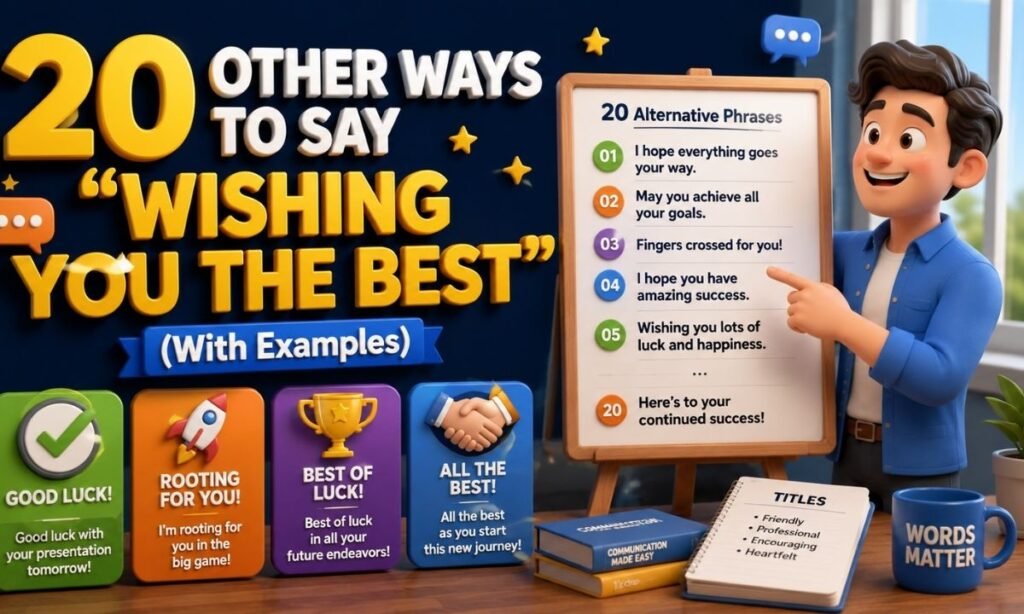
You just typed “wishing you the best” for the third time this week. A coworker’s leaving, a friend’s got a big interview, your cousin’s starting a new chapter. Same five words every time. It works, but it starts to feel a little empty after a while, like a sticky note you’ve used so many times the glue stopped holding.
Here’s the good news: there are dozens of ways to say the same warm thing without sounding like a copy-paste job. Below, you’ll find 20 fresh alternatives, what each one really means, when to use it, and a few you can send today.
What Does “Wishing You the Best” Mean?
At its core, “wishing you the best” is a way of telling someone you hope good things come their way. It’s a well wish, plain and simple. No strings attached, no specific outcome named, just a general nod that says “I’m rooting for you.”
People reach for it because it fits almost anywhere. A birthday card. A goodbye email. A text before someone’s surgery. It doesn’t demand much emotional effort, which is exactly why it gets used so often.
The catch is that its flexibility is also its weakness. Because it fits everywhere, it doesn’t feel tailored anywhere. When you say it to your best friend and your mail carrier the same way, it starts to sound like a default phrase rather than a genuine one.
That’s not a knock on the phrase. It’s just a reason to keep a few backups in your pocket.
Is It Professional or Polite to Say “Wishing You the Best”?

Yes, it’s both. “Wishing you the best” sits comfortably in almost any setting: emails to your boss, farewell cards for a coworker, LinkedIn messages, even wedding toasts. It reads as polite, warm, and safe.
That said, “safe” can work against you in high-stakes moments. If a colleague just landed a huge promotion, or a friend is heading into chemo, this phrase might feel a little thin. It’s not wrong, it’s just not specific.
Think of it like a greeting card everyone in the office signs. It says something nice, but it doesn’t say something about them. Save it for situations where a light, general touch is exactly what’s called for, and reach for something more pointed when the moment deserves more weight.
ALSO READ THIS:20 Other Ways to Say “No Worries” Professionally (With Examples)
Advantages and Disadvantages
Before you swap this phrase out everywhere, it helps to know what it actually does well, and where it falls short.
Advantages:
• Universally appropriate – fits formal emails, casual texts, and everything between
• Easy to say – no risk of sounding awkward or overly emotional
• Non-committal – doesn’t require you to know the person’s exact situation
• Quick to write – perfect for closing out a message fast
• Widely understood – no cultural or generational confusion around the meaning
Disadvantages:
• Overused – shows up so often it can sound automatic
• Lacks personality – doesn’t reflect the specific relationship or moment
• Feels generic – in emotional situations, it can come across as distant
• Repetitive in writing – using it in every email or card gets noticed
• Misses the chance to connect – a more specific line often means more to the reader
Why You Need Alternatives
Repetition dulls meaning. If you say “wishing you the best” to every single person, in every single situation, it stops carrying weight. The words are still nice, but the reader’s brain glosses right over them, the same way you skim past a store’s “have a great day” at checkout.
Alternatives fix this in two ways. First, they let your message match the actual moment, a job interview needs different energy than a farewell dinner. Second, they show the other person you actually thought about what to say, instead of grabbing the first phrase that came to mind.
There’s also a practical side if you write for a living, like emails, cards, captions, or announcements. Using the same closing line over and over makes your writing feel flat and predictable. A rotating set of phrases keeps your tone fresh and your readers engaged.
Tips for Choosing the Right Phrase
Picking the right alternative isn’t about finding the fanciest words. It’s about matching tone, context, and relationship.
• Match the formality of the situation. A business email calls for something like “to your continued success,” not “sending positive vibes.”
• Think about your relationship. Close friends can handle playful or emotional phrases. Acquaintances usually need something more neutral.
• Consider the occasion. A wedding, a farewell, and a get-well card all call for different tones, don’t reuse the same line across all three.
• Read it out loud. If it sounds stiff coming out of your mouth, it’ll probably read stiff too.
• Don’t overdo the flourish. One warm, well-chosen phrase beats three stacked together.
• Add a personal detail when you can. Naming the specific goal or event (“good luck with your presentation Tuesday”) makes any phrase land harder.
Full List of Alternatives
Here’s the complete lineup: 20 phrases you can swap in, organized by the vibe they bring to a message.
| # | Phrase | Best For | Tone |
| 1 | All the Best | General farewells, emails | Warm, neutral |
| 2 | Best Wishes | Cards, formal notes | Polite, classic |
| 3 | Wishing You Success | Career moves, new jobs | Professional |
| 4 | Wishing You Joy | Weddings, celebrations | Heartfelt |
| 5 | Wishing You Happiness | Life milestones | Warm, personal |
| 6 | All Good Things | Casual send-offs | Friendly |
| 7 | May Your Dreams Come True | Graduations, big goals | Inspiring |
| 8 | Good Luck | Interviews, tests, tryouts | Casual, direct |
| 9 | Sending Positive Vibes | Texts, social captions | Light, casual |
| 10 | May You Thrive | New chapters, moves | Encouraging |
| 11 | To Your Continued Success | Business emails | Formal |
| 12 | Here’s Wishing You Well | Recovery, health updates | Gentle |
| 13 | Best of Luck and Happiness | Weddings, new ventures | Warm |
| 14 | Cheers to Your Success | Celebrations, toasts | Celebratory |
| 15 | Hoping for Your Success | Interviews, applications | Supportive |
| 16 | May Your Efforts Pay Off | Hard work, projects | Motivating |
| 17 | Sending My Best | Quick texts, emails | Casual, sincere |
| 18 | All the Happiness in the World | Weddings, births | Deeply warm |
| 19 | Here’s to New Beginnings | Farewells, fresh starts | Hopeful |
| 20 | May Your Path Be Bright | Graduations, new roles | Poetic |
1. All the Best
“All the best” is the closest cousin to the original phrase, and honestly, it might be even more common. It works at the bottom of an email, in a card, or as a quick text sign-off.
Example: “It was great working with you these past two years. All the best in your new role!”
This one leans slightly more casual than “wishing you the best,” which makes it a smooth swap for coworkers you’re friendly with, not just formal contacts.
2. Best Wishes
“Best wishes” has an old-school charm to it. It shows up on greeting cards constantly, and for good reason: it’s short, sincere, and never feels out of place.
Example: “Best wishes on your new home! We hope it brings you years of happiness.”
Use it for weddings, retirements, new babies, or any card where you want something classic without sounding stiff.
3. Wishing You Success
When someone’s chasing a specific goal, like a promotion, a business launch, or a certification, “wishing you success” narrows the focus. It’s not just hoping things go well generally, it’s hoping this particular thing works out.
Example: “Wishing you success as you take on this new leadership position.”
Save it for career and achievement-focused moments rather than casual hangouts or birthdays.
4. Wishing You Joy
This phrase pulls emotion into the mix. Instead of hoping for outcomes, you’re hoping for a feeling, which makes it perfect for weddings, engagements, and family celebrations.
Example: “Wishing you joy as you begin this new life together.”
It’s a step warmer than “best wishes,” so save it for people you’re genuinely close to.
5. Wishing You Happiness
Similar to “wishing you joy,” but slightly broader. This one works for retirements, new homes, birthdays, or really any life milestone where the goal isn’t achievement, it’s contentment.
Example: “Wishing you happiness in this next chapter of your life.”
It reads as sincere without feeling overly formal, which makes it flexible for both cards and casual messages.
6. All Good Things
This phrase has a laid-back, almost poetic feel. It doesn’t specify what “good things” means, which gives it a relaxed, open-ended warmth.
Example: “All good things coming your way, friend. Enjoy the trip!”
It fits texts, social captions, and casual goodbyes better than formal business emails.
7. May Your Dreams Come True
Big goals deserve a big phrase. This one works especially well for graduations, career leaps, or anyone chasing something they’ve talked about for years.
Example: “May your dreams come true as you head off to college this fall.”
It carries a hopeful, almost storybook energy, so it’s better suited to milestone moments than everyday farewells.
8. Good Luck
Simple, direct, and instantly understood. “Good luck” works anywhere a specific event is coming up: a game, a test, a job interview, a first date.
Example: “Good luck on your exam tomorrow, you’ve got this!”
It’s less emotional than most of the phrases on this list, which makes it a safe pick for casual or even professional situations.
9. Sending Positive Vibes
This one leans casual and modern. It’s common in texts, Instagram captions, and quick check-ins, especially among younger audiences or close friends.
Example: “Sending positive vibes your way for the surgery tomorrow.”
Skip it for formal business communication, but lean on it for supportive, informal messages.
10. May You Thrive
“Thrive” implies more than survival, it means growth, success, and genuine flourishing. This phrase fits big transitions: new cities, new jobs, or a fresh business venture.
Example: “May you thrive in your new role, we’re rooting for you back home.”
It works well when someone’s stepping into unfamiliar territory and needs a little extra encouragement.
11. To Your Continued Success
This is one of the more formal picks on the list, ideal for business emails, LinkedIn messages, or notes to clients and partners.
Example: “Congratulations on the merger. To your continued success in the years ahead.”
It carries a polished, corporate tone, so save it for professional relationships rather than close friends or family.
12. Here’s Wishing You Well
Gentle and comforting, this phrase suits recovery messages, health updates, or anyone going through a hard stretch. It doesn’t push positivity too hard, which can feel more genuine during tough times.
Example: “Here’s wishing you well as you recover. Take all the time you need.”
It’s a good middle ground between formal and heartfelt.
13. Best of Luck and Happiness
This one combines two ideas: hoping for good fortune and hoping for genuine contentment. It works well for weddings, new business ventures, or any moment that blends risk with excitement.
Example: “Best of luck and happiness as you open your new shop downtown!”
The double meaning gives it more weight than a single-word wish like “good luck.”
14. Cheers to Your Success
There’s a celebratory ring to this phrase, almost like raising a glass. It fits toasts, retirement parties, or achievement announcements perfectly.
Example: “Cheers to your success, you earned every bit of it.”
Save it for moments where celebration is part of the vibe, not quiet or somber occasions.
15. Hoping for Your Success
A slightly softer version of “wishing you success,” this phrase feels more personal, like you’re genuinely invested in the outcome rather than just offering a polite line.
Example: “Hoping for your success at the interview next week, you’ve prepared so well.”
It’s a strong pick when you want to acknowledge someone’s effort alongside your good wishes.
16. May Your Efforts Pay Off
This phrase recognizes the work someone put in, not just the outcome. It’s ideal for projects, applications, or anything that took real time and energy to complete.
Example: “May your efforts pay off, you’ve put in so much work on this proposal.”
It adds a layer of respect that generic phrases miss, since it acknowledges the process, not just the result.
17. Sending My Best
Short, casual, and easy to drop into a quick text or closing line. It reads as sincere without requiring much elaboration.
Example: “Can’t make it to the party, but sending my best your way!”
It’s a solid substitute for “wishing you the best” when you want something a touch more personal without adding extra length.
18. All the Happiness in the World
This is one of the warmest phrases on the list, often reserved for weddings, engagements, or the birth of a child. It goes beyond a simple wish and leans into deep, genuine warmth.
Example: “All the happiness in the world to you both on your wedding day.”
Save this one for the big, emotional milestones, it loses impact if used too casually.
19. Here’s to New Beginnings
Perfect for farewells, career changes, moves, or anytime someone’s closing one chapter and opening another. It has a hopeful, forward-looking energy.
Example: “Here’s to new beginnings as you start this next chapter in Austin.”
It works especially well in toasts, cards, and farewell speeches.
20. May Your Path Be Bright
The most poetic phrase on this list, ideal for graduations, new careers, or any moment that feels like a fresh start. It paints a picture rather than just stating a hope.
Example: “May your path be bright as you begin medical school this fall.”
Use it when you want your message to feel a little more memorable and less like a standard line.
How to Personalize These Phrases
A great alternative phrase still needs a personal touch to really land. Here’s how to make any of these 20 feel like your words, not just a swap from a list.
• Add the person’s name. “Wishing you success, Sarah” hits harder than the phrase alone.
• Name the specific event. Instead of “good luck,” try “good luck at your presentation on Thursday.”
• Reference a shared memory or inside detail. It shows the message was written for them, not copy-pasted.
• Match your usual tone with that person. If you always joke around with a friend, don’t suddenly switch to formal language.
• Keep it short. One well-chosen, personalized line beats three generic ones stacked together.
Frequently Asked Questions
Is “wishing you the best” too casual for work emails?
No, it works fine in professional emails, though “to your continued success” sounds more polished for clients or executives.
What’s the most heartfelt alternative on this list?
“All the happiness in the world” and “wishing you joy” carry the most emotional weight.
Can I use more than one phrase in the same message?
It’s best to stick with one main phrase so the message doesn’t feel overloaded.
What should I say instead for a sick friend?
“Here’s wishing you well” is gentle and fitting for health-related messages.
Are these phrases okay to use in text messages?
Yes, casual ones like “sending positive vibes” or “sending my best” fit texts perfectly.
Final Thoughts
“Wishing you the best” will always have a place, it’s warm, easy, and works almost anywhere. But your messages get stronger when you mix in phrases that actually match the moment, whether that’s a graduation, a job interview, or a friend going through something hard.
Keep this list handy the next time you’re staring at a blank card or an empty email. A little variety goes a long way, and the right phrase, paired with a personal touch, always means more than the same five words on repeat.