
If you have written even one essay, report, or blog post that references someone else’s work, you already know the problem. You type “the author states” once. Then twice. By the third time, it feels like your keyboard is stuck on repeat.
The good news is you have options. This guide walks you through 20 alternatives to “the author states,” what each one means, when to use it, and when to skip it. You will also get quick answers on tone, pros and cons, and how to pick the right word for your writing.
What Does “The Author States” Mean?
At its core, “the author states” is a reporting phrase. It tells your reader that the idea coming next belongs to someone else, not you. You are pointing to a source and saying, “here is what this person wrote.”
Say you are writing a book review or a research paper. You read a line from your source, and you want to bring it into your own paragraph. You could write, “The author states that remote work boosts productivity.” That sentence tells your reader exactly where the idea came from.
The phrase works because it is neutral. It does not tell your reader whether the author was right, wrong, confident, or unsure. It just reports. That neutrality is exactly why so many students and writers lean on it so often, sometimes too often.
Teachers and editors see this phrase constantly because it is one of the first attribution verbs people learn in school. It is safe, it is grammatically simple, and it never really sounds wrong. The catch is that safe can turn into boring fast.
Is It Professional or Polite to Say “The Author States”?
Yes, “the author states” is professional. You will not get marked down for using it, and no reader will think you sound rude or careless. It is a standard piece of academic vocabulary used in essays, literature reviews, and citations.
That said, professional does not mean powerful. A paper full of “the author states this, the author states that” reads flat. Your reader starts skimming instead of engaging, because nothing in the sentence signals tone, confidence, or stance.
Think about a coffee chat with a friend who just read a great article. They would not say “the author states” five times in one story. They would say the writer argued this, hinted at that, or flat out claimed something wild. That natural shift in language is what makes writing feel alive instead of mechanical.
So the short answer is this: use “the author states” when you need a clean, neutral reference. Reach for something else when you want your writing to carry more personality, precision, or nuance.
Advantages and Disadvantages of Using “The Author States”
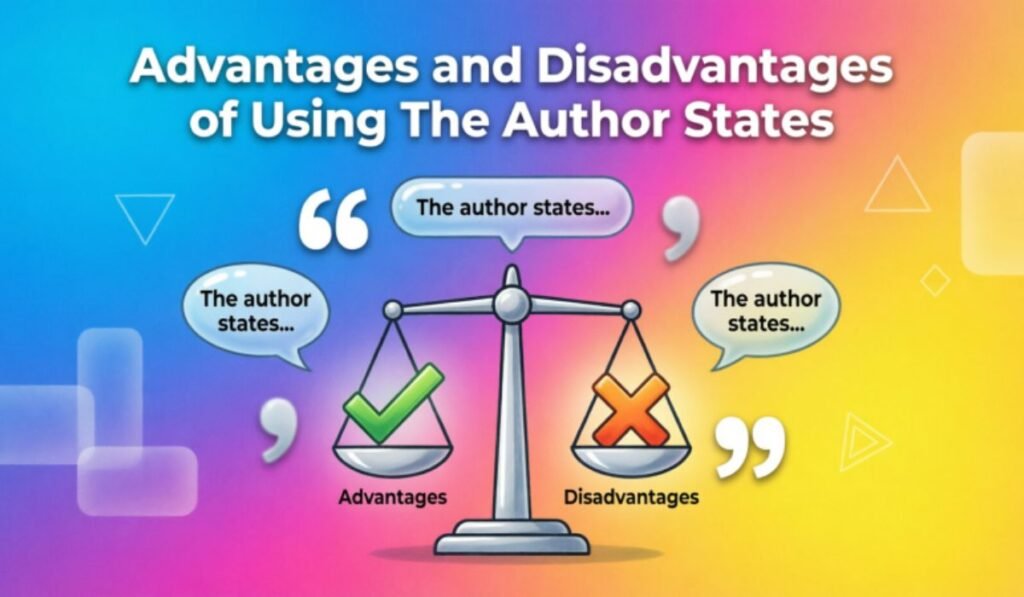
Every phrase has a job it does well and a job it does not. Here is a quick breakdown before you decide when to keep it and when to swap it out.
Advantages
• Neutral tone – it does not accidentally add bias or judgment to what the author said
• Easy to use correctly – simple sentence structure, no confusing grammar
• Widely accepted – teachers, editors, and readers all recognize it instantly
• Works in almost any context – essays, articles, business reports, even casual writing
Disadvantages
• Gets repetitive fast – using it more than once or twice in a page feels robotic
• Lacks nuance – it cannot show if the author was arguing, guessing, or being firm
• Reads as generic – it does not add any personality or voice to your writing
• Can hurt readability scores – repeated phrasing is one of the first things flagged in writing tools
Why You Need Alternatives to “The Author States”
Picture reading a five-page article where every single paragraph starts with “the author states.” By page two, your eyes would glaze over. Alternatives keep your reader hooked instead of checked out.
There is also a precision problem. “States” is flat. It does not tell you if the author was confident, hesitant, or pushing an agenda. Words like argues, suggests, or claims carry built-in meaning that “states” simply cannot offer.
Search engines pay attention to this too. Pages that use varied vocabulary and synonyms tend to read more naturally, which helps with readability scores and keeps people on the page longer. Google rewards content that people actually want to finish reading.
And honestly, using different phrases just makes you sound like you know your material. A paper packed with varied verbs shows you understand the author’s tone, not just their words. That is the kind of detail a sharp teacher or editor always notices.
Tips for Choosing the Right Phrase

Picking the right word is not about grabbing a random synonym. It is about matching the verb to what the author actually did. Keep these tips in mind before you swap “states” for something else.
• Match the author’s tone. If they were firm and direct, use asserts or argues. If they were gentle, try suggests or implies.
• Think about certainty. Claims signals doubt. Demonstrates signals proof. Pick the one that matches the evidence.
• Vary your verbs across the page. Do not just replace “states” with one new word and repeat that instead.
• Read the sentence out loud. If it sounds forced or overly fancy, pick a simpler option.
• Keep your audience in mind. A casual blog post can handle mentions or points out. A formal paper might call for asserts or demonstrates.
Synonym for “The Author States”
Here is a quick reference table with all 20 alternatives, their tone, and when they fit best.
| Alternative | Tone | Best Used When |
| The Author Explains | Clear, helpful | Breaking down a concept step by step |
| The Author Suggests | Soft, tentative | The idea is a possibility, not a fact |
| The Author Argues | Firm, persuasive | Defending a stance or opinion |
| The Author Claims | Cautious, questioning | The point is debatable or unproven |
| The Author Emphasizes | Strong, insistent | Highlighting a key takeaway |
| The Author Highlights | Focused, spotlighting | Drawing attention to one detail |
| The Author Notes | Casual, observational | Mentioning something in passing |
| The Author Points Out | Direct, informative | Flagging something readers might miss |
| The Author Observes | Analytical, careful | Sharing a pattern or trend they noticed |
| The Author Mentions | Light, brief | A small detail, not the main point |
| The Author Describes | Detailed, vivid | Painting a picture with words |
| The Author Reveals | Surprising, dramatic | Sharing something new or unexpected |
| The Author Illustrates | Visual, example-driven | Using an example to explain a point |
| The Author Expresses | Personal, emotional | Sharing a feeling or opinion |
| The Author Discusses | Balanced, exploratory | Looking at multiple sides of an issue |
| The Author Asserts | Bold, confident | Stating something as fact, no hedging |
| The Author Proposes | Forward-looking | Offering a plan or new idea |
| The Author Implies | Subtle, indirect | Hinting without saying it outright |
| The Author Demonstrates | Proven, evidence-based | Backing a point with data or example |
| The Author Concludes | Final, summarizing | Wrapping up an argument or paper |
1. The Author Explains
The author explains works best when someone is breaking down a process, a term, or an idea so the reader can follow along. It carries a teaching tone, like the author is walking you through something step by step.
Use it when the source is clarifying, not arguing. Say a health guide is describing how sleep cycles work. You would write, “The author explains that deep sleep happens in 90 minute cycles.”
Avoid this one if the author was making a bold claim or taking a side. Explains fits information, not opinion. Save argues or asserts for those moments instead.
2. The Author Suggests
The author suggests signals that the idea is a possibility, not a locked in fact. It is a softer verb, perfect for research that is still developing or theories that have not been fully proven.
For example, “The author suggests that shorter work weeks could raise productivity.” That sentence tells your reader the claim is worth considering, not a done deal.
Skip this word if your source was confident and direct. Using suggests for a firm, evidence backed claim would water down the author’s actual message.
3. The Author Argues
The author argues is your go-to when someone is defending a position or pushing back against another view. It carries weight and shows the author has a stake in the outcome.
A good example: “The author argues that social media has weakened face to face friendships.” That line tells your reader this is a debated topic, and the author picked a side.
Use this word in persuasive essays, opinion pieces, or any writing where the source is clearly taking a stance rather than just reporting facts.
4. The Author Claims
The author claims works when a statement has not been fully proven, or when you want to stay neutral about whether you agree. It naturally builds in a little skepticism.
Try it like this: “The author claims that this diet plan works for everyone.” Notice how that phrasing keeps some distance, letting your reader know the point is still up for debate.
Be careful with this one. Overusing claims can make it sound like you doubt every source you cite, even when that is not your intent.
5. The Author Emphasizes
The author emphasizes tells your reader that a point matters more than the rest of the piece. It is useful when a source repeats an idea or stresses its importance clearly.
For example, “The author emphasizes the need for daily movement, even outside of formal exercise.” That sentence shows the point was not just mentioned once, it was pushed hard.
Use this when you want your reader to slow down and pay closer attention to a specific detail the author cared about.
6. The Author Highlights
The author highlights is close to emphasizes but feels slightly more visual, like the author is drawing a circle around one specific detail in a bigger picture.
A natural example: “The author highlights three warning signs of burnout that most people miss.” This phrasing works great for lists, key takeaways, or standout facts in a longer piece.
It fits well in summaries and reviews where you are pulling out the most useful pieces from a longer source.
7. The Author Notes
The author notes has a light, almost conversational feel. It works for small observations or side comments that are not the main focus of the piece.
Example: “The author notes that the study only included adult participants.” That is useful context, but it is not the headline point of the source.
Use notes for background details, caveats, or extra information that supports the main argument without stealing the spotlight.
8. The Author Points Out
The author points out is direct and informative. It tends to flag something a reader might otherwise scroll past, almost like a friendly nudge.
For example, “The author points out that most budgeting apps ignore irregular income.” That phrasing draws attention to a gap or issue the author caught.
This verb works well when you are highlighting a flaw, an overlooked detail, or a fact that changes how the reader sees the topic.
9. The Author Observes
The author observes carries an analytical tone. It fits research, data heavy writing, or any piece where the author is describing a pattern they noticed over time.
Try this: “The author observes that remote teams communicate more in writing than in meetings.” That sentence sounds like it came from someone studying behavior closely.
Use observes in academic or research based writing where the source is reporting a trend rather than pushing an opinion.
10. The Author Mentions
The author mentions is the lightest verb on this list. It signals a small, brief detail, something touched on quickly rather than explored in depth.
Example: “The author mentions a similar study from 2019 without going into detail.” That tells your reader the point is a side note, not the main topic.
Use mentions for quick references, passing comments, or details that support the bigger picture without needing much explanation.
11. The Author Describes
The author describes is your best pick when a source is painting a picture with words, using vivid or detailed language rather than making a factual claim.
For example, “The author describes the city at dawn as quiet, foggy, and almost frozen in time.” This verb fits storytelling, memoirs, and descriptive nonfiction well.
Use it whenever the goal is to show your reader something visually, not just report a fact or opinion.
12. The Author Reveals
The author reveals works when a source shares something surprising, hidden, or previously unknown. It adds a bit of drama and keeps readers curious.
Try this: “The author reveals that the company knew about the defect months before the recall.” That phrasing signals a big, meaningful piece of information.
Save reveals for genuinely surprising details. Overusing it on small facts makes your writing feel exaggerated instead of trustworthy.
13. The Author Illustrates
The author illustrates fits perfectly when a source uses an example, story, or comparison to make a point land more clearly.
Example: “The author illustrates the wage gap using three real world case studies.” That phrasing shows the author is not just stating a fact, they are proving it with examples.
Use illustrates in writing that leans on stories, comparisons, or real world evidence to make an argument stick.
14. The Author Expresses
The author expresses works best for personal, emotional, or opinion based writing. It fits memoirs, essays, and first person pieces more than dry factual reports.
For example, “The author expresses frustration with how slowly the healthcare system moves.” That phrasing brings feeling into the sentence, not just facts.
Use this verb when the source is sharing how they feel about a topic, not just what they know about it.
15. The Author Discusses
The author discusses signals a balanced, exploratory tone. It fits pieces that look at multiple angles of an issue instead of picking one side.
Try this: “The author discusses both the benefits and risks of remote schooling.” That phrasing tells your reader the source covered more than one viewpoint.
Use discusses for literature reviews, balanced articles, or any writing where the author explored a topic from different directions.
16. The Author Asserts
The author asserts is bold and confident. It works when the source states something as fact without hedging or offering much room for doubt.
Example: “The author asserts that early screen exposure directly harms attention spans.” That phrasing shows real conviction behind the claim.
Use asserts sparingly, and only when the source truly sounds certain. Otherwise it can misrepresent a cautious or balanced point as overly aggressive.
17. The Author Proposes
The author proposes fits situations where the source offers a plan, solution, or new idea rather than reporting existing facts.
For example, “The author proposes a four day work week as a fix for burnout.” That phrasing signals forward thinking, not just observation.
Use proposes in writing about solutions, policy changes, or new approaches to an old problem.
18. The Author Implies
The author implies is subtle. The source is not saying something outright, but the meaning comes through anyway, almost like reading between the lines.
Try this: “The author implies that the company prioritized profit over safety.” That phrasing tells your reader the point was not stated directly, but it was clear.
Use implies carefully, since it depends on interpretation. Make sure your reading of the text is fair before assigning this word to it.
19. The Author Demonstrates
The author demonstrates works when a source backs up a claim with solid proof, data, or a clear example rather than just stating an opinion.
Example: “The author demonstrates that daily journaling reduces reported stress levels by citing a year long study.” That phrasing shows evidence behind the words.
Use demonstrates when the source did more than claim something, they actually showed it with data, research, or a real world case.
20. The Author Concludes
The author concludes is your closing move. It signals the final point, summary, or takeaway at the end of a piece or argument.
For example, “The author concludes that community support matters more than income when it comes to happiness.” That line wraps up the bigger discussion.
Use concludes when you are referencing the last section of a source, or the main takeaway the author wanted readers to walk away with.
Frequently Asked Questions
Is “the author states” grammatically correct?
Yes, it is a simple and correct sentence structure used often in academic and formal writing.
Can I use these alternatives in a college essay?
Yes, professors generally welcome varied vocabulary as long as the word matches the author’s actual tone.
Which alternative works best for a research paper?
Words like demonstrates, observes, and asserts tend to fit research writing best because they signal evidence or certainty.
Is it okay to mix formal and casual alternatives in one piece?
It depends on your audience. Keep formal papers consistent, but blog posts and casual writing can mix tones more freely.
How many times should I repeat the same alternative in one article?
Try not to repeat the same verb more than once or twice per page to keep your writing feeling fresh.
Personalizing Your Word Choice
Once you know these 20 options, the real skill is picking the right one for your own writing voice. Here is how to make that choice feel natural instead of random.
• Read your source twice. The first read is for content, the second is for tone. That second read tells you if the author was firm, soft, curious, or certain.
• Build a small word bank. Keep a short list of your five favorite alternatives so you are not stuck guessing every time you write.
• Match formality to your platform. A LinkedIn post can handle points out or mentions. A thesis probably needs asserts or demonstrates.
• Test it by reading aloud. If the sentence sounds stiff or overly dressed up, swap it for something simpler.
Final Thoughts
Swapping out “the author states” is a small change that makes a big difference in how your writing feels. Once you start noticing tone, confidence, and nuance in your sources, picking the right verb becomes second nature instead of a chore.
Keep this list close the next time you are writing an essay, article, or report. With 20 solid alternatives in your back pocket, your writing will sound sharper, more precise, and a lot less repetitive than it did before.